
Insights · What an insight is
The Anatomy of a Consumer Insight
A well-formed consumer insight has four parts: a context, a motivation, a tension and an implication. This short guide explains each part and shows how to write insights that teams can act on.
"Consumer insight" is one of the most used phrases in marketing and one of the least defined. Much of what is presented under the name is a statistic, a description of a segment or a restatement of what everyone already knew. A genuine consumer insight has a recognisable structure. Taking it apart into its components makes it easier to write good ones and to spot weak ones.
The four parts
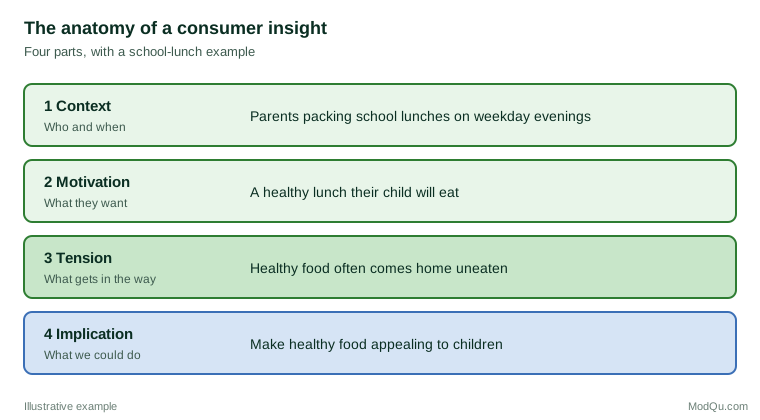
1. Context: who and when. An insight is about specific people in a specific situation, not about "consumers" in general. "Parents shopping for school lunches on a weekday evening" is a context. "Families" is not. The narrower the context, the more likely the insight is to be true and useful.
2. Motivation: what they are trying to achieve. Behaviour is driven by goals. The motivation might be practical (getting lunches packed quickly), social (not wanting their child to feel different at school) or emotional (wanting to feel like a good parent). Belk (1988) showed that the things people buy often carry meaning about who they are, so motivations are frequently about identity as well as function.
3. Tension: what gets in the way. This is the heart of an insight. A tension is a conflict between what people want and what they currently experience, or between two things they want at once. A parent wants lunches that are healthy and wants lunches that the child will actually eat. The tension explains behaviour that would otherwise look puzzling, such as buying healthy food that is then thrown away.
4. Implication: what could be done. An insight earns its place when it suggests an action that resolves or reduces the tension. Said, Macdonald, Wilson and Marcos (2015) found that organisations value customer insight when it is new to them and leads to action. If no response is possible, the observation may be interesting, but it is not yet useful.
Writing it down
A practical way to write an insight is a short statement in the customer's voice followed by the implication:
"I want my child to eat a healthy lunch, but if it comes home uneaten I have wasted food and my child has gone hungry. So I end up packing what I know they will eat."
Implication: products and messages that make healthy food appealing to children address the parent's real problem.
The first-person form forces the writer to describe the situation as the customer experiences it. The word but marks the tension. If the statement does not need a but, it probably lacks one.
Where the evidence comes from
An insight is a claim about why people behave as they do, so it needs evidence. Customers cannot always report their own motives accurately. Nisbett and Wilson (1977) showed that people often give confident explanations for their choices that do not match the real influences on them. Good insights therefore combine what people say with what they do: survey answers with purchase data, interviews with observation. Contradictions between the two are often where the tension is found. Klein and Jarosz (2011) found that noticing an inconsistency is one of the most common routes to insight.
Signs of a weak insight
- It is a fact. "Sixty percent of parents pack lunches" describes behaviour but explains nothing.
- It is universal. "People want value for money" is true of almost everyone and suggests nothing specific.
- It has no tension. Without a conflict, there is nothing to solve.
- It is already known. If the team would have said it before the research, it is not new.
- It has no evidence. A clever phrase is not an insight unless the data support it.
Key takeaways
A consumer insight combines a specific context, a motivation, a tension and an implication. The tension is the part that makes it powerful, because it explains behaviour and shows where an organisation can help. Writing insights in the customer's voice, with a clear but, and grounding them in evidence about both what people say and what they do, turns observations into understanding that a business can act on, which is what a market-oriented firm needs (Kohli & Jaworski, 1990).
References
Belk, R. W. (1988). Possessions and the extended self. Journal of Consumer Research, 15(2), 139–168. https://doi.org/10.1086/209154
Klein, G., & Jarosz, A. (2011). A naturalistic study of insight. Journal of Cognitive Engineering and Decision Making, 5(4), 335–351. https://doi.org/10.1177/1555343411427013
Kohli, A. K., & Jaworski, B. J. (1990). Market orientation: The construct, research propositions, and managerial implications. Journal of Marketing, 54(2), 1–18. https://doi.org/10.1177/002224299005400201
Nisbett, R. E., & Wilson, T. D. (1977). Telling more than we can know: Verbal reports on mental processes. Psychological Review, 84(3), 231–259. https://doi.org/10.1037/0033-295X.84.3.231
Said, E., Macdonald, E. K., Wilson, H. N., & Marcos, J. (2015). How organisations generate and use customer insight. Journal of Marketing Management, 31(9–10), 1158–1179. https://doi.org/10.1080/0267257X.2015.1037785