
Insights · What an insight is
What Is an Insight? Definitions From Psychology and Business
How psychologists and businesses define insight, what the two traditions share, where they differ, and a working definition that research teams can use to judge whether a finding deserves the name.
The word insight is used everywhere in modern organisations. Yet the word is rarely defined, and it is often used for anything from a single statistic to a strategic revelation. Psychology has studied insight for more than a century and has a fairly precise meaning for it. Business uses the word more loosely, but it has also developed a recognisable meaning of its own. This article sets out both traditions, shows how they connect, and offers a working definition that can be used to judge whether a piece of research has actually produced one.
Insight in psychology
The Gestalt origins
The scientific study of insight began with the Gestalt psychologists in the early twentieth century. Wolfgang Köhler (1925) observed chimpanzees on Tenerife trying to reach bananas placed out of reach. After failed attempts, some animals paused and then, apparently suddenly, stacked boxes or joined sticks together to get the fruit. Köhler argued that this was not trial-and-error learning. The animal had grasped the structure of the situation as a whole, and the solution followed from that new understanding.
Karl Duncker (1945) developed the idea in human problem-solving. In Duncker's famous candle problem, people must fix a candle to a wall using a box of tacks. The solution, using the box itself as a shelf, is difficult because people see the box only as a container. Duncker called this functional fixedness. Insight, in this view, is the moment when a person sees an object or situation in a new way. Norman Maier (1931) showed something similar with the two-string problem, in which people must tie together two strings hanging too far apart to reach at once. Many participants solved it only after Maier casually brushed one string to make it swing, and most of them did not report noticing the hint. The new view of the problem had arrived without awareness of where it came from.
Insight as restructuring
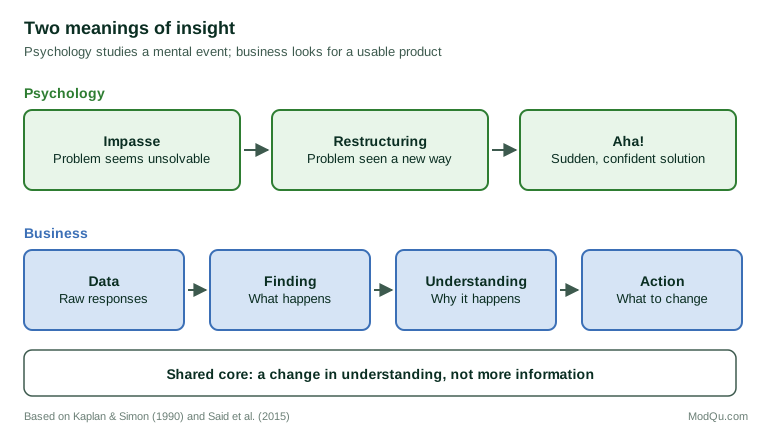
Later cognitive psychologists translated these observations into the language of information processing. Kaplan and Simon (1990) described insight as a change in the problem representation: people search a space of possible solutions, reach an impasse, and then find a different way to represent the problem, which opens up a new search space. Knoblich, Ohlsson, Haider and Rhenius (1999) tested this account with matchstick arithmetic puzzles. They showed that insight problems are hard because people apply constraints that the problem does not actually impose, and that solutions come when those constraints are relaxed or when familiar chunks are broken into their parts.
Not everyone accepts that insight is a special process. Weisberg (2015) argues that many insight solutions can be explained by ordinary analytic thinking combined with relevant knowledge, and Weisberg proposes an integrated theory in which both routes play a part. The debate continues, but most researchers agree on the core features of what an insight feels like and how it behaves.
The "Aha!" experience
A defining feature of insight in psychology is its suddenness. Metcalfe and Wiebe (1987) asked people to rate how close they were to a solution while working on problems. On ordinary algebra problems, "warmth" ratings rose gradually. On insight problems, people felt no closer to a solution until just before solving it, when ratings jumped. Smith and Kounios (1996) used a speed-accuracy technique to show that insight solutions tend to arrive in an all-or-none way rather than being built up piece by piece.
Topolinski and Reber (2010) describe the "Aha!" experience as having four parts: suddenness, ease of processing once the solution appears, positive feeling, and confidence that the answer is correct. That confidence is often justified, but not always. Danek and Wiley (2017) showed that people can have strong Aha! experiences for wrong answers too, although the feeling is on average stronger for correct ones. Neuroscience studies have linked insight solutions to distinctive patterns of brain activity, especially in the right temporal lobe (Bowden et al., 2005; Kounios & Beeman, 2014). The psychological definition can therefore be summarised as follows: insight is a sudden reorganisation of how a problem is understood, which produces a solution or new understanding that seems obvious in hindsight.
Insight outside the laboratory
Laboratory puzzles are artificial, and some researchers have studied insight in real work instead. Klein and Jarosz (2011) collected 120 accounts of insights from professionals, including firefighters, military officers, scientists and managers. They found that real insights came through several routes: noticing a connection between pieces of information, spotting a contradiction that did not fit, or abandoning a belief that had blocked understanding out of desperation when nothing else worked. Klein (2013) later argued that organisations often suppress insight by focusing on reducing errors rather than increasing understanding.
Insight in business
From market research to customer insight
In business, the term grew out of market research and marketing strategy. The market orientation literature of the 1990s defined a market-oriented firm as one that generates intelligence about customers and competitors, spreads it across departments, and responds to it (Kohli & Jaworski, 1990). Day (1994) described "market sensing" as a distinctive capability of successful companies: the ability to learn about customers and markets ahead of competitors and to act on that learning.
Over the following decades, many companies renamed their market research departments as "consumer insight" or "customer insight" teams. The change signalled an ambition to move from supplying data to supplying understanding. Said, Macdonald, Wilson and Marcos (2015) studied how large organisations actually generate and use customer insight. They found that insight was treated as more than information: it was understanding of customers that was new to the organisation, that was shared, and that led to action. Information that sat in a report without changing anything did not count.
Common business definitions
Business definitions tend to share three elements:
- Understanding of motivation. An insight explains why customers behave as they do, not only what they do. A statistic showing that 40% of customers abandon their online basket is a finding; understanding that they abandon it because delivery costs appear only at checkout is closer to an insight.
- Novelty to the organisation. The understanding must be something the organisation did not already know or had not fully grasped. A restatement of common knowledge, however well evidenced, is not usually called an insight.
- Usefulness for decisions. The understanding must suggest an action, such as a new product, a changed message or a removed obstacle. This is what practitioners mean when they say an insight must be "actionable".
This business usage overlaps with an older idea from information science. The data-information-knowledge-wisdom hierarchy describes how raw data becomes useful only when it is organised, interpreted and applied (Rowley, 2007). In that framework, an insight belongs at the knowledge level or above, not at the level of data or information.
What the two traditions share
At first sight, the laboratory Aha! moment and the corporate insights report seem to have little in common. One is a private mental event lasting a fraction of a second; the other is a product delivered by a team after weeks of work. But they share a central feature: both describe a change in understanding rather than an increase in information.
In the psychological tradition, the problem solver does not gain new facts at the moment of insight. The candle, the box and the tacks are the same before and after. What changes is how they are seen. In the business tradition, a good insight often comes not from collecting more data but from seeing existing data in a new light: noticing that a group of dissatisfied customers shares a characteristic, or that a stated reason for leaving hides a different underlying one.
Both traditions also warn against the same mistake. In psychology, the sudden confidence of an Aha! experience can attach to a wrong answer (Danek & Wiley, 2017). In business, an attractive insight can rest on a small or unrepresentative sample, or on the researcher's own expectations. The feeling that something is obvious in hindsight is not evidence that it is true.
Where they differ
The traditions differ in three important ways. First, psychology treats insight as a process inside an individual mind, while business treats it as a product that can be passed from one person to another. A business insight must be communicated, and its value depends on whether others accept it and act on it.
Second, psychology defines insight by how it is reached, through sudden restructuring rather than step-by-step analysis. Business is indifferent to the route. An insight reached by careful statistical modelling is just as valuable as one that arrives in a flash during a workshop. What matters is the content and its consequences.
Third, business adds the requirement of action. A psychologist would say that a person who suddenly understands a riddle has had an insight, whether or not anything follows. Most businesses would not call a finding an insight unless it can change a decision (Said et al., 2015).
A working definition
Drawing the two traditions together, a practical definition for research teams is this:
An insight is a new understanding of why people or markets behave as they do, supported by evidence, that changes how a decision-maker sees a situation and suggests what to do differently.
Each part of the definition can be tested. New: would the decision-makers have said this before seeing the research? Understanding of why: does it explain a cause or motivation, or only describe a pattern? Supported by evidence: does it rest on data that would survive a sceptical review? Changes how a situation is seen: does it reframe the problem, as the Gestalt psychologists described? Suggests what to do: can someone name a decision that would change as a result?
A finding that passes all five tests deserves to be called an insight. A finding that fails them may still be useful, but calling it an insight inflates its value and makes the word meaningless.
Why the definition matters
Clear definitions are not academic hair-splitting. When every chart is labelled an insight, decision-makers learn to ignore the label, and genuine discoveries are lost in the noise. Sternberg and Davidson (1995) noted that the study of insight was long held back because researchers used the word in different ways. Organisations face the same problem, and a shared definition helps teams recognise the rare finding that genuinely changes how a market is understood.
Key takeaways
Psychology defines insight as a sudden reorganisation of understanding that produces a solution which seems obvious in hindsight. Business defines it as new, evidence-based understanding of customers or markets that leads to action. The traditions differ on whether insight is a process or a product and on whether action is required, but they agree that insight is a change in how something is understood rather than an accumulation of facts. A good working test asks whether a finding is new, explains why, rests on evidence, reframes the situation and suggests a decision.
References
Bowden, E. M., Jung-Beeman, M., Fleck, J., & Kounios, J. (2005). New approaches to demystifying insight. Trends in Cognitive Sciences, 9(7), 322–328. https://doi.org/10.1016/j.tics.2005.05.012
Danek, A. H., & Wiley, J. (2017). What about false insights? Deconstructing the Aha! experience along its multiple dimensions for correct and incorrect solutions separately. Frontiers in Psychology, 7, Article 2077. https://doi.org/10.3389/fpsyg.2016.02077
Day, G. S. (1994). The capabilities of market-driven organizations. Journal of Marketing, 58(4), 37–52. https://doi.org/10.1177/002224299405800404
Duncker, K. (1945). On problem-solving. Psychological Monographs, 58(5), i–113. https://doi.org/10.1037/h0093599
Kaplan, C. A., & Simon, H. A. (1990). In search of insight. Cognitive Psychology, 22(3), 374–419. https://doi.org/10.1016/0010-0285(90)90008-R
Klein, G. (2013). Seeing what others don't: The remarkable ways we gain insights. PublicAffairs.
Klein, G., & Jarosz, A. (2011). A naturalistic study of insight. Journal of Cognitive Engineering and Decision Making, 5(4), 335–351. https://doi.org/10.1177/1555343411427013
Knoblich, G., Ohlsson, S., Haider, H., & Rhenius, D. (1999). Constraint relaxation and chunk decomposition in insight problem solving. Journal of Experimental Psychology: Learning, Memory, and Cognition, 25(6), 1534–1555. https://doi.org/10.1037/0278-7393.25.6.1534
Kohli, A. K., & Jaworski, B. J. (1990). Market orientation: The construct, research propositions, and managerial implications. Journal of Marketing, 54(2), 1–18. https://doi.org/10.1177/002224299005400201
Köhler, W. (1925). The mentality of apes (E. Winter, Trans.). Kegan Paul, Trench, Trubner.
Kounios, J., & Beeman, M. (2014). The cognitive neuroscience of insight. Annual Review of Psychology, 65, 71–93. https://doi.org/10.1146/annurev-psych-010213-115154
Maier, N. R. F. (1931). Reasoning in humans. II. The solution of a problem and its appearance in consciousness. Journal of Comparative Psychology, 12(2), 181–194. https://doi.org/10.1037/h0071361
Metcalfe, J., & Wiebe, D. (1987). Intuition in insight and noninsight problem solving. Memory & Cognition, 15(3), 238–246. https://doi.org/10.3758/BF03197722
Rowley, J. (2007). The wisdom hierarchy: Representations of the DIKW hierarchy. Journal of Information Science, 33(2), 163–180. https://doi.org/10.1177/0165551506070706
Said, E., Macdonald, E. K., Wilson, H. N., & Marcos, J. (2015). How organisations generate and use customer insight. Journal of Marketing Management, 31(9–10), 1158–1179. https://doi.org/10.1080/0267257X.2015.1037785
Smith, R. W., & Kounios, J. (1996). Sudden insight: All-or-none processing revealed by speed–accuracy decomposition. Journal of Experimental Psychology: Learning, Memory, and Cognition, 22(6), 1443–1462. https://doi.org/10.1037/0278-7393.22.6.1443
Sternberg, R. J., & Davidson, J. E. (Eds.). (1995). The nature of insight. MIT Press.
Topolinski, S., & Reber, R. (2010). Gaining insight into the "Aha" experience. Current Directions in Psychological Science, 19(6), 402–405. https://doi.org/10.1177/0963721410388803
Weisberg, R. W. (2015). Toward an integrated theory of insight in problem solving. Thinking & Reasoning, 21(1), 5–39. https://doi.org/10.1080/13546783.2014.886625