
Insights · Customer and market insight
Purchase Decision Journeys and Touchpoint Insight
How customers move from first awareness to purchase and beyond, how the decision journey has been modelled, how to find out which touchpoints influence decisions, and why attribution models and experiments can give very different answers.
Customers rarely decide to buy in a single moment. They notice a need, become aware of options, consider some of them, compare, choose, buy, use and, sometimes, recommend or buy again. Along the way they encounter many touchpoints: advertisements, search results, websites, reviews, friends, shop staff and the product itself. Understanding this journey, and which touchpoints actually influence it, helps organisations decide where to invest and what to improve.
Models of the decision journey
Early models of consumer behaviour described buying as a sequence of stages. Engel et al. (1968) set out a model in which consumers move from recognising a problem through searching for information and evaluating alternatives to purchase and post-purchase evaluation. Howard and Sheth (1969) proposed a theory of buyer behaviour that emphasised how information and learning shape the set of brands a buyer considers and the criteria used to choose between them.
The idea of a consideration set, the small group of options a buyer seriously considers, has been especially influential. Hauser and Wernerfelt (1990) explained consideration sets as the result of a trade-off between the benefit of considering more options and the cost of evaluating them, which is why buyers usually consider only a few. A brand that is not in the consideration set has little chance of being chosen, however good it is.
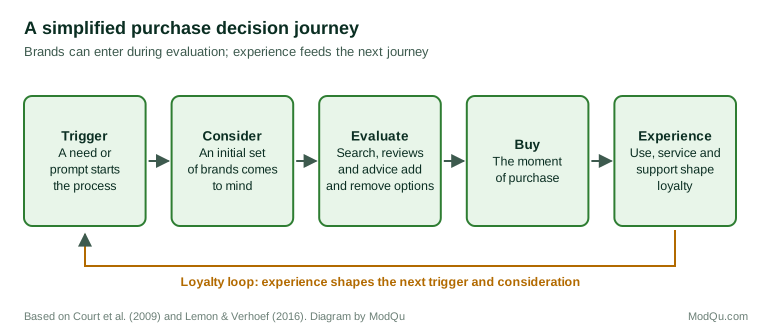
Court et al. (2009) argued that the traditional "funnel", in which buyers narrow down options step by step, no longer described how many people buy. In their account, consumers often add brands during active evaluation, as they search online and read reviews, and the experience after purchase feeds into the next decision through a "loyalty loop". Lemon and Verhoef (2016) described the customer journey as running through pre-purchase, purchase and post-purchase stages, with touchpoints owned by the brand, by partners, by customers and by independent sources.
Which touchpoints matter?
Finding out which touchpoints influence decisions is harder than it looks. Customers encounter many touchpoints, and those who buy may have encountered more of them simply because they were already interested.
Asking customers. Surveys can ask which touchpoints customers noticed and how they felt about them. Baxendale et al. (2015) asked consumers to report touchpoints as they occurred, using mobile phones, and related these to changes in brand consideration. They found that the effect of touchpoints depended not only on how often they occurred but also on whether they were positive, and that peer conversations and in-store experiences had notable effects. Macdonald et al. (2012) described this real-time approach as a way of capturing touchpoints that people forget by the time of a later survey.
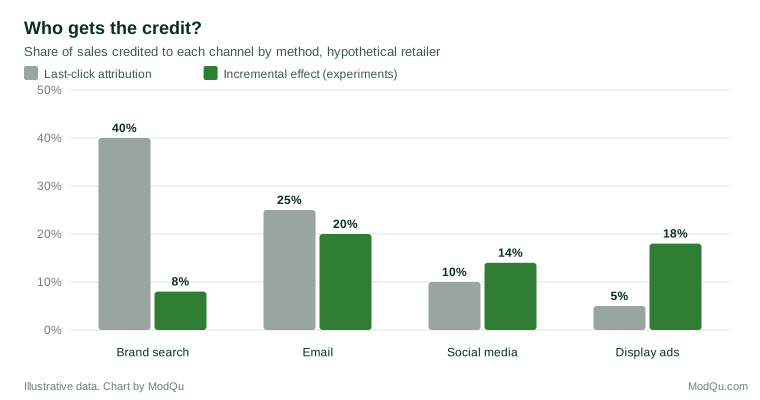
Attribution models. Digital tracking records many online touchpoints, and attribution models assign credit for each sale among them. Simple rules, such as giving all credit to the last click before purchase, are easy to apply but often misleading. Li and Kannan (2014) developed a model of how customers move between online channels and found that last-click attribution misrepresented the contribution of several channels. Anderl et al. (2016) modelled customer journeys as sequences of channel contacts and found that channels differed in their role at different stages of the journey.
Experiments. Attribution models describe associations, and the customers who click on an advertisement may have bought anyway. Blake et al. (2015) ran large field experiments at eBay and found that search advertising on the company's own brand name had little or no effect on sales, because customers who searched for eBay would have reached the site anyway. Gordon et al. (2019) compared the results of large advertising experiments on Facebook with estimates from observational methods and found that the observational methods often gave substantially wrong answers. Lewis and Rao (2015) showed that the effects of advertising on sales are usually small relative to the natural variation in sales, so that very large experiments are needed to measure them reliably.
Journeys across channels
Many journeys cross between online and offline channels. Verhoef et al. (2007) studied "research shoppers" who search for information in one channel and buy in another, typically searching online and buying in a shop, and found that this behaviour was driven by the perceived attributes of each channel and by a lack of incentives to stay in the channel where the search began. Insight into journeys therefore needs to combine digital data with surveys and in-store observation, because no single data source sees the whole journey.
From journeys to action
Edelman and Singer (2015) argued that organisations can compete by designing journeys deliberately, automating and personalising steps so that customers are guided smoothly from one stage to the next. Journey insight supports this by showing where customers drop out, which touchpoints move them forward and where problems arise.
The practical lessons are to map the journey from the customer's point of view, including touchpoints the organisation does not own; to measure influence, not just exposure; to test the effect of important touchpoints with experiments wherever possible; and to treat attribution models as descriptions to be checked rather than as measures of cause. Journeys also change over time and differ between customer groups, so a map drawn once should be revisited regularly and checked separately for the most important segments.
An example
Consider a hypothetical furniture retailer whose attribution reports show that most online sales follow a click on a search advertisement for the retailer's own name. The marketing team proposes moving budget from display advertising, which appears to generate few sales, into brand search.
Before doing so, the insight team runs two tests. In one, brand search advertising is switched off in a random selection of regions for six weeks. Sales in those regions barely change, because customers searching for the retailer's name find it through the ordinary search results instead. In the other, display advertising is shown to a random half of a target audience and withheld from the other half. Customers who saw the display advertising are noticeably more likely to visit the website and buy over the following weeks, even though few of them ever clicked on an advertisement.
A survey of recent buyers adds context. Many say they first noticed the retailer through an advertisement or a friend's recommendation, then visited a showroom to see and touch the furniture, and finally searched for the retailer's name to buy online. The journey began long before the final click, and the touchpoints that mattered most were those that brought the retailer into consideration in the first place.
The retailer keeps its display advertising, reduces spending on brand search and adds showroom visits to its picture of the journey. Its marketing decisions now rest on what each touchpoint adds, not on which one happened to come last.
Key takeaways
Purchase decisions unfold over a journey from trigger to consideration, evaluation, purchase and experience, with post-purchase experience shaping the next journey. Consideration sets are small, and brands can enter or leave them during active evaluation. Customer surveys, digital attribution models and experiments each shed light on which touchpoints matter, but attribution models can be badly misleading, and experiments often show that touchpoints near the purchase receive more credit than they deserve. Combining sources, and testing where possible, gives the most reliable picture.
References
Anderl, E., Becker, I., von Wangenheim, F., & Schumann, J. H. (2016). Mapping the customer journey: Lessons learned from graph-based online attribution modeling. International Journal of Research in Marketing, 33(3), 457–474. https://doi.org/10.1016/j.ijresmar.2016.03.001
Baxendale, S., Macdonald, E. K., & Wilson, H. N. (2015). The impact of different touchpoints on brand consideration. Journal of Retailing, 91(2), 235–253. https://doi.org/10.1016/j.jretai.2014.12.008
Blake, T., Nosko, C., & Tadelis, S. (2015). Consumer heterogeneity and paid search effectiveness: A large-scale field experiment. Econometrica, 83(1), 155–174. https://doi.org/10.3982/ECTA12423
Court, D., Elzinga, D., Mulder, S., & Vetvik, O. J. (2009). The consumer decision journey. McKinsey Quarterly, 3, 96–107.
Edelman, D. C., & Singer, M. (2015). Competing on customer journeys. Harvard Business Review, 93(11), 88–100.
Engel, J. F., Kollat, D. T., & Blackwell, R. D. (1968). Consumer behavior. Holt, Rinehart and Winston.
Gordon, B. R., Zettelmeyer, F., Bhargava, N., & Chapsky, D. (2019). A comparison of approaches to advertising measurement: Evidence from big field experiments at Facebook. Marketing Science, 38(2), 193–225. https://doi.org/10.1287/mksc.2018.1135
Hauser, J. R., & Wernerfelt, B. (1990). An evaluation cost model of consideration sets. Journal of Consumer Research, 16(4), 393–408. https://doi.org/10.1086/209225
Howard, J. A., & Sheth, J. N. (1969). The theory of buyer behavior. Wiley.
Lemon, K. N., & Verhoef, P. C. (2016). Understanding customer experience throughout the customer journey. Journal of Marketing, 80(6), 69–96. https://doi.org/10.1509/jm.15.0420
Lewis, R. A., & Rao, J. M. (2015). The unfavorable economics of measuring the returns to advertising. Quarterly Journal of Economics, 130(4), 1941–1973. https://doi.org/10.1093/qje/qjv023
Li, H., & Kannan, P. K. (2014). Attributing conversions in a multichannel online marketing environment: An empirical model and a field experiment. Journal of Marketing Research, 51(1), 40–56. https://doi.org/10.1509/jmr.13.0050
Macdonald, E. K., Wilson, H. N., & Konuş, U. (2012). Better customer insight—in real time. Harvard Business Review, 90(9), 102–108.
Verhoef, P. C., Neslin, S. A., & Vroomen, B. (2007). Multichannel customer management: Understanding the research-shopper phenomenon. International Journal of Research in Marketing, 24(2), 129–148. https://doi.org/10.1016/j.ijresmar.2006.11.002