
Insights · Communicating insight
Metaphor and Analogy as Cognitive Tools for Insight Articulation
How metaphor and analogy shape thinking and help people understand new insights, what research shows about their power and their risks, how customers' own metaphors reveal hidden meanings, and practical guidance for choosing and testing analogies.
When people try to explain something new, they often reach for something familiar. A new product category is described as "like a gym membership for your car". A market is said to be "a tug of war" between two brands. A customer journey becomes "a leaky funnel". Metaphors and analogies are not decoration added to an otherwise literal explanation. They are among the main tools people use to understand unfamiliar ideas, and they shape the conclusions people draw. For insight work, this makes them both powerful and risky. A good analogy can make an insight instantly clear; a poor one can lead an organisation to the wrong decisions. This article examines what research shows about metaphor and analogy and how to use them well.
Metaphor shapes thinking
Lakoff and Johnson (1980) argued that metaphor is not mainly a feature of language but a feature of thought. Many everyday concepts are understood through metaphors so familiar that they are not noticed: arguments are discussed in terms of war ("defending" a position, "attacking" a claim), and time in terms of money ("spending" or "saving" time). These metaphors highlight some aspects of a concept and hide others.
Experiments show that metaphors can change how people reason. Thibodeau and Boroditsky (2011) gave participants a short report about crime in a city, describing crime either as a "beast" preying on the city or as a "virus" infecting it. Those who read the beast metaphor were more likely to propose enforcement measures such as more police and harsher punishment, while those who read the virus metaphor were more likely to propose investigating causes and addressing social conditions. Few participants identified the metaphor as the influence on their reasoning.
Sopory and Dillard (2002) combined the results of many studies of metaphor in persuasion and found that messages containing metaphors were, on average, somewhat more persuasive than equivalent literal messages, especially when the metaphor was novel, used early in a message and easy to understand.
Glucksberg and Keysar (1990) argued that metaphors such as "my job is a jail" work not as loose comparisons but as statements that place the topic in a category defined by the metaphor's vehicle, here, situations that are confining and unpleasant. This helps explain why a metaphor can carry a whole set of implications at once.
How analogy works
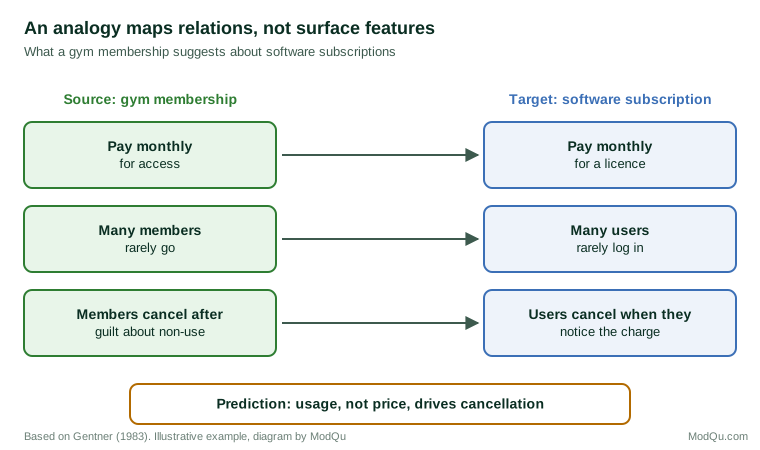
An analogy maps the structure of a familiar situation, the source, onto an unfamiliar one, the target. Gentner (1983) proposed the structure-mapping theory, which holds that good analogies map relations between elements rather than surface features. The analogy between the solar system and the atom works not because planets resemble electrons, but because the relation of smaller bodies orbiting a larger central body is shared.
Analogy is a powerful tool for solving problems, but people often fail to use it spontaneously. Gick and Holyoak (1980) gave participants a medical problem, how to destroy a tumour with rays that would damage healthy tissue at full strength, after they had read a military story in which an army divided its forces to converge on a fortress from many directions. Many more participants solved the problem when they were told the story might help than when they were not. Gick and Holyoak (1983) found that people who compared two analogous stories were much more likely to extract the underlying principle and apply it to a new problem.
Analogy is also a common route to discovery. Dunbar (1995) observed scientists at work in laboratories and found that they used analogies frequently, mostly drawn from closely related domains, to explain unexpected results, generate hypotheses and communicate findings. Holyoak and Thagard (1995) and Hofstadter and Sander (2013) argued that analogy lies at the heart of creative thought and of categorisation itself.
Analogy in strategy and innovation
Managers often reason by analogy when facing new situations. Gavetti et al. (2005) argued that analogy is one of the main ways strategists make sense of novel and complex environments, and that its value depends on whether the strategist identifies the deep similarities that matter rather than surface resemblances. Gavetti and Rivkin (2005) described cases in which successful strategies were built on well-chosen analogies and cases in which superficial analogies led firms astray.
Analogies also help with innovation. Dahl and Moreau (2002) found that people designing new products produced more original designs when they drew on analogies from distant domains, rather than from the product's own category. Christensen and Schunn (2007) studied engineers designing products and found that analogies from distant domains tended to be used to generate new ideas, while analogies from close domains were used more often to solve specific problems.
Analogy helps customers understand new products
Customers also use analogy to understand what is new. Gregan-Paxton and Roedder John (1997) proposed a model in which consumers learn about new products by transferring knowledge from familiar ones. Moreau et al. (2001) found that consumers' expectations of a really new product depended on which existing category they related it to: the same digital camera was evaluated differently depending on whether it was first presented as a type of camera or as a type of computer scanner. The analogy a company uses to introduce a product therefore shapes what customers expect from it.
Customers' own metaphors
Customers' metaphors are also a source of insight. Zaltman and Coulter (1995) described a research method in which participants collect images that represent their thoughts and feelings about a topic, then discuss them in depth, revealing the metaphors through which they understand a product or experience. Zaltman (2003) argued that much of what drives customer behaviour is expressed in metaphor rather than in literal statements. A customer who describes dealing with an insurance company as "fighting" and one who describes it as "being looked after" are revealing very different relationships, which a satisfaction score would not capture.
Listening for the metaphors customers use in interviews, reviews and complaints can show how they frame a category, what they fear and what they hope for.
The risks
Because metaphors and analogies shape reasoning, they can also mislead.
Surface similarity. People are often drawn to analogies that share surface features rather than deep structure. Gentner's research showed that people tend to retrieve analogies by surface similarity even when they would judge structural similarity more important if asked. An analogy between two companies because they are in the same industry may be less informative than one between companies in different industries facing the same structural situation.
Hidden implications. A metaphor carries implications that may not be intended. Describing customers as "targets" or a market as a "battlefield" frames customers as objects to be captured rather than people to be served, and may influence decisions in ways no one chose. Cornelissen (2005) argued that in organisational thinking, metaphors do not simply transfer meaning from one domain to another but create new meanings through the combination, which can be insightful or misleading.
Selection of convenient analogies. Analogies can be chosen to support a conclusion already reached. Lovallo et al. (2012) found that forecasts for investment decisions improved when managers considered a set of several analogous cases rather than relying on one, an approach that reduces the influence of a single favoured comparison. Kahneman and Lovallo (1993) argued that decision makers tend to take an "inside view", focusing on the specifics of their own case, and benefit from an "outside view" based on the outcomes of a reference class of similar cases.
Overextension. Every analogy breaks down somewhere. Morgan (1986) showed how different metaphors for organisations, as machines, organisms, brains, cultures or political systems, each reveal some aspects of organisational life while obscuring others, and argued that using several metaphors gives a fuller understanding than relying on one.
Metaphors built into insight tools
Many of the standard tools of insight work are themselves metaphors. The sales "funnel" pictures customers as a stream that narrows as some leak out at each stage, which suggests that the task is to plug leaks. The customer "journey" pictures a traveller moving through a sequence of places, which suggests that the experience is linear and that each stage follows the last. The "voice of the customer" suggests that customers speak with one voice that can simply be heard.
Each of these metaphors is useful, and each has limits. Real purchase decisions often loop back, skip stages or happen in parallel, which a funnel cannot show. Journeys imply a destination, while many customer relationships have no end point. And customers speak with many voices that often disagree. Being aware that these tools are metaphors helps analysts notice when the data do not fit the shape the metaphor expects, and avoid forcing them into it.
Using metaphor and analogy well
Several practices help insight teams use metaphor and analogy deliberately.
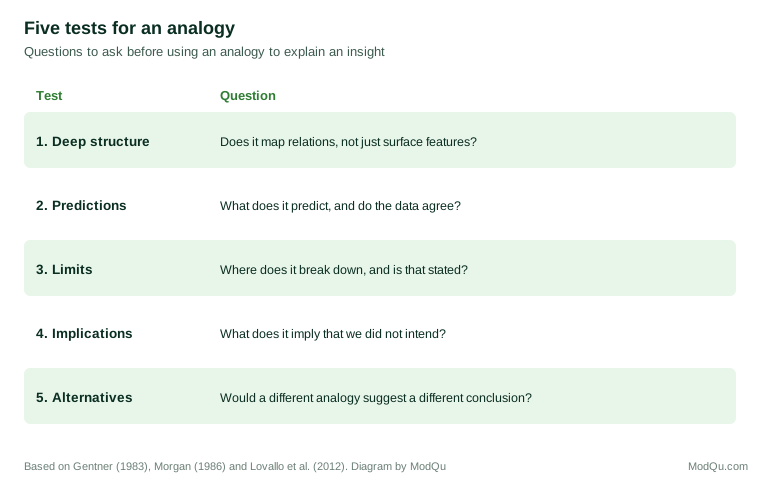
Choose for structure. Pick analogies that share the relations that matter for the insight, not merely a superficial resemblance.
State what the analogy predicts, and check it. A good analogy implies predictions about the target. If customers cancel subscriptions for the same reason people cancel gym memberships, usage should predict cancellation better than price. The data can test this.
State the limits. Say where the analogy breaks down, so that the audience does not extend it too far.
Consider alternatives. Try two or three analogies and see whether they point to different conclusions. If they do, the choice of analogy is doing more work than the evidence.
Notice the metaphors already in use. Organisations' internal language, such as "funnels", "targets", "wars" and "capturing share", carries assumptions. Ask whether they still fit.
Listen to customers' metaphors. Record and analyse the figurative language customers use, which often reveals how they frame their experience.
A worked example
Consider a hypothetical insight team at a home insurance company that has found that customers who make a claim are much more likely to renew if the claim is handled quickly, regardless of the outcome, and much more likely to leave after a slow claim, even when it is paid in full. The team needs to explain this to executives who believe that renewal depends mainly on price.
A first draft uses the metaphor "claims are the moment of truth". It is memorable, but it implies that a claim is a single moment, while the data show that it is the duration of the process that matters. A second draft uses an analogy: "A claim is like a hospital stay. Patients judge the hospital less by the diagnosis than by how they were treated while they waited." This maps the relations more closely: an anxious person, an uncertain outcome, a period of waiting, and a judgement formed by the experience of the process rather than its result.
The team tests the analogy. It predicts that the length and communication of the process should matter more than the size of the payment, and the data agree. It predicts that customers with simple claims should be less affected than those with complex ones, which the data also support. The team notes the limit: unlike most hospital stays, the customer can choose to leave at the end of the year. Finally, it considers an alternative, "a claim is a test of a promise", which emphasises trust rather than process. Both analogies point in the same direction, which gives the team more confidence that the conclusion rests on the evidence rather than on the comparison.
The final presentation leads with the evidence, uses the hospital analogy to make it vivid, and states its limits. Executives remember the analogy, but the decision to invest in faster claims handling rests on the data it helped explain.
Key takeaways
Metaphors and analogies shape how people understand new ideas and what they conclude from them, often without people noticing. Analogies work by mapping relations from a familiar situation onto an unfamiliar one, and good ones help solve problems, generate innovations and help customers understand new products. Customers' own metaphors reveal how they frame their experiences. The risks include analogies chosen for surface similarity, unintended implications, the selection of convenient comparisons and overextension. Insight teams should choose analogies for their structure, state and test what they predict, state their limits and compare alternatives.
References
Christensen, B. T., & Schunn, C. D. (2007). The relationship of analogical distance to analogical function and preinventive structure: The case of engineering design. Memory & Cognition, 35(1), 29–38. https://doi.org/10.3758/BF03195939
Cornelissen, J. P. (2005). Beyond compare: Metaphor in organization theory. Academy of Management Review, 30(4), 751–764. https://doi.org/10.5465/amr.2005.18378876
Dahl, D. W., & Moreau, P. (2002). The influence and value of analogical thinking during new product ideation. Journal of Marketing Research, 39(1), 47–60. https://doi.org/10.1509/jmkr.39.1.47.18930
Dunbar, K. (1995). How scientists really reason: Scientific reasoning in real-world laboratories. In R. J. Sternberg & J. E. Davidson (Eds.), The nature of insight (pp. 365–395). MIT Press.
Gavetti, G., & Rivkin, J. W. (2005). How strategists really think: Tapping the power of analogy. Harvard Business Review, 83(4), 54–63.
Gavetti, G., Levinthal, D. A., & Rivkin, J. W. (2005). Strategy making in novel and complex worlds: The power of analogy. Strategic Management Journal, 26(8), 691–712. https://doi.org/10.1002/smj.475
Gentner, D. (1983). Structure-mapping: A theoretical framework for analogy. Cognitive Science, 7(2), 155–170. https://doi.org/10.1207/s15516709cog0702_3
Gick, M. L., & Holyoak, K. J. (1980). Analogical problem solving. Cognitive Psychology, 12(3), 306–355. https://doi.org/10.1016/0010-0285(80)90013-4
Gick, M. L., & Holyoak, K. J. (1983). Schema induction and analogical transfer. Cognitive Psychology, 15(1), 1–38. https://doi.org/10.1016/0010-0285(83)90002-6
Glucksberg, S., & Keysar, B. (1990). Understanding metaphorical comparisons: Beyond similarity. Psychological Review, 97(1), 3–18. https://doi.org/10.1037/0033-295X.97.1.3
Gregan-Paxton, J., & Roedder John, D. (1997). Consumer learning by analogy: A model of internal knowledge transfer. Journal of Consumer Research, 24(3), 266–284. https://doi.org/10.1086/209509
Hofstadter, D., & Sander, E. (2013). Surfaces and essences: Analogy as the fuel and fire of thinking. Basic Books.
Holyoak, K. J., & Thagard, P. (1995). Mental leaps: Analogy in creative thought. MIT Press.
Kahneman, D., & Lovallo, D. (1993). Timid choices and bold forecasts: A cognitive perspective on risk taking. Management Science, 39(1), 17–31. https://doi.org/10.1287/mnsc.39.1.17
Lakoff, G., & Johnson, M. (1980). Metaphors we live by. University of Chicago Press.
Lovallo, D., Clarke, C., & Camerer, C. (2012). Robust analogizing and the outside view: Two empirical tests of case-based decision making. Strategic Management Journal, 33(5), 496–512. https://doi.org/10.1002/smj.962
Moreau, C. P., Markman, A. B., & Lehmann, D. R. (2001). "What is it?" Categorization flexibility and consumers' responses to really new products. Journal of Consumer Research, 27(4), 489–498. https://doi.org/10.1086/319623
Morgan, G. (1986). Images of organization. SAGE.
Sopory, P., & Dillard, J. P. (2002). The persuasive effects of metaphor: A meta-analysis. Human Communication Research, 28(3), 382–419. https://doi.org/10.1111/j.1468-2958.2002.tb00813.x
Thibodeau, P. H., & Boroditsky, L. (2011). Metaphors we think with: The role of metaphor in reasoning. PLoS ONE, 6(2), Article e16782. https://doi.org/10.1371/journal.pone.0016782
Zaltman, G. (2003). How customers think: Essential insights into the mind of the market. Harvard Business School Press.
Zaltman, G., & Coulter, R. H. (1995). Seeing the voice of the customer: Metaphor-based advertising research. Journal of Advertising Research, 35(4), 35–51.