
Insights · What an insight is
Gestalt Psychology and Restructuring in Problem-Solving
How the Gestalt psychologists explained insight as the restructuring of a problem, the classic experiments behind the idea, how modern cognitive science has revised it, and what it means for analysts who need to see data in new ways.
Some problems are hard not because they require much knowledge or many steps, but because people look at them the wrong way. Once the problem is seen differently, the answer is obvious. The Gestalt psychologists of the early twentieth century built a theory of thinking around this observation. They called the change in view restructuring and argued that it is the essence of insight. Their experiments are still among the best-known in psychology, and their central idea has survived a century of testing, although in modified form.
The Gestalt starting point
Gestalt psychology began in Germany as a theory of perception. Its founders, Max Wertheimer, Wolfgang Köhler and Kurt Koffka, argued that people perceive organised wholes rather than collections of separate sensations. A melody is recognised even when played in a different key, although every note has changed. Their principles of perceptual grouping, such as proximity, similarity and closure, are still taught and studied today (Wagemans et al., 2012).
The Gestalt psychologists applied the same idea to thinking. A problem, they argued, is also perceived as a structure. When that structure is incomplete or contradictory, people experience a problem; when it is reorganised into a coherent whole, the solution appears. Wertheimer (1945) distinguished between reproductive thinking, which applies methods learned in the past, and productive thinking, which grasps the structure of a new situation. Wertheimer gave the example of finding the area of a parallelogram. Pupils who had memorised a formula could apply it to standard diagrams but failed when the figure was drawn at an unusual angle. Pupils who saw that a triangle cut from one end could be moved to the other, turning the parallelogram into a rectangle, understood why the formula worked and could apply it to any case.
The classic experiments
Köhler's apes
During the First World War, Köhler (1925) studied chimpanzees at a research station on Tenerife. In one famous case, a chimpanzee named Sultan was given two sticks, neither long enough to reach a banana outside the cage. After failing with each stick separately, the ape later fitted one into the other and used the joined stick to pull in the fruit. Köhler argued that this was not gradual trial-and-error learning of the kind described by behaviourist psychologists. The solution came suddenly, was used smoothly once found and was repeated without hesitation. The animal had seen the sticks in a new relationship.
Duncker and functional fixedness
Karl Duncker (1945) studied human problem-solving using problems that seemed simple but were rarely solved. In the best known, people were given a candle, a box of tacks and matches, and asked to attach the candle to a wall so that it could burn without dripping wax on the floor. The solution is to empty the box, tack it to the wall and use it as a platform. Many people failed because they saw the box only as a container for tacks. Duncker called this functional fixedness: the tendency to see objects only in terms of their usual function.
Adamson (1952) repeated Duncker's experiments with American students. When the box was presented empty, most participants solved the problem; when it was presented full of tacks, far fewer did. Presenting the box in its usual role made it harder to see it in a new one. Functional fixedness is not just a habit of technologically complex societies. German and Barrett (2005) found the same effect among the Shuar of Ecuador, a group with relatively few manufactured tools.
Maier's two strings
Norman Maier (1931) hung two strings from a ceiling, too far apart for a person holding one to reach the other, and asked participants to tie them together. One solution was to tie a heavy object to one string and swing it like a pendulum. When participants were stuck, Maier walked past and casually set one string swinging. Many then solved the problem within a minute, yet most said that the idea had simply come to them and did not mention the hint. The restructuring happened without awareness of what had triggered it. Thomas and Lleras (2009) later found a modern version of the effect: people who were asked to move their arms in a pattern related to the solution of a different problem were more likely to solve it, even though they did not notice the connection.
Luchins and mental set
Abraham Luchins (1942) showed that past success can block restructuring. Participants solved a series of water-jar problems that could all be solved with the same complicated formula. They then met problems that could be solved with a much simpler method. Most continued to use the complicated formula, and many failed a problem that could be solved only with the simple method. Luchins called this the Einstellung effect: a mental set created by experience that prevents people from seeing a better approach. Öllinger, Jones and Knoblich (2008) found similar effects of mental set in matchstick arithmetic problems.
The nine-dot problem
Another famous puzzle asks people to connect nine dots arranged in a square, using four straight lines without lifting the pen. Scheerer (1963) popularised the problem and argued that people fail because they assume, without being told, that the lines must stay inside the square formed by the dots. The solution requires extending lines beyond it, which is the origin of the phrase "thinking outside the box".
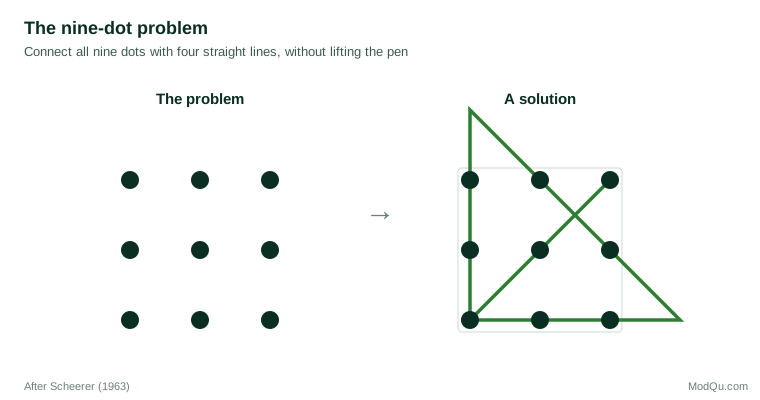
The Gestalt explanation turned out to be incomplete. Weisberg and Alba (1981) told participants directly that they could draw lines outside the square. The hint helped only a little; most people still failed. Removing the supposed self-imposed constraint was not enough. MacGregor, Ormerod and Chronicle (2001) proposed that people choose moves that seem to make the most progress toward the goal, such as covering as many dots as possible with each line. Moves that extend beyond the square seem unproductive until people realise that the obvious moves cannot succeed. Their account combines Gestalt ideas with ordinary search processes. Ormerod, MacGregor and Chronicle (2002) tested it by changing the number of dots already connected at the start, and found that solution rates rose or fell as the theory predicted. Chronicle, MacGregor and Ormerod (2004) extended the model to other puzzles and concluded that what makes an insight problem hard is often the way people judge their own progress: as long as familiar moves seem to be working, they have no reason to look for an unfamiliar one.
Restructuring in modern cognitive science
Cognitive psychologists have translated the Gestalt idea of restructuring into more precise terms. Ohlsson (1984a, 1984b) reviewed the Gestalt theory and proposed an information-processing account: people represent a problem in a certain way, search for moves within that representation and reach an impasse when no move works. Restructuring is a change in the representation that makes new moves available. Kaplan and Simon (1990) described the same process as a search for a new problem space.
Knoblich, Ohlsson, Haider and Rhenius (1999) tested two specific mechanisms. Constraint relaxation means dropping an assumption that the problem never stated, such as the assumption that the lines in the nine-dot problem must stay inside the square. Chunk decomposition means breaking a familiar unit into its parts, such as seeing that the Roman numeral IV is made of an I and a V that can be separated. Using matchstick arithmetic puzzles, they showed that problems requiring the relaxation of more fundamental constraints, or the decomposition of tighter chunks, were much harder.
Other researchers question whether restructuring is a special process at all. Weisberg (2015) argues that many insight solutions can be explained by ordinary thinking guided by knowledge, and that restructuring often happens gradually, through feedback from failed attempts. The disagreement is partly about emphasis. Most researchers accept that changes in representation are central to solving difficult problems; they differ on whether those changes are sudden and special or the result of ordinary search. Measurements of how close people feel to a solution do show that progress on insight problems is felt as sudden rather than gradual (Metcalfe & Wiebe, 1987).
Why it matters for analysts
The Gestalt experiments were designed with puzzles, but the same obstacles appear in research and data analysis.
- Functional fixedness in data. A variable collected for one purpose, such as a delivery postcode used for shipping, can reveal something different when viewed another way, for example as a measure of local income or distance from a competitor's store. Analysts who see data only in terms of why it was collected may miss these uses.
- Mental set in analysis. Teams that have explained past results in a particular way tend to explain new results the same way. Like Luchins's participants, they may continue to apply a familiar method when a simpler or better one is available.
- Unstated constraints. Research questions often carry hidden assumptions about who the customer is, which competitors matter or what counts as success. Making these assumptions explicit and asking which can be dropped is a practical form of constraint relaxation.
- Breaking chunks. Familiar categories such as "loyal customers" or "the youth segment" can hide important differences within them. Breaking a category into its parts often reveals the pattern that the average concealed.
- Hints from elsewhere. As in Maier's experiment, a solution often comes from something seen in a different context. Exposure to other industries, datasets and disciplines increases the chance of noticing a useful connection. Gick and Holyoak (1980) found that people could solve a difficult problem by analogy to a story they had read earlier, but often only when someone pointed out that the story was relevant. Connections across contexts are powerful, but they rarely happen by themselves.
Key takeaways
Gestalt psychology described insight as restructuring: seeing a problem as a new organised whole, which makes the solution obvious. Classic experiments by Köhler, Duncker, Maier and Luchins showed that functional fixedness and mental set prevent restructuring, and that hints can trigger it without awareness. Modern research has refined the theory, identifying specific mechanisms such as constraint relaxation and chunk decomposition and showing that restructuring interacts with ordinary search. For analysts, the lesson is practical: many hard problems in data are hard because of how they are framed, and deliberately questioning that framing is one of the most reliable ways to find insight.
References
Adamson, R. E. (1952). Functional fixedness as related to problem solving: A repetition of three experiments. Journal of Experimental Psychology, 44(4), 288–291. https://doi.org/10.1037/h0062487
Chronicle, E. P., MacGregor, J. N., & Ormerod, T. C. (2004). What makes an insight problem? The roles of heuristics, goal conception, and solution recoding in knowledge-lean problems. Journal of Experimental Psychology: Learning, Memory, and Cognition, 30(1), 14–27. https://doi.org/10.1037/0278-7393.30.1.14
Duncker, K. (1945). On problem-solving. Psychological Monographs, 58(5), i–113. https://doi.org/10.1037/h0093599
German, T. P., & Barrett, H. C. (2005). Functional fixedness in a technologically sparse culture. Psychological Science, 16(1), 1–5. https://doi.org/10.1111/j.0956-7976.2005.00771.x
Gick, M. L., & Holyoak, K. J. (1980). Analogical problem solving. Cognitive Psychology, 12(3), 306–355. https://doi.org/10.1016/0010-0285(80)90013-4
Kaplan, C. A., & Simon, H. A. (1990). In search of insight. Cognitive Psychology, 22(3), 374–419. https://doi.org/10.1016/0010-0285(90)90008-R
Knoblich, G., Ohlsson, S., Haider, H., & Rhenius, D. (1999). Constraint relaxation and chunk decomposition in insight problem solving. Journal of Experimental Psychology: Learning, Memory, and Cognition, 25(6), 1534–1555. https://doi.org/10.1037/0278-7393.25.6.1534
Köhler, W. (1925). The mentality of apes (E. Winter, Trans.). Kegan Paul, Trench, Trubner.
Luchins, A. S. (1942). Mechanization in problem solving: The effect of Einstellung. Psychological Monographs, 54(6), i–95. https://doi.org/10.1037/h0093502
MacGregor, J. N., Ormerod, T. C., & Chronicle, E. P. (2001). Information processing and insight: A process model of performance on the nine-dot and related problems. Journal of Experimental Psychology: Learning, Memory, and Cognition, 27(1), 176–201. https://doi.org/10.1037/0278-7393.27.1.176
Maier, N. R. F. (1931). Reasoning in humans. II. The solution of a problem and its appearance in consciousness. Journal of Comparative Psychology, 12(2), 181–194. https://doi.org/10.1037/h0071361
Metcalfe, J., & Wiebe, D. (1987). Intuition in insight and noninsight problem solving. Memory & Cognition, 15(3), 238–246. https://doi.org/10.3758/BF03197722
Ohlsson, S. (1984a). Restructuring revisited: I. Summary and critique of the Gestalt theory of problem solving. Scandinavian Journal of Psychology, 25(1), 65–78. https://doi.org/10.1111/j.1467-9450.1984.tb01001.x
Ohlsson, S. (1984b). Restructuring revisited: II. An information processing theory of restructuring and insight. Scandinavian Journal of Psychology, 25(2), 117–129. https://doi.org/10.1111/j.1467-9450.1984.tb01005.x
Öllinger, M., Jones, G., & Knoblich, G. (2008). Investigating the effect of mental set on insight problem solving. Experimental Psychology, 55(4), 269–282. https://doi.org/10.1027/1618-3169.55.4.269
Ormerod, T. C., MacGregor, J. N., & Chronicle, E. P. (2002). Dynamics and constraints in insight problem solving. Journal of Experimental Psychology: Learning, Memory, and Cognition, 28(4), 791–799. https://doi.org/10.1037/0278-7393.28.4.791
Scheerer, M. (1963). Problem-solving. Scientific American, 208(4), 118–128. https://doi.org/10.1038/scientificamerican0463-118
Thomas, L. E., & Lleras, A. (2009). Swinging into thought: Directed movement guides insight in problem solving. Psychonomic Bulletin & Review, 16(4), 719–723. https://doi.org/10.3758/PBR.16.4.719
Wagemans, J., Elder, J. H., Kubovy, M., Palmer, S. E., Peterson, M. A., Singh, M., & von der Heydt, R. (2012). A century of Gestalt psychology in visual perception: I. Perceptual grouping and figure–ground organization. Psychological Bulletin, 138(6), 1172–1217. https://doi.org/10.1037/a0029333
Weisberg, R. W. (2015). Toward an integrated theory of insight in problem solving. Thinking & Reasoning, 21(1), 5–39. https://doi.org/10.1080/13546783.2014.886625
Weisberg, R. W., & Alba, J. W. (1981). An examination of the alleged role of "fixation" in the solution of several "insight" problems. Journal of Experimental Psychology: General, 110(2), 169–192. https://doi.org/10.1037/0096-3445.110.2.169
Wertheimer, M. (1945). Productive thinking. Harper.