
Insights · Customer and market insight
Employee Insight and the Internal Customer
Why employees are both a source of customer insight and customers of internal services themselves, what the evidence shows about links between employee attitudes and customer outcomes, and how to gather employee insight that is honest and useful.
Employees see customers every day. Frontline staff hear complaints that never reach a survey, notice which products customers struggle with and know which processes frustrate them. Employees are also customers themselves, of the internal services, systems and managers that enable them to do their work. Employee insight treats employees in both roles: as a source of knowledge about customers and as internal customers whose experience shapes the service that external customers receive.
The internal customer
Berry (1981) argued that organisations should treat employees as internal customers and jobs as internal products, applying the same attention to employees' needs that they apply to customers'. Lings (2004) developed the idea of internal market orientation, describing how organisations can gather information about employees' needs, communicate with them and respond, in the same way that market orientation involves gathering and responding to information about customers.
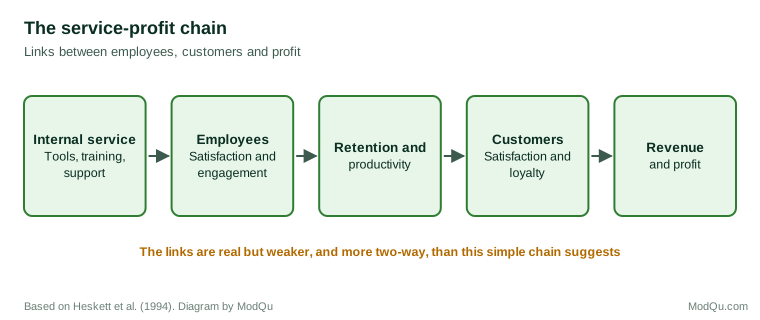
The service-profit chain proposed by Heskett et al. (1994) linked these ideas to business results. They argued that the quality of internal services, such as tools, training and support, drives employee satisfaction, which leads to employee retention and productivity, which creates value for customers, which drives customer satisfaction and loyalty, and ultimately revenue and profit.
What the evidence shows
Several studies support links between employee experience and customer outcomes. Schneider and Bowen (1985) surveyed employees and customers of bank branches and found that branches where employees reported a stronger emphasis on service had customers who reported better service. Schneider et al. (1998) found that a climate for service, as reported by employees, predicted customers' later perceptions of service quality, and that customer perceptions also influenced the service climate. Harter et al. (2002) conducted a meta-analysis of studies covering thousands of business units and found that employee engagement was related to customer satisfaction, productivity, profit, employee turnover and safety. Rucci et al. (1998) described how a large retailer modelled the links between employee attitudes, customer impressions and revenue across its stores.
The links are not simple. Schneider et al. (2003) examined data over several years and found that financial and market performance predicted later employee attitudes more strongly than employee attitudes predicted later performance, suggesting that working for a successful organisation makes employees more satisfied, as well as the reverse. Homburg et al. (2009) found that the link from employees to customers worked partly through employees' identification with the company, which was passed on to customers through their interactions. The service-profit chain is therefore best seen as a set of related, two-way influences rather than a simple sequence.
Employees as a source of customer insight
Frontline employees often know about customer problems before managers do. Bitner et al. (1994) collected accounts from employees in hotels, restaurants and airlines of service encounters that customers found satisfying or dissatisfying, and found that employees' accounts largely matched customers' but also revealed problem customers, a category customers themselves did not report. Employee accounts thus add a perspective that customer research alone may miss.
But employees do not always pass on what they know. Morrison and Milliken (2000) described organisational silence, in which employees withhold information about problems because they believe speaking up is futile or risky. Detert and Burris (2007) found that employees were more likely to speak up when their managers were open to suggestions, and that this effect worked through employees' sense that speaking up was safe. Edmondson (1999) found that teams with greater psychological safety, a shared belief that it is safe to take interpersonal risks, engaged in more learning behaviour, including asking questions and reporting errors.
Gathering employee insight well
Several practices help. Ask frontline employees specific questions about customers: what customers most often complain about, which processes cause the most difficulty, and what customers ask for that the organisation cannot provide. Use anonymous channels, so that employees can report problems without fear. Combine employee reports with customer data, since each reveals things the other misses. Measure the quality of internal services as well as overall engagement, so that the organisation can see which tools, processes or policies make good service harder. And act visibly on what employees report, because nothing discourages speaking up more than seeing it ignored. Finally, treat employee reports as evidence to be tested, not as conclusions: employees see customers through the lens of their own role, and their accounts are most valuable when compared with what customers themselves say and do.
Measuring internal service
Many organisations run an annual engagement survey but know little about the specific internal services that help or hinder employees in serving customers. Internal service can be measured in much the same way as external service: by asking employees, as internal customers, to rate the support they receive from other teams, the systems they use and the policies they must follow, and to describe recent occasions when these made it harder to help a customer. Linking these ratings to customer outcomes at the level of stores, branches or teams shows which internal services matter most for the customer experience.
An example
Consider a hypothetical chain of home improvement stores whose customer satisfaction scores vary widely between stores. Store managers attribute the differences to local competition and the quality of staff.
The insight team surveys frontline employees, asking them what most often prevents them from helping customers. A common answer is that the stock system shows items as available when they are not, so that staff send customers to empty shelves or promise deliveries that cannot be made. Employees in the lowest-scoring stores report this problem far more often than those in the highest-scoring stores. Many say they have stopped reporting it because nothing changes.
Analysis of the stock data confirms that the lowest-scoring stores have the largest discrepancies between recorded and actual stock, mostly because of delays in recording deliveries and returns. The company fixes the recording process, tells employees what has changed as a result of their feedback, and tracks customer satisfaction in the affected stores. Scores in those stores rise over the following months. The problem had been visible to frontline staff for a long time, but it reached decision makers only when someone asked them the right question.
Key takeaways
Employees are both a source of insight about customers and internal customers themselves. The service-profit chain links internal service quality, employee satisfaction, customer satisfaction and profit, and research supports these links, although they run in both directions and are weaker than the simple model suggests. Frontline employees often know about customer problems first, but will share what they know only if they feel it is safe and worthwhile. Gathering employee insight through specific questions, anonymous channels and visible action, and combining it with customer data, gives a fuller picture of the customer experience.
References
Berry, L. L. (1981). The employee as customer. Journal of Retail Banking, 3(1), 33–40.
Bitner, M. J., Booms, B. H., & Mohr, L. A. (1994). Critical service encounters: The employee's viewpoint. Journal of Marketing, 58(4), 95–106. https://doi.org/10.1177/002224299405800408
Detert, J. R., & Burris, E. R. (2007). Leadership behavior and employee voice: Is the door really open? Academy of Management Journal, 50(4), 869–884. https://doi.org/10.5465/amj.2007.26279183
Edmondson, A. (1999). Psychological safety and learning behavior in work teams. Administrative Science Quarterly, 44(2), 350–383. https://doi.org/10.2307/2666999
Harter, J. K., Schmidt, F. L., & Hayes, T. L. (2002). Business-unit-level relationship between employee satisfaction, employee engagement, and business outcomes: A meta-analysis. Journal of Applied Psychology, 87(2), 268–279. https://doi.org/10.1037/0021-9010.87.2.268
Heskett, J. L., Jones, T. O., Loveman, G. W., Sasser, W. E., Jr., & Schlesinger, L. A. (1994). Putting the service-profit chain to work. Harvard Business Review, 72(2), 164–174.
Homburg, C., Wieseke, J., & Hoyer, W. D. (2009). Social identity and the service-profit chain. Journal of Marketing, 73(2), 38–54. https://doi.org/10.1509/jmkg.73.2.38
Lings, I. N. (2004). Internal market orientation: Construct and consequences. Journal of Business Research, 57(4), 405–413. https://doi.org/10.1016/S0148-2963(02)00274-6
Morrison, E. W., & Milliken, F. J. (2000). Organizational silence: A barrier to change and development in a pluralistic world. Academy of Management Review, 25(4), 706–725. https://doi.org/10.5465/amr.2000.3707697
Rucci, A. J., Kirn, S. P., & Quinn, R. T. (1998). The employee-customer-profit chain at Sears. Harvard Business Review, 76(1), 82–97.
Schneider, B., & Bowen, D. E. (1985). Employee and customer perceptions of service in banks: Replication and extension. Journal of Applied Psychology, 70(3), 423–433. https://doi.org/10.1037/0021-9010.70.3.423
Schneider, B., Hanges, P. J., Smith, D. B., & Salvaggio, A. N. (2003). Which comes first: Employee attitudes or organizational financial and market performance? Journal of Applied Psychology, 88(5), 836–851. https://doi.org/10.1037/0021-9010.88.5.836
Schneider, B., White, S. S., & Paul, M. C. (1998). Linking service climate and customer perceptions of service quality: Test of a causal model. Journal of Applied Psychology, 83(2), 150–163. https://doi.org/10.1037/0021-9010.83.2.150