
Insights · Customer and market insight
Customer Experience Insights: Measuring Moments That Matter
How to identify and measure the moments in a customer's experience that most shape their judgements and behaviour, drawing on research into how experiences are remembered, critical incidents, service recovery and the link between experience measures and business results.
Customers interact with an organisation many times: seeing an advertisement, browsing a website, making a purchase, waiting for delivery, using the product, calling for help, renewing or leaving. Not all of these interactions matter equally. Some pass unnoticed; others shape how customers feel about the organisation for years. Customer experience insight is the work of finding out which moments matter most, measuring how well they go, and understanding how they affect what customers do next.
This article reviews what research shows about how customers experience and remember interactions, how to identify the moments that matter, how to measure them, and how to connect experience measures to business outcomes.
What customer experience is
Lemon and Verhoef (2016) reviewed research on customer experience and described it as a customer's cognitive, emotional, behavioural, sensory and social responses to an organisation's offerings during the entire customer journey. They described the journey as passing through pre-purchase, purchase and post-purchase stages, with touchpoints in each that are owned by the organisation, by partners, by customers themselves or by others such as reviewers and friends. Verhoef et al. (2009) argued that customer experience is shaped by many factors, including the service interface, the retail atmosphere, price and the behaviour of other customers, and that some of these lie outside the organisation's direct control.
Pine and Gilmore (1998) argued that experiences had become a distinct form of economic value, beyond goods and services, and that organisations could differentiate themselves by deliberately designing memorable experiences. Homburg et al. (2017) studied how firms manage customer experience in practice and described it as requiring cultural mindsets, strategic directions and capabilities for continually renewing the experience across the journey.
How experiences are remembered
A central finding of research on experience is that what people remember is not a simple average of what happened. Fredrickson and Kahneman (1993) showed participants film clips and found that their overall evaluations were strongly influenced by the most intense moment and by the final moment, while the duration of the experience had little effect, a pattern they called duration neglect.
Kahneman et al. (1993) asked participants to hold a hand in painfully cold water for 60 seconds on one trial, and on another trial for 60 seconds followed by a further 30 seconds at a slightly less painful temperature. Most participants chose to repeat the longer trial, even though it involved more total discomfort, because it ended less painfully. Redelmeier and Kahneman (1996) found a similar pattern among patients undergoing colonoscopy: patients' memories of the procedure were related to the peak and the final moments of pain, not to its total duration.
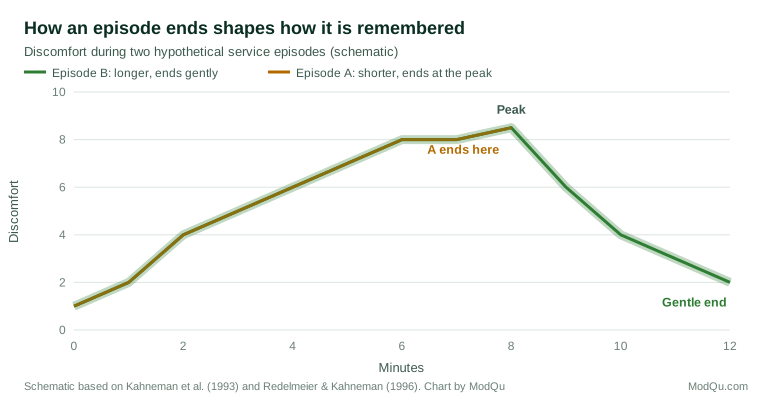
These findings have direct implications for customer experience. The moments that shape customers' memories, and therefore their future decisions, are likely to be the peaks, positive or negative, and the endings. A long but pleasant wait may be forgotten; a brief moment of rudeness at the end of an otherwise good visit may not. Baumeister et al. (2001) reviewed evidence across many areas of psychology and concluded that bad events generally have stronger and more lasting effects than good ones of equal size, which suggests that negative peaks deserve particular attention.
Identifying moments that matter
Several methods help identify which moments matter most.
Critical incidents. Flanagan (1954) developed the critical incident technique, which asks people to describe specific events that were particularly effective or ineffective in achieving an outcome. Bitner et al. (1990) applied it to service encounters, collecting several hundred customer accounts of especially satisfying and dissatisfying encounters with airlines, hotels and restaurants. They found that the incidents fell into a small number of groups: how employees responded to service failures, how they responded to customers' special needs and requests, and unprompted, spontaneous actions by employees. The technique remains a powerful way to discover moments that matter in customers' own terms.
Journey analysis. Mapping the steps in a customer journey and measuring experience at each step shows where problems occur. Rawson et al. (2013) argued that organisations often measure satisfaction with individual touchpoints, which may all score well, while missing problems with the journey as a whole, such as the experience of resolving a billing problem across several calls and channels. They found that performance on whole journeys was more strongly related to overall satisfaction and to business outcomes than performance on individual touchpoints.
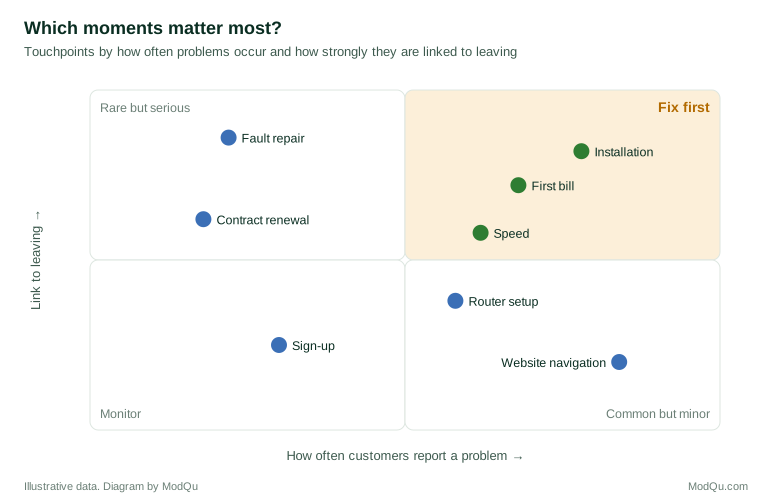
Driver analysis. Relating ratings of individual moments to overall satisfaction, loyalty or behaviour shows which moments are most strongly associated with the outcomes that matter. Combined with measures of how often each moment goes wrong, this identifies priorities.
Experience sampling. Most experience measurement asks customers to look back. Csikszentmihalyi and Larson (1987) described the experience sampling method, in which people report what they are doing and feeling at random moments, and Kahneman et al. (2004) developed the day reconstruction method, in which people systematically reconstruct the previous day's episodes. Applied to customer experience, such methods can capture moments as they happen, which helps distinguish the experience itself from the memory of it.
Service failure and recovery
Moments when something goes wrong are among the most important. Smith et al. (1999) studied customers' reactions to service failures and recovery efforts in restaurants and hotels, and found that satisfaction after a failure depended on whether customers felt fairly treated in the outcome they received, the process used to resolve the problem and the way they were treated by staff. Recovery efforts that matched the type and size of the failure were most effective.
Dixon et al. (2010) argued, from studies of customer service interactions, that efforts to exceed customers' expectations in service contacts do less for loyalty than efforts to reduce the effort customers must make to get problems resolved, such as repeated contacts, transfers and having to repeat information. Whatever the precise balance, the implication is that the moments when customers need help are moments that matter, and that ease of resolution is as important as delight.
Measuring experience
Customer experience is usually measured through surveys at or after key moments, complemented by operational and behavioural data.
Satisfaction and service quality. Parasuraman et al. (1988) developed SERVQUAL, a scale measuring service quality across dimensions such as reliability, responsiveness and empathy. Fornell et al. (1996) described the American Customer Satisfaction Index, which measures satisfaction across many industries using a consistent model.
Recommendation. Reichheld (2003) proposed the net promoter score, based on a single question about likelihood to recommend, as the best single predictor of growth. Later research questioned this claim. Keiningham et al. (2007) found that the net promoter score did not predict revenue growth better than other satisfaction measures, and Morgan and Rego (2006) found that measures of average satisfaction were generally better predictors of future business performance than recommendation measures.
Experience quality. Klaus and Maklan (2013) developed a scale to measure customer experience quality and found that it predicted loyalty and word-of-mouth behaviour better than satisfaction alone.
Behaviour. Survey measures should be linked to what customers actually do. Mittal and Kamakura (2001) found that the relationship between satisfaction and repurchase behaviour differed between customer groups, so that customers with the same satisfaction scores could have very different repurchase rates. Linking experience scores to behaviour at the individual level is therefore essential.
Pitfalls in experience measurement
Experience measurement is easy to start and easy to do badly. Several problems recur.
Skewed scores. Peterson and Wilson (1992) reviewed satisfaction research and found that satisfaction ratings are typically skewed toward the positive end of the scale, so that most customers report being satisfied. Averages therefore hide much of what matters. The share of customers giving the lowest ratings, and the reasons they give, are often more informative than the mean.
Timing. A survey sent immediately after an interaction measures the interaction; a survey sent weeks later measures the memory of it, coloured by peaks, endings and everything that has happened since. Both are useful, but they answer different questions. Customer experience programmes should be clear about which they are measuring and should not compare scores collected at different points in the journey as though they were equivalent.
Who responds. Customers with very good or very bad experiences may be more likely to respond to surveys, and those who have already decided to leave may not respond at all. Response rates and the characteristics of respondents should be monitored, and survey results compared with behavioural data that covers all customers.
Survey fatigue. Asking customers for feedback after every interaction burdens them and lowers response rates. Sampling, so that each customer is asked only occasionally, and keeping surveys short protect the quality of the data.
Gaming. When experience scores are used to judge or reward staff, they can be manipulated, for example by asking customers for high ratings or by choosing which customers are surveyed. Scores used for management purposes should be collected and analysed independently of the people being assessed, and examined for signs of manipulation.
Measurement without action. Many organisations collect large volumes of experience data but do little with it. Homburg et al. (2017) argued that customer experience management requires the capability to act on what is learned, including clear ownership of each part of the journey. Closing the loop, by contacting dissatisfied customers, fixing the causes of problems and telling customers what has changed, is what turns measurement into improvement.
Emotion and the moments that matter
Customer experience is not only about whether things work. Lemon and Verhoef (2016) included emotional responses in their definition of customer experience, and the research on peaks and endings shows that the emotional intensity of a moment shapes how it is remembered. Moments of anxiety, such as waiting for a medical result, a delayed flight or a large financial transaction, tend to matter more than routine ones. Asking customers how they felt, not only how satisfied they were, and paying attention to the moments where emotions run highest, helps identify which moments deserve the most care.
Connecting experience to business results
Organisations invest in customer experience because they expect it to improve business results. Research supports a link at the level of firms. Anderson et al. (2004) found that customer satisfaction, measured by the American Customer Satisfaction Index, was positively associated with shareholder value. But the link for any particular moment, or any particular investment, must be established with the organisation's own data.
The most useful customer experience programmes therefore link each important moment to downstream behaviour: whether customers who had a poor installation experience were more likely to leave, whether those whose complaints were resolved quickly spent more afterwards, and so on. Such analysis, ideally supported by experiments or comparison groups, turns experience measurement from a reporting exercise into a guide to investment.
An example
Consider a hypothetical broadband provider whose overall satisfaction scores are stable but whose customer losses are rising. Touchpoint surveys show high satisfaction with most individual interactions. A critical incident study asks customers who left to describe the moment they decided to go. Many describe the same sequence: an installation appointment that was missed or rescheduled, followed by a first bill that was higher than expected because of installation charges. Neither touchpoint scored especially badly in surveys, but together they formed a negative peak at the start of the relationship.
Linking survey data to account records confirms that customers who experienced both problems were several times more likely to leave in their first year. The company introduces firm appointment times, proactive notice of rescheduling, and a clearer first bill with an explanation. It measures the effect by comparing regions that introduced the changes early with those that did so later. After six months, first-year losses in the early regions have fallen noticeably compared with the later ones, and the company extends the changes nationally.
The example shows several of the principles in this article at work. The moments that mattered were not visible in average touchpoint scores, because each was only moderately bad on its own. They were found by asking customers to describe the decisive moment in their own words, and confirmed by linking experience data to behaviour. They came at the start of the relationship, when customers were forming their view of the company, and they combined into a single negative peak. And the response was evaluated with a comparison group, so that the company could be confident that the changes, not other factors, reduced customer losses. The provider now monitors the first ninety days of every customer relationship as a distinct stage, with its own measures and its own owner.
Key takeaways
Customer experience is shaped by many interactions, but some matter far more than others. Research on memory shows that peaks and endings dominate how experiences are remembered, and negative moments carry particular weight. Critical incident studies, journey analysis, driver analysis and experience sampling help identify the moments that matter. Service failures and the effort needed to resolve them are often decisive. Experience measures, whether satisfaction, recommendation or experience quality, are most useful when linked to actual customer behaviour, so that organisations can see which moments drive the outcomes they care about.
References
Anderson, E. W., Fornell, C., & Mazvancheryl, S. K. (2004). Customer satisfaction and shareholder value. Journal of Marketing, 68(4), 172–185. https://doi.org/10.1509/jmkg.68.4.172.42723
Baumeister, R. F., Bratslavsky, E., Finkenauer, C., & Vohs, K. D. (2001). Bad is stronger than good. Review of General Psychology, 5(4), 323–370. https://doi.org/10.1037/1089-2680.5.4.323
Bitner, M. J., Booms, B. H., & Tetreault, M. S. (1990). The service encounter: Diagnosing favorable and unfavorable incidents. Journal of Marketing, 54(1), 71–84. https://doi.org/10.1177/002224299005400105
Csikszentmihalyi, M., & Larson, R. (1987). Validity and reliability of the experience-sampling method. Journal of Nervous and Mental Disease, 175(9), 526–536. https://doi.org/10.1097/00005053-198709000-00004
Dixon, M., Freeman, K., & Toman, N. (2010). Stop trying to delight your customers. Harvard Business Review, 88(7/8), 116–122.
Flanagan, J. C. (1954). The critical incident technique. Psychological Bulletin, 51(4), 327–358. https://doi.org/10.1037/h0061470
Fornell, C., Johnson, M. D., Anderson, E. W., Cha, J., & Bryant, B. E. (1996). The American Customer Satisfaction Index: Nature, purpose, and findings. Journal of Marketing, 60(4), 7–18. https://doi.org/10.1177/002224299606000403
Fredrickson, B. L., & Kahneman, D. (1993). Duration neglect in retrospective evaluations of affective episodes. Journal of Personality and Social Psychology, 65(1), 45–55. https://doi.org/10.1037/0022-3514.65.1.45
Homburg, C., Jozić, D., & Kuehnl, C. (2017). Customer experience management: Toward implementing an evolving marketing concept. Journal of the Academy of Marketing Science, 45(3), 377–401. https://doi.org/10.1007/s11747-015-0460-7
Kahneman, D., Fredrickson, B. L., Schreiber, C. A., & Redelmeier, D. A. (1993). When more pain is preferred to less: Adding a better end. Psychological Science, 4(6), 401–405. https://doi.org/10.1111/j.1467-9280.1993.tb00589.x
Kahneman, D., Krueger, A. B., Schkade, D. A., Schwarz, N., & Stone, A. A. (2004). A survey method for characterizing daily life experience: The day reconstruction method. Science, 306(5702), 1776–1780. https://doi.org/10.1126/science.1103572
Keiningham, T. L., Cooil, B., Andreassen, T. W., & Aksoy, L. (2007). A longitudinal examination of net promoter and firm revenue growth. Journal of Marketing, 71(3), 39–51. https://doi.org/10.1509/jmkg.71.3.039
Klaus, P., & Maklan, S. (2013). Towards a better measure of customer experience. International Journal of Market Research, 55(2), 227–246. https://doi.org/10.2501/IJMR-2013-021
Lemon, K. N., & Verhoef, P. C. (2016). Understanding customer experience throughout the customer journey. Journal of Marketing, 80(6), 69–96. https://doi.org/10.1509/jm.15.0420
Mittal, V., & Kamakura, W. A. (2001). Satisfaction, repurchase intent, and repurchase behavior: Investigating the moderating effect of customer characteristics. Journal of Marketing Research, 38(1), 131–142. https://doi.org/10.1509/jmkr.38.1.131.18832
Morgan, N. A., & Rego, L. L. (2006). The value of different customer satisfaction and loyalty metrics in predicting business performance. Marketing Science, 25(5), 426–439. https://doi.org/10.1287/mksc.1050.0180
Parasuraman, A., Zeithaml, V. A., & Berry, L. L. (1988). SERVQUAL: A multiple-item scale for measuring consumer perceptions of service quality. Journal of Retailing, 64(1), 12–40.
Peterson, R. A., & Wilson, W. R. (1992). Measuring customer satisfaction: Fact and artifact. Journal of the Academy of Marketing Science, 20(1), 61–71. https://doi.org/10.1007/BF02723476
Pine, B. J., II, & Gilmore, J. H. (1998). Welcome to the experience economy. Harvard Business Review, 76(4), 97–105.
Rawson, A., Duncan, E., & Jones, C. (2013). The truth about customer experience. Harvard Business Review, 91(9), 90–98.
Redelmeier, D. A., & Kahneman, D. (1996). Patients' memories of painful medical treatments: Real-time and retrospective evaluations of two minimally invasive procedures. Pain, 66(1), 3–8. https://doi.org/10.1016/0304-3959(96)02994-6
Reichheld, F. F. (2003). The one number you need to grow. Harvard Business Review, 81(12), 46–54.
Smith, A. K., Bolton, R. N., & Wagner, J. (1999). A model of customer satisfaction with service encounters involving failure and recovery. Journal of Marketing Research, 36(3), 356–372. https://doi.org/10.1177/002224379903600305
Verhoef, P. C., Lemon, K. N., Parasuraman, A., Roggeveen, A., Tsiros, M., & Schlesinger, L. A. (2009). Customer experience creation: Determinants, dynamics and management strategies. Journal of Retailing, 85(1), 31–41. https://doi.org/10.1016/j.jretai.2008.11.001