
Insights · What an insight is
Actionable Insight: Criteria for Insight That Changes Decisions
What makes an insight actionable, five criteria for testing it, and what research on information use and the value of information says about why many insights never change a decision.
Almost every research brief asks for "actionable insights". The phrase is so common that it has become a cliché, yet the idea behind it is sound. Research is commissioned to improve decisions, and an insight that changes nothing has cost money without returning value. This article sets out what actionability means, offers five criteria for judging it, and summarises research on why so much research goes unused.
What "actionable" means
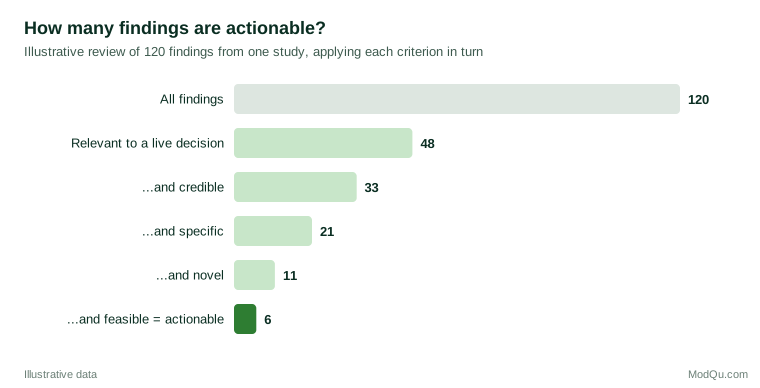
An insight is actionable when it gives a decision-maker a reason to do something different from what they would otherwise have done, and when that different course of action is within their power. Two elements matter: the insight must bear on a real choice, and the choice must be one the organisation can actually make.
Decision analysis gives this idea a precise form. Howard (1966) showed that information has value only to the extent that it can change a decision. If a manager would choose the same option whatever the research found, the expected value of that research is zero, however interesting the results. This principle, known as the value of information, is the formal basis of actionability. It also implies that research should be planned backwards from the decisions it is meant to inform.
Five criteria
1. Relevant to a live decision
The insight must connect to a decision that is open now or will be soon: a product launch, a price change, a campaign, a service redesign. Insights about questions nobody is currently asking may be valuable later, but they are not actionable today.
2. Credible
Decision-makers act on evidence they trust. In a classic study of how managers use market research, Deshpandé and Zaltman (1982) found that the perceived quality of the research and the interaction between researchers and managers strongly influenced whether results were used. Credibility depends on a sound sample, clear methods and an honest statement of uncertainty. Statistical significance alone does not establish importance or reliability (Wasserstein & Lazar, 2016).
3. Specific
"Customers want better service" cannot be acted on. "First-time customers call the help line within a week because the set-up instructions omit a step" can. Specificity identifies who is affected, what is happening and where in the customer's experience it occurs.
4. Novel or surprising
An insight that confirms what everyone already believed may provide reassurance, but it rarely changes a decision. Insights that challenge assumptions have more potential to change action, although they also meet more resistance. Said, Macdonald, Wilson and Marcos (2015) found that organisations valued customer insight that was new to them and shared across functions.
5. Feasible
The action implied by the insight must be possible within the organisation's resources, rules and timeframe. An insight that customers want a product the company cannot make is useful for strategy, but it is not actionable for the team that commissioned the research.
A worked example
Consider a subscription meal-kit company whose survey shows that 30% of new subscribers cancel within two months. On its own, that is a finding. Follow-up analysis shows that cancellations are concentrated among single-person households, and open-ended answers repeatedly mention food waste: the smallest box contains more food than one person can cook before it spoils. Customers who cancel describe feeling guilty about throwing food away.
Now the five criteria can be applied. The insight is relevant, because the company is about to review its product range. It is credible, because the pattern appears in both the survey answers and the cancellation records, and the sample of single-person households is large enough to trust. It is specific, naming the group, the cause and the moment in the customer's experience when the problem appears. It is novel, because the company had assumed that price was the main reason for cancelling. And it is feasible, because a smaller box or a flexible delivery schedule is within the company's control.
Compare this with the original finding. "Thirty percent cancel early" invites a discount campaign, which would cost money and leave the real cause untouched. The actionable insight points to a product change aimed at a defined group and gives the company a way to measure whether it worked.
Why research goes unused
Research on information use in organisations suggests that failure to act is common and has predictable causes. Moorman (1995) found that the way organisations acquire, transmit and use market information shaped the outcomes of new products. Menon and Varadarajan (1992) distinguished between action-oriented use, where research directly changes a decision, and knowledge-enhancing use, where it changes how managers think about a problem without an immediate decision. Weiss (1979) made a similar distinction in public policy, describing much research use as gradual "enlightenment" rather than direct problem-solving.
These studies suggest that "actionable" should not be read too narrowly. Some of the most valuable insights change the way an organisation frames its market and influence many later decisions. But they also explain why insights often fail to change anything:
- Timing. Research arrives after the decision has already been made.
- Ownership. No one with authority to act is responsible for the insight.
- Presentation. The insight is buried in a long report among dozens of findings.
- Conflict with existing beliefs. Insights that challenge senior assumptions are questioned more harshly than those that confirm them.
Actionability and organisational performance
Studies of market orientation have linked the ability to generate and respond to market intelligence with business performance. Narver and Slater (1990) found a positive relationship between market orientation and profitability, and Jaworski and Kohli (1993) found that market orientation was associated with overall performance and with employee commitment. The theory behind these studies, set out by Kohli and Jaworski (1990), places responsiveness, acting on what is learned, alongside generating and spreading intelligence. Day (1994) called this combination a market-sensing capability.
More recent research on data use points in the same direction. Brynjolfsson, Hitt and Kim (2011) found that firms that reported basing decisions on data and analysis had output and productivity about 5–6% higher than would be expected from their other investments. The gain came from using data in decisions, not from collecting it.
Making insights actionable
Several practices improve the chance that an insight leads to action:
- Start from the decision. Before designing research, write down the decisions it will inform and what result would change each one. This applies Howard's (1966) value-of-information logic in plain terms.
- Involve decision-makers early. Managers who help shape the research questions are more likely to trust and use the results (Deshpandé & Zaltman, 1982).
- State the implication explicitly. End each insight with the action it suggests and who should take it.
- Quantify where possible. Estimate the size of the opportunity or problem so that insights can be compared and prioritised.
- Follow up. Track which insights led to action and with what result. This builds the evidence that research is worth commissioning.
Key takeaways
An actionable insight bears on a live decision, is credible, specific, new and feasible. Its value comes from its potential to change what an organisation does, which is the core idea behind the value of information. Research on information use shows that insights often go unused because of timing, ownership, presentation and resistance to unwelcome findings. Planning research around decisions and stating implications clearly makes action far more likely.
References
Brynjolfsson, E., Hitt, L. M., & Kim, H. H. (2011). Strength in numbers: How does data-driven decisionmaking affect firm performance? (SSRN Working Paper). https://doi.org/10.2139/ssrn.1819486
Day, G. S. (1994). The capabilities of market-driven organizations. Journal of Marketing, 58(4), 37–52. https://doi.org/10.1177/002224299405800404
Deshpandé, R., & Zaltman, G. (1982). Factors affecting the use of market research information: A path analysis. Journal of Marketing Research, 19(1), 14–31. https://doi.org/10.1177/002224378201900102
Howard, R. A. (1966). Information value theory. IEEE Transactions on Systems Science and Cybernetics, 2(1), 22–26. https://doi.org/10.1109/TSSC.1966.300074
Jaworski, B. J., & Kohli, A. K. (1993). Market orientation: Antecedents and consequences. Journal of Marketing, 57(3), 53–70. https://doi.org/10.1177/002224299305700304
Kohli, A. K., & Jaworski, B. J. (1990). Market orientation: The construct, research propositions, and managerial implications. Journal of Marketing, 54(2), 1–18. https://doi.org/10.1177/002224299005400201
Menon, A., & Varadarajan, P. R. (1992). A model of marketing knowledge use within firms. Journal of Marketing, 56(4), 53–71. https://doi.org/10.1177/002224299205600405
Moorman, C. (1995). Organizational market information processes: Cultural antecedents and new product outcomes. Journal of Marketing Research, 32(3), 318–335. https://doi.org/10.1177/002224379503200307
Narver, J. C., & Slater, S. F. (1990). The effect of a market orientation on business profitability. Journal of Marketing, 54(4), 20–35. https://doi.org/10.1177/002224299005400403
Said, E., Macdonald, E. K., Wilson, H. N., & Marcos, J. (2015). How organisations generate and use customer insight. Journal of Marketing Management, 31(9–10), 1158–1179. https://doi.org/10.1080/0267257X.2015.1037785
Wasserstein, R. L., & Lazar, N. A. (2016). The ASA statement on p-values: Context, process, and purpose. The American Statistician, 70(2), 129–133. https://doi.org/10.1080/00031305.2016.1154108
Weiss, C. H. (1979). The many meanings of research utilization. Public Administration Review, 39(5), 426–431. https://doi.org/10.2307/3109916