
Inquiry · Philosophy of inquiry
Socratic Questioning and the Examined Life
Socrates claimed that the unexamined life is not worth living and made questioning his method. This article explains how the Socratic method works, what research says about its value in teaching and therapy, and how to use it well.
At his trial in Athens in 399 BCE, Socrates told the jury that he could not stop asking questions, even to save his life, because "the unexamined life is not worth living for a human being" (Plato, 1997, Apology 38a). He was convicted and executed. Nearly two and a half thousand years later, the method of inquiry associated with his name is used in law schools, classrooms, psychotherapy and management training. This article explains what Socratic questioning originally was, how it has been adapted, what evidence supports it, and what it can teach anyone who wants to inquire well.
Socrates and the sources
Socrates wrote nothing. What we know of him comes mainly from the dialogues of his student Plato, together with accounts by the historian Xenophon and the playwright Aristophanes. Scholars generally distinguish Plato's early dialogues, which are thought to portray Socrates' own method fairly closely, from later works in which "Socrates" becomes a mouthpiece for Plato's own theories (Vlastos, 1991; Kraut, 1992). This "Socratic problem", the question of how much of Plato's Socrates is the historical man, has never been fully settled, and modern companions to Socrates set out the competing views in detail (Ahbel-Rappe & Kamtekar, 2006). For practical purposes, however, what matters is the method the early dialogues display, whoever devised it. The early dialogues, such as the Euthyphro, Laches, Charmides and Apology, show a recognisable pattern: Socrates asks someone who claims to know about a subject, often a virtue such as courage, piety or justice, to say what it is, and then examines the answer.
The Socratic elenchus
The Greek word elenchus means refutation or cross-examination. Gregory Vlastos (1983) described its standard form in four steps. First, the interlocutor states a thesis, such as a definition of courage. Second, Socrates secures agreement to further premises, usually through short questions that seem harmless. Third, he shows that these premises, taken together, contradict the original thesis. Fourth, he concludes that the thesis has been shown to be false, or at least that the interlocutor's beliefs are inconsistent and need revising (Figure 1).
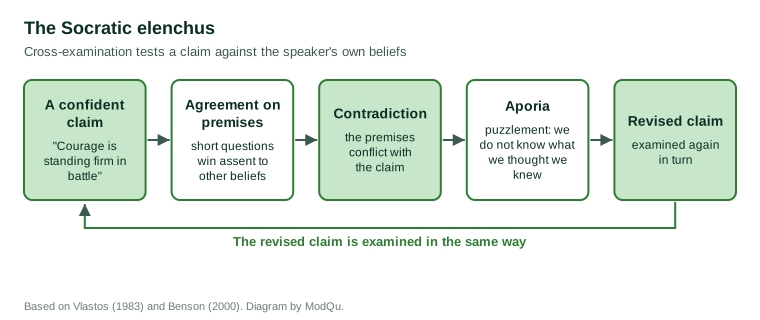
In the Laches, for example, the general Laches defines courage as standing firm in battle. Socrates asks whether retreating can ever be courageous; Laches agrees that it can, for instance in cavalry tactics. Laches then tries "endurance of the soul", but agrees that foolish endurance is not admirable while courage always is. Each answer collapses under questions that Laches himself agrees to. The dialogue ends without a definition.
This ending is typical. Many early dialogues finish in aporia, a state of puzzlement in which the participants realise they do not know what they thought they knew. Scholars have long debated what the method can achieve. Vlastos (1983) argued that Socrates believed it could establish positive truths, because the beliefs that survive repeated examination are likely to be true. Hugh Benson (2000) argued instead that the elenchus mainly tests whether a person has knowledge, and shows that most people lack it. Kenneth Seeskin (1987) emphasised that the method aims at changing the person, not only at reaching conclusions: it is a form of moral education.
The midwife and the slave boy
Two other images from Plato have shaped how the method is understood. In the Theaetetus, Socrates compares himself to a midwife, like his mother. He says he is barren of wisdom himself but can help others give birth to their ideas and then test whether each "offspring" is genuine or a mere wind-egg (Plato, 1997, Theaetetus 150b–151d). The image presents the questioner as a helper whose job is to draw out and examine the other person's thinking, not to deliver conclusions. The term maieutic method, from the Greek for midwifery, comes from this passage.
In the Meno, Socrates questions an enslaved boy who has never studied geometry about how to double the area of a square. The boy first answers confidently that one should double the length of the side. Questioning shows him that this gives a square four times as large, and he falls into confusion. Socrates then points out to Meno that the boy is better off now: he no longer thinks he knows what he does not, and he will want to find out (Plato, 1997, Meno 84a–c). Further questions, with the help of lines drawn in the sand, lead the boy to see that the square on the diagonal is the answer.
Plato used the episode to argue for his theory that learning is recollection of knowledge the soul already possesses, a theory few modern readers accept. But the episode is still cited by teachers because it illustrates a sequence that every educator recognises: confident error, productive confusion, and then understanding that the learner has reached through their own reasoning. Critics note that Socrates' questions in this passage are often leading, so the boy contributes less than the story suggests, which is itself a useful warning for anyone who uses questions to teach.
Socratic ignorance and the examined life
Socrates explained his mission through a story. The oracle at Delphi had declared that no one was wiser than Socrates. Puzzled, he questioned politicians, poets and craftsmen who were reputed to be wise. He found that each believed they knew things they did not. He concluded that he was wiser only in one small way: "what I do not know I do not think I know either" (Plato, 1997, Apology 21d). This is the origin of the idea of Socratic ignorance: awareness of the limits of one's own knowledge as the starting point of inquiry.
For Socrates, examining beliefs was not an academic exercise but a way of life. Alexander Nehamas (1998) and Pierre Hadot (1995) describe ancient philosophy, beginning with Socrates, as an "art of living": a practice of self-examination aimed at living well. The examined life is one in which a person regularly asks what they believe, why they believe it and whether their actions match their convictions. The dialogues show Socrates applying the same questioning to himself as to others (Brickhouse & Smith, 1994).
Modern evidence that we know less than we think
Psychological research has given Socrates' observation a modern form. Rozenblit and Keil (2002) asked people to rate how well they understood everyday devices such as zips, flush toilets and cylinder locks. When participants were then asked to write a step-by-step explanation, their ratings of their own understanding fell sharply. The authors called this the illusion of explanatory depth. Fernbach et al. (2013) found the same effect for political policies: asking people to explain how a policy would work, rather than to give reasons for their position, reduced their confidence and moderated their views. Kruger and Dunning (1999) showed that people with the least skill in a domain often overestimate their performance the most, partly because the knowledge needed to perform well is also needed to recognise poor performance.
These findings suggest why Socratic questioning works. Asking someone to explain, define or give an example forces them to articulate what they actually know, and gaps that were invisible become obvious. The questioner does not need to tell the person they are wrong; the questions let them find out for themselves. This is also why the method is often more persuasive than argument. People are more likely to revise a belief when they discover its weakness themselves than when someone else points it out, because the discovery does not feel like a defeat in a contest.
Socratic questioning in education
Socratic questioning has been adapted for teaching in many forms. The German philosopher Leonard Nelson developed a group method, later called the Socratic dialogue, in which participants work from a concrete experience towards a general understanding of a concept, with a facilitator who asks questions but does not supply answers (Nelson, 1949). The method is still used in schools, universities and professional training (Saran & Neisser, 2004). Matthew Lipman's Philosophy for Children programme built "communities of inquiry" in which pupils question one another about ideas raised by a story (Lipman, 2003).
Richard Paul and Linda Elder made Socratic questioning a central tool of critical thinking education. They classified questions by what they probe: clarification ("What do you mean by…?"), assumptions ("What are you taking for granted?"), reasons and evidence ("How do you know?"), viewpoints ("How would someone who disagrees respond?"), implications ("If that is true, what follows?") and questions about the question itself ("Why is this question important?") (Paul, 1993; Paul & Elder, 2006). This taxonomy is now widely used by teachers.
Socratic teaching is not without critics. In law schools, where the "case method" of cold-calling students and questioning them on judicial reasoning became standard in the twentieth century, some students experience it as intimidating rather than illuminating. Fiona Leigh (2007) argues that the Socratic method is valuable mainly when the questioner helps learners draw out and test their own ideas, rather than leading them to a predetermined answer, which she calls a misreading of the maieutic or "midwife" image in Plato's Theaetetus. Oyler and Romanelli (2014) recommend it in health professions education for developing reasoning, provided it is used in a supportive climate. Chin and Osborne (2008) review evidence that encouraging students to ask their own questions, not just answer the teacher's, improves engagement and understanding in science.
Socratic questioning in therapy
Cognitive therapy, developed by Aaron Beck, uses a form of Socratic questioning to help patients examine the evidence for their negative beliefs. Instead of telling a depressed patient that a belief such as "I always fail" is wrong, the therapist asks questions: What is the evidence for this? Is there evidence against it? What would you say to a friend who thought this? (Beck et al., 1979). James Overholser (1993) set out the elements of systematic questioning in psychotherapy, including the use of questions to help clients reach their own conclusions rather than accept the therapist's.
There is some direct evidence that this works. Braun et al. (2015) coded recordings of cognitive therapy sessions for depression and found that the more therapists used Socratic questioning in a session, the greater the patient's improvement in symptoms before the next session, even after accounting for earlier symptom change. The finding supports the idea that guided questioning, not just information, helps people change entrenched beliefs.
Socratic questioning in organisations and research
The same techniques are increasingly used outside classrooms and clinics. In management, Socratic questioning appears in coaching, in after-action reviews and in strategy discussions where the aim is to surface assumptions before committing resources. A leader who asks "What would have to be true for this plan to work?" or "What evidence would make us change course?" is applying the elenchus to a business proposal. The questions do not assert that the plan is wrong; they invite the people who proposed it to examine whether their premises hold together.
In qualitative research, interviewers use similar probes to move beyond a respondent's first, often rehearsed, answer. Asking for a concrete example, asking what a term means to the respondent, or asking how two statements fit together are standard interviewing techniques with a Socratic ancestry. The difference is one of purpose. A researcher is trying to understand the respondent's view, not to refute it, so the probing must stay curious rather than adversarial. The aim is to discover what people actually think and why, which is often different from what they say first.
Market and survey researchers can borrow a further lesson from the illusion of explanatory depth. Respondents asked to rate their understanding of a product or policy often report more knowledge than they have. Questions that ask people to explain how something works, or to choose between concrete alternatives, give a more accurate picture of what they know and believe than questions that simply ask them to rate their own familiarity.
How to ask Socratic questions well
The research and practice traditions suggest several principles for anyone using Socratic questioning, whether in a classroom, a meeting or a research interview.
- Start with what the other person believes. The elenchus works on the interlocutor's own claims and premises. Questions that impose the questioner's framework produce defensiveness, not reflection.
- Ask for definitions and examples. "What do you mean by quality?" and "Can you give me an example?" are among the most productive questions in any inquiry, because they expose vagueness quickly.
- Probe reasons and evidence. "How do we know?" and "What would show us that this is wrong?" connect claims to evidence.
- Look for consistency. Point out, gently, when two things a person has said seem to conflict, and ask how they fit together.
- Tolerate aporia. A discussion that ends in an open question has not failed. Recognising what is not known is often the most valuable outcome.
- Question yourself too. Socrates' authority came from his willingness to be examined as well as to examine. A questioner who treats their own position as beyond question is not using the Socratic method.
A short example
The following exchange, adapted from a typical product meeting, shows the main moves in a few lines.
Manager: Customers want more features.
Questioner: Which customers do you have in mind?
Manager: Our larger accounts. They keep asking for them.
Questioner: Are those the customers we are losing?
Manager: No, most of the cancellations are from small accounts.
Questioner: What do the small accounts say when they leave?
Manager: Mostly that the product is too complicated.
Questioner: So if we add features, what happens to them?
No question in the exchange asserts anything, and the manager supplies every fact. Yet within a few turns the original claim has been narrowed ("some customers want more features"), an apparent conflict has emerged between two things the manager believes, and a better question has appeared: which customers matter most for the decision at hand? That is the elenchus in miniature. Its value lies not in winning the argument but in replacing a confident generalisation with a sharper problem that evidence can settle.
Limits
The Socratic method has limitations. It is good at exposing confusion and inconsistency but less good at generating new information: questioning can show that a belief is poorly grounded, but it cannot by itself discover what is true about the world. That requires observation and evidence. The method can also be misused, as a rhetorical technique to trap opponents rather than a shared search for understanding. Plato's own dialogues show how irritating Socrates' questioning could be to those on the receiving end, and the Athenians' verdict is a reminder that people do not always welcome having their beliefs examined.
Conclusion
The core of Socratic questioning is simple: ask people to say what they mean, give reasons and test their claims against their other beliefs. Its effect can be powerful, because most of us know less than we think, and questions reveal the gap in a way that assertions do not. Used with patience and respect, the method turns conversation into inquiry. Socrates' claim that the unexamined life is not worth living may be too strong for modern taste, but his practical insight remains: the questions we ask of our own beliefs largely determine how much we learn.
References
Ahbel-Rappe, S., & Kamtekar, R. (Eds.). (2006). A companion to Socrates. Blackwell. https://doi.org/10.1002/9780470996218
Beck, A. T., Rush, A. J., Shaw, B. F., & Emery, G. (1979). Cognitive therapy of depression. Guilford Press.
Benson, H. H. (2000). Socratic wisdom: The model of knowledge in Plato's early dialogues. Oxford University Press.
Braun, J. D., Strunk, D. R., Sasso, K. E., & Cooper, A. A. (2015). Therapist use of Socratic questioning predicts session-to-session symptom change in cognitive therapy for depression. Behaviour Research and Therapy, 70, 32–37. https://doi.org/10.1016/j.brat.2015.05.004
Brickhouse, T. C., & Smith, N. D. (1994). Plato's Socrates. Oxford University Press.
Chin, C., & Osborne, J. (2008). Students' questions: A potential resource for teaching and learning science. Studies in Science Education, 44(1), 1–39. https://doi.org/10.1080/03057260701828101
Fernbach, P. M., Rogers, T., Fox, C. R., & Sloman, S. A. (2013). Political extremism is supported by an illusion of understanding. Psychological Science, 24(6), 939–946. https://doi.org/10.1177/0956797612464058
Hadot, P. (1995). Philosophy as a way of life: Spiritual exercises from Socrates to Foucault (A. I. Davidson, Ed.; M. Chase, Trans.). Blackwell.
Kraut, R. (Ed.). (1992). The Cambridge companion to Plato. Cambridge University Press. https://doi.org/10.1017/CCOL0521430186
Kruger, J., & Dunning, D. (1999). Unskilled and unaware of it: How difficulties in recognizing one's own incompetence lead to inflated self-assessments. Journal of Personality and Social Psychology, 77(6), 1121–1134. https://doi.org/10.1037/0022-3514.77.6.1121
Leigh, F. (2007). Platonic dialogue, maieutic method and critical thinking. Journal of Philosophy of Education, 41(3), 309–323. https://doi.org/10.1111/j.1467-9752.2007.00563.x
Lipman, M. (2003). Thinking in education (2nd ed.). Cambridge University Press. https://doi.org/10.1017/CBO9780511840272
Nehamas, A. (1998). The art of living: Socratic reflections from Plato to Foucault. University of California Press.
Nelson, L. (1949). Socratic method and critical philosophy: Selected essays (T. K. Brown, Trans.). Yale University Press.
Overholser, J. C. (1993). Elements of the Socratic method: I. Systematic questioning. Psychotherapy: Theory, Research, Practice, Training, 30(1), 67–74. https://doi.org/10.1037/0033-3204.30.1.67
Oyler, D. R., & Romanelli, F. (2014). The fact of ignorance: Revisiting the Socratic method as a tool for teaching critical thinking. American Journal of Pharmaceutical Education, 78(7), Article 144. https://doi.org/10.5688/ajpe787144
Paul, R. (1993). Critical thinking: What every person needs to survive in a rapidly changing world (3rd ed.). Foundation for Critical Thinking.
Paul, R., & Elder, L. (2006). The thinker's guide to the art of Socratic questioning. Foundation for Critical Thinking.
Plato. (1997). Complete works (J. M. Cooper, Ed.). Hackett.
Rozenblit, L., & Keil, F. (2002). The misunderstood limits of folk science: An illusion of explanatory depth. Cognitive Science, 26(5), 521–562. https://doi.org/10.1207/s15516709cog2605_1
Saran, R., & Neisser, B. (Eds.). (2004). Enquiring minds: Socratic dialogue in education. Trentham Books.
Seeskin, K. (1987). Dialogue and discovery: A study in Socratic method. State University of New York Press.
Vlastos, G. (1983). The Socratic elenchus. Oxford Studies in Ancient Philosophy, 1, 27–58.
Vlastos, G. (1991). Socrates: Ironist and moral philosopher. Cambridge University Press.