
Inquiry · Philosophy of inquiry
The Nature of Inquiry: Doubt, Question and Belief
What inquiry is, why it starts with doubt and ends in belief, how questions give it direction, and what philosophy and psychology say about doing it well.
Most of what any of us believe was never inquired into. We absorb it from parents, teachers, colleagues and the news, and it serves us well enough until something goes wrong: a forecast misses, a product fails, an explanation stops fitting the facts. Then we start asking questions. This article sets out the classic account of inquiry as a movement from doubt to belief, explains why questions drive that movement, and draws on psychology to show where the process tends to break down.
What counts as inquiry
In ordinary speech, "inquiry" can mean anything from a casual question to a public investigation. Philosophers are more precise. An inquiry is a deliberate, goal-directed effort to settle a question that the inquirer does not yet know the answer to. It has a starting point (an open question), a method (gathering evidence and reasoning about it) and an end point (a settled answer, or a reasoned decision to stop).
Three features distinguish inquiry from simply having beliefs. First, inquiry is active: it involves doing something, such as observing, measuring, asking or testing, rather than passively receiving information. Second, it is directed: it aims at a particular question, and what counts as relevant evidence depends on that question. Third, it is self-correcting: a good inquiry can discover that its own starting assumptions were wrong. Susan Haack (1993) describes the inquirer's task as fitting new evidence into a growing web of reasons, much as a solver fits answers into a crossword puzzle, where each entry is supported both by its clue and by the entries that cross it.
Peirce: inquiry as the struggle from doubt to belief
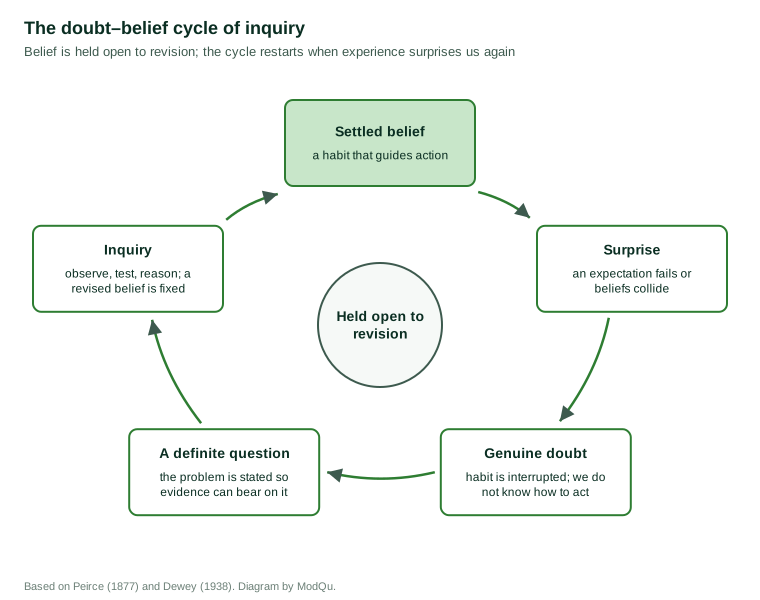
The most influential account of the nature of inquiry was given by the American philosopher Charles Sanders Peirce in an essay called "The Fixation of Belief" (Peirce, 1877). Peirce began with a psychological observation. Belief and doubt feel different, and they do different work. Belief is a calm and satisfactory state that guides action; it establishes what Peirce called a habit, a readiness to act in a certain way when the occasion arises. Peirce took this view of belief from the Scottish psychologist Alexander Bain, who had defined belief as that on which a person is prepared to act (Bain, 1859).
Doubt, by contrast, is "an uneasy and dissatisfied state from which we struggle to free ourselves" (Peirce, 1877, p. 5). It interrupts habits, because we no longer know how to act. Peirce called the struggle to pass from doubt back to belief inquiry. On this view, the sole immediate aim of inquiry is to settle opinion, and inquiry stops when doubt stops.
Peirce added a condition: doubt has to be genuine. A person cannot doubt something simply by deciding to. Real doubt arises when experience surprises us, when an expectation fails or two beliefs collide. "Paper doubts," manufactured for the sake of argument, do not start real inquiry because they do not disturb any habit of action (Peirce, 1877). This was partly a criticism of Descartes, whose method began by doubting everything at once.
Figure 1 sets out the cycle in its simplest form.
Four ways of fixing belief
If the only aim of inquiry is to end doubt, any method that ends doubt might seem as good as any other. Peirce faced this objection directly by comparing four methods by which people actually settle their opinions (Peirce, 1877):
- Tenacity. Hold on to whatever you already believe and avoid anything that might disturb it. This breaks down as soon as we meet people who believe otherwise and realise their opinions are as good as ours.
- Authority. Let an institution decide what everyone must believe and suppress dissent. No institution can regulate every opinion, and people eventually notice that other societies believe differently.
- The a priori method. Believe whatever seems "agreeable to reason". This is more respectable, but it makes belief a matter of taste and fashion.
- The method of science. Let beliefs be determined by something independent of what anyone thinks, an external reality that affects every inquirer and to which, with enough investigation, all would come to agree.
Only the fourth method, Peirce argued, can survive reflection, because only it contains a way of discovering that it has gone wrong. The first three methods fix belief by shielding it from experience. The scientific method fixes belief by exposing it to experience. A year later Peirce (1878) added his pragmatic maxim, that the meaning of a concept lies in its practical consequences, which gave inquirers a way of telling whether a dispute is about anything that could be tested at all.
Dewey: from doubt to the problematic situation
John Dewey developed Peirce's ideas into a full theory of inquiry. In How We Think (Dewey, 1910), written for teachers, he described reflective thought as beginning with a "felt difficulty", moving through its definition, the suggestion of possible solutions and the reasoning out of their implications, and ending in observation or experiment that leads to acceptance or rejection.
In his later Logic: The Theory of Inquiry, Dewey (1938) shifted the emphasis from the inquirer's mind to the situation. Inquiry, he wrote, is the controlled transformation of an indeterminate situation into one that is so determinate in its distinctions and relations that it converts the elements of the original situation into a unified whole. The doubt is not merely a private feeling; the situation itself is unsettled. A factory whose output is falling for unknown reasons is unsettled regardless of how anyone feels about it, and inquiry ends when the situation is resolved and action can proceed.
Dewey stressed that the first step is often the hardest: the indeterminate situation must be turned into a definite problem. "A problem well put is half-solved," he wrote (Dewey, 1938, p. 108). The way a problem is stated determines which suggestions will be considered and which evidence will be sought.
Questions as the engine of inquiry
The step from doubt to a definite problem is, in practice, the step of asking a question. Several philosophers have argued that questions deserve a central place in any account of inquiry. The historian and philosopher R. G. Collingwood (1939) held that every statement is an answer to a question, and that one cannot understand what a person meant without knowing the question they were trying to answer. Formal logicians developed systems to describe how questions relate to their possible answers (Belnap & Steel, 1976). Jaakko Hintikka (2007) went further and modelled inquiry as a game in which the inquirer puts questions to nature or to other sources of information and uses the answers as premises in reasoning. The quality of an inquiry then depends on which questions are asked, and in what order.
More recently, Jane Friedman has argued that inquiry involves a distinctive family of mental states she calls question-directed attitudes: wondering, being curious, investigating and suspending judgement (Friedman, 2013). To inquire into whether something is true is to have the question open in one's mind. Friedman (2017) argues that suspending judgement is not simply the absence of belief but an attitude directed at a question, and that it is the natural state of a person who is inquiring. In a later paper, Friedman (2020) points out a tension between the norms of inquiry and the traditional norms of belief. An inquirer must decide not only what to believe but which questions to pursue and when to stop gathering evidence. Christopher Hookway (2008) similarly argues that epistemology should pay more attention to the activity of inquiring, not only to the beliefs it produces.
The psychology of doubt and closure
Later psychological research broadly supports Peirce's description of doubt and belief, with complications.
Curiosity can be pleasant as well as uncomfortable. George Loewenstein (1994) proposed that curiosity arises when people notice a gap between what they know and what they want to know. Like Peirce's doubt, this information gap motivates people to seek answers. But Loewenstein also noted that people actively seek out puzzles, mysteries and quizzes, suggesting that opening questions can be rewarding, not merely irritating. Kidd and Hayden (2015) review evidence that curiosity engages the brain's reward systems and improves memory for what is learned. Dennis Whitcomb (2010) argues from the philosophical side that curiosity, rather than belief, is the basic attitude behind inquiry.
Belief comes first, doubt comes later. Daniel Gilbert (1991) reviewed evidence that people tend to accept a proposition at the moment they understand it, and only afterwards, if they have the time and mental capacity, assess and possibly reject it. Doubt is effortful: distracted or rushed people accept claims they would otherwise question.
People differ in their need to end doubt. Webster and Kruglanski (1994) developed a scale to measure the need for cognitive closure, the desire for a firm answer and an aversion to ambiguity. Kruglanski and Webster (1996) showed that people with a high need for closure tend to "seize" on early information and then "freeze" on the resulting judgement, becoming less responsive to new evidence. Time pressure, noise and fatigue raise the need for closure in everyone.
Belief shapes how evidence is gathered. Once a belief is in place, inquiry is rarely neutral. Raymond Nickerson (1998) documented the many forms of confirmation bias: the tendency to seek, interpret and remember information in ways that support existing beliefs. Ziva Kunda (1990) showed that when people want to reach a particular conclusion, they construct seemingly reasonable justifications for it, while believing themselves to be objective.
When should inquiry end?
Peirce said inquiry ends when doubt ends, but doubt can end too early, for bad reasons. In later work Peirce described truth as the opinion that would be agreed upon by all who investigate, if inquiry were pursued long enough, and he held that any present belief might need to be revised. Cheryl Misak (2013) traces how this idea of truth as the hypothetical end of inquiry runs through the American pragmatist tradition.
In practice, inquirers stop for many reasons: the answer is good enough for the decision at hand, further evidence would cost more than it is worth, or the question has changed. The important difference is between stopping because the question has been answered well enough and stopping because doubt has become uncomfortable or inconvenient. Karl Popper (1959) put the point strongly: scientific knowledge is never finally established, and every accepted theory remains open to future testing. Belief at the end of a good inquiry is settled enough to act on but held in a way that allows it to be reopened.
What this means for inquiry in practice
The classical account has practical consequences for anyone who asks questions for a living.
- Take surprise seriously. Genuine doubt begins when expectations fail. A complaint that does not fit or a result that contradicts last year's is often where useful inquiry starts.
- State the question before gathering evidence. Dewey's point that a well-stated problem is half solved applies to every survey, interview and investigation. Vague questions produce evidence that cannot settle anything.
- Separate the comfort of an answer from its quality. The need for closure is strongest when people are busy and under pressure, which is when organisations make many of their decisions. Building in a deliberate pause to ask "what would change our mind?" helps.
- Look for evidence that could show you are wrong. Peirce's method of science, Popper's emphasis on testing and the research on confirmation bias all point the same way: an inquiry is only as good as its exposure to evidence that might disconfirm its conclusion.
- Hold conclusions open. A settled belief is a basis for action, not a final verdict. Recording the evidence and reasoning behind a conclusion makes it easier to reopen when circumstances change.
Inquiry, on this account, is less a special technique than a disciplined version of something everyone does: noticing that we do not know, asking the right question and working our way to an answer we can act on. The discipline lies in letting the world, rather than our preferences, decide where the inquiry ends.
References
Bain, A. (1859). The emotions and the will. John W. Parker and Son.
Belnap, N. D., & Steel, T. B. (1976). The logic of questions and answers. Yale University Press.
Collingwood, R. G. (1939). An autobiography. Oxford University Press.
Dewey, J. (1910). How we think. D. C. Heath. https://doi.org/10.1037/10903-000
Dewey, J. (1938). Logic: The theory of inquiry. Henry Holt.
Friedman, J. (2013). Question-directed attitudes. Philosophical Perspectives, 27(1), 145–174. https://doi.org/10.1111/phpe.12026
Friedman, J. (2017). Why suspend judging? Noûs, 51(2), 302–326. https://doi.org/10.1111/nous.12137
Friedman, J. (2020). The epistemic and the zetetic. The Philosophical Review, 129(4), 501–536. https://doi.org/10.1215/00318108-8540918
Gilbert, D. T. (1991). How mental systems believe. American Psychologist, 46(2), 107–119. https://doi.org/10.1037/0003-066X.46.2.107
Haack, S. (1993). Evidence and inquiry: Towards reconstruction in epistemology. Blackwell.
Hintikka, J. (2007). Socratic epistemology: Explorations of knowledge-seeking by questioning. Cambridge University Press. https://doi.org/10.1017/CBO9780511619298
Hookway, C. (2008). Questions, epistemology, and inquiries. Grazer Philosophische Studien, 77(1), 1–21. https://doi.org/10.1163/18756735-90000841
Kidd, C., & Hayden, B. Y. (2015). The psychology and neuroscience of curiosity. Neuron, 88(3), 449–460. https://doi.org/10.1016/j.neuron.2015.09.010
Kruglanski, A. W., & Webster, D. M. (1996). Motivated closing of the mind: "Seizing" and "freezing." Psychological Review, 103(2), 263–283. https://doi.org/10.1037/0033-295X.103.2.263
Kunda, Z. (1990). The case for motivated reasoning. Psychological Bulletin, 108(3), 480–498. https://doi.org/10.1037/0033-2909.108.3.480
Loewenstein, G. (1994). The psychology of curiosity: A review and reinterpretation. Psychological Bulletin, 116(1), 75–98. https://doi.org/10.1037/0033-2909.116.1.75
Misak, C. (2013). The American pragmatists. Oxford University Press.
Nickerson, R. S. (1998). Confirmation bias: A ubiquitous phenomenon in many guises. Review of General Psychology, 2(2), 175–220. https://doi.org/10.1037/1089-2680.2.2.175
Peirce, C. S. (1877). The fixation of belief. Popular Science Monthly, 12, 1–15.
Peirce, C. S. (1878). How to make our ideas clear. Popular Science Monthly, 12, 286–302.
Popper, K. R. (1959). The logic of scientific discovery. Hutchinson.
Webster, D. M., & Kruglanski, A. W. (1994). Individual differences in need for cognitive closure. Journal of Personality and Social Psychology, 67(6), 1049–1062. https://doi.org/10.1037/0022-3514.67.6.1049
Whitcomb, D. (2010). Curiosity was framed. Philosophy and Phenomenological Research, 81(3), 664–687. https://doi.org/10.1111/j.1933-1592.2010.00394.x