
Inquiry · Philosophy of inquiry
Charles Sanders Peirce and the Fixation of Belief
Peirce's 1877 essay on how people settle their opinions remains one of the clearest accounts of why inquiry matters. This article explains its argument, its place in his wider philosophy and what it still teaches researchers.
In November 1877 the American magazine Popular Science Monthly published an essay by a 38-year-old scientist working for the United States Coast Survey. It was the first in a series called "Illustrations of the Logic of Science", and it carried the modest title "The Fixation of Belief" (Peirce, 1877). Its author, Charles Sanders Peirce, is now regarded as one of the most original thinkers the United States has produced. The essay is short, written for a general audience and full of practical examples, yet it set out an account of inquiry that philosophers still debate and that applies directly to modern research.
Who was Peirce?
Peirce (pronounced "purse") was born in 1839 in Cambridge, Massachusetts, the son of the Harvard mathematician Benjamin Peirce. He trained as a chemist, worked for three decades on geodetic and gravity measurements for the Coast Survey, and made original contributions to logic, probability and the theory of signs. His biographer describes a brilliant but difficult man whose academic career was cut short; he held only one university post, a lectureship at Johns Hopkins, and died in poverty in 1914 (Brent, 1993). Much of his work was published only after his death, in the Collected Papers (Peirce, 1931–1958) and later in carefully edited selections (Houser & Kloesel, 1992; Peirce Edition Project, 1998).
His practical experience matters for understanding the essay. Peirce spent years taking precise measurements, estimating their errors and combining them. He knew that individual observations are always uncertain, and that knowledge grows by correcting errors over many observations. This experience shaped his view that inquiry is a self-correcting process carried out by a community, not a search for certainty by a single mind (Misak, 2004).
He also put the view into practice. In 1884 Peirce and his student Joseph Jastrow ran an experiment on whether people can detect very small differences in weight. To prevent the experimenter's expectations from influencing the results, they used shuffled playing cards to decide the order of the trials (Peirce & Jastrow, 1885). The historian Ian Hacking (1988) identifies this as one of the earliest uses of deliberate randomisation in experimental design, decades before randomisation became standard practice. It is a small example of Peirce's larger conviction: a good method protects inquiry from the inquirer's own wishes.
The argument of "The Fixation of Belief"
The essay opens by observing that few people bother to study logic, because everyone thinks they already reason well enough. Peirce then makes three moves.
Belief and doubt are practical states. A belief, he argues, is a habit: a settled disposition to act in a particular way. Doubt is the uneasy state in which we do not know how to act. The two are distinguished by how they feel and by what they do. "Our beliefs guide our desires and shape our actions," while doubt stimulates us to inquire until it is destroyed (Peirce, 1877, p. 5).
Inquiry is the struggle from doubt to belief. Since doubt is uncomfortable, we try to escape it. Peirce called this struggle inquiry and claimed that "the settlement of opinion is the sole end of inquiry" (p. 6). This claim is deliberately provocative. It seems to say that we inquire only to feel settled, not to find the truth.
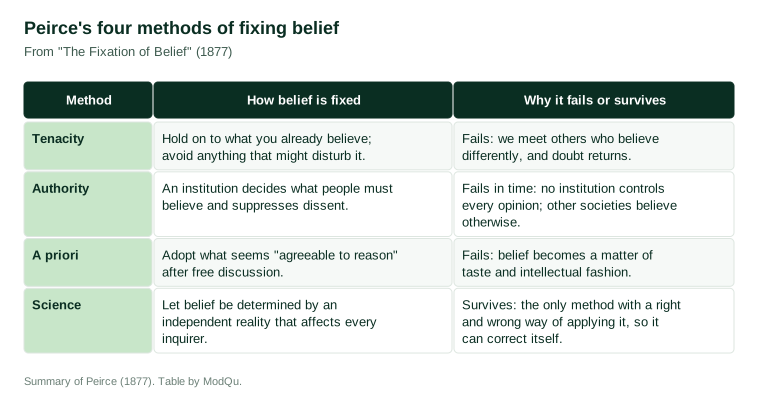
Some ways of settling opinion are better than others. If settlement were all that mattered, any method that produced it would do. Peirce therefore examined four methods by which people actually settle their beliefs, and asked which of them could survive once people became aware of how they worked. Figure 1 summarises the four methods.
The four methods in detail
Tenacity means clinging to whatever one already believes and avoiding anything that might shake it. Peirce compares it to the ostrich burying its head in the sand. The method can make a person content, but it fails in practice because people live among others. "The social impulse is against it": when we discover that other people, equally sensible, think differently, our confidence is shaken (Peirce, 1877, p. 9). Modern research on the need for cognitive closure describes a similar pattern, in which people under pressure seize on early answers and freeze on them (Kruglanski & Webster, 1996).
Authority transfers the work of fixing belief from the individual to an institution, such as a church or state, which decides what people should believe and punishes dissent. Peirce did not dismiss this method. He regarded it as more effective than tenacity, and he noted that it had sustained great civilisations. But no institution can control every opinion, and sooner or later some people notice that other times and places have believed differently, which reopens doubt.
The a priori method lets beliefs form through free discussion, adopting whatever seems "agreeable to reason". Peirce had metaphysical systems in mind: theories that were accepted not because of observed facts but because they seemed natural to their authors. This method is intellectually more respectable, but it makes inquiry "something similar to the development of taste" and so subject to fashion (Peirce, 1877, p. 11).
The method of science lets beliefs be determined "by nothing human, but by some external permanency": by real things whose characters are independent of our opinions about them, and which affect every observer according to regular laws (Peirce, 1877, p. 11). Its fundamental hypothesis is that there is a reality that, by investigation, anyone would come to know, given enough experience and reasoning.
The decisive advantage of the scientific method, in Peirce's account, is that it is the only one of the four that distinguishes a right and a wrong way of proceeding. Under tenacity, authority or the a priori method, whatever you end up believing is correct by definition. Under the method of science, you can test whether you applied the method properly, and discover that you did not. The method therefore contains its own corrective.
From settlement to truth
The essay's claim that the settlement of opinion is the sole end of inquiry has been called puzzling, because Peirce plainly thought truth mattered. The answer emerges in the next essay in the series, "How to Make Our Ideas Clear" (Peirce, 1878). There Peirce introduced the principle later known as the pragmatic maxim: to clarify a concept, consider what practical effects its object could have. Applying this maxim to truth itself, he wrote that the opinion "which is fated to be ultimately agreed to by all who investigate, is what we mean by the truth, and the object represented in this opinion is the real" (Peirce, 1878, p. 300).
Cheryl Misak (1991) argues that the two essays fit together. A belief that would never be overturned, however long inquiry continued, is exactly the belief that would permanently settle opinion. So aiming at a permanently settled opinion is, in effect, aiming at truth, and only the scientific method can deliver it. Christopher Hookway (1985, 2000) reads Peirce similarly, as offering an account of what we are committed to when we assert something and take it to be open to investigation.
Inquiry as a community activity
Peirce insisted that inquiry is social. In an earlier paper, he argued that reality is what a community of inquirers would eventually agree on, given indefinite investigation, and that the very idea of reality "essentially involves the notion of a community, without definite limits, and capable of a definite increase of knowledge" (Peirce, 1868, p. 155). No single inquirer will reach the final opinion; each contributes to a process that corrects itself over time.
This view led Peirce to reject the Cartesian ideal of starting from private certainty. We cannot begin by doubting everything, because real doubt needs a reason, and we start inquiry with the beliefs we already have. Susan Haack (1982) shows how Peirce replaced the lone Cartesian thinker with a community whose collective, fallible inquiry is the route to knowledge. His later writing contains a principle that sums up this outlook, which he called the first rule of reason: "Do not block the way of inquiry" (Peirce, 1931–1958, Vol. 1, para. 135). Any doctrine that declares a question closed for good, or a fact inexplicable in principle, violates it.
Reasoning within inquiry
Peirce also described the kinds of reasoning that inquiry uses. In his mature account, inquiry begins with abduction, the forming of an explanatory hypothesis when something surprising happens. Deduction then works out what would follow if the hypothesis were true, and induction tests those consequences against experience (Peirce Edition Project, 1998). K. T. Fann (1970) traced the development of the idea of abduction through Peirce's career, and Harry Frankfurt (1958) noted that Peirce treated it both as a logic of discovery and as a way of judging which hypotheses deserve testing. Deborah Mayo (1996) built on Peirce's view of inquiry as self-correcting in her account of how experiments detect and remove errors.
A worked illustration
Consider how the four methods might appear in a modern organisation facing a simple question: why are sales of a long-established product falling?
A tenacious answer holds on to the existing explanation, perhaps that the decline is seasonal, and treats contrary signals as noise. An answer fixed by authority adopts whatever the most senior person believes, and junior staff learn not to raise awkward data. An a priori answer settles on the explanation that seems most reasonable in a meeting, for example that a competitor's new advertising must be responsible, without checking whether the timing fits. Each of these answers can end the discussion, and each can feel satisfying. None of them can reveal that it is wrong.
The scientific approach starts by turning the doubt into definite, testable questions. Did the decline begin before or after the competitor's campaign? Is it concentrated among particular customers or regions? What do lapsed customers say when asked directly? Each answer can come out against the favoured explanation, and that possibility is exactly what makes the method trustworthy. If the evidence points somewhere unexpected, the organisation learns something it did not know.
Influence and criticism
Peirce's ideas reached a wide audience mainly through his friend William James, who credited him with founding pragmatism, although James's version emphasised the usefulness of beliefs in ways Peirce disliked (James, 1907). John Dewey developed the doubt–belief model into a general theory of inquiry (Dewey, 1938). Louis Menand (2001) describes the circle of thinkers around Peirce, James and Oliver Wendell Holmes as shaping a distinctively American suspicion of certainty.
The essay has also attracted criticism. Some readers think Peirce's psychological starting point, that inquiry aims to relieve discomfort, cannot ground a normative theory of how we ought to inquire. Others question whether there really is a single opinion that all inquirers would converge on, especially in fields where values are at stake. Misak (2013) argues that Peirce's position is better read as a claim about what inquirers hope for and must assume in order to inquire at all, rather than a guarantee that convergence will happen. Isaac Levi (1980) developed a related view in which the aim of inquiry is to revise one's current body of knowledge in a justified way, not to escape doubt as such.
Lessons for researchers today
Peirce wrote for scientists, but his analysis applies to any organised attempt to answer questions.
- Methods matter more than conclusions. An organisation can fix belief by tenacity ("we've always done it this way"), by authority ("the chief executive is sure") or by what seems agreeable to reason ("it makes sense that customers want this"). Only by testing beliefs against independent evidence can it discover when it is wrong.
- Surprises are valuable. Real inquiry starts when expectations fail. Research that is designed only to confirm existing beliefs gives up the main benefit of inquiry.
- Knowledge is collective and cumulative. No single survey or study settles a question. Results from different sources, gathered over time, correct one another.
- Keep questions open. Peirce's first rule of reason is a useful test for any research programme: does it leave room for evidence that could change the answer?
Nearly 150 years later, "The Fixation of Belief" remains a short and readable statement of why careful inquiry is worth the trouble. People will always find ways to settle their opinions. The question Peirce posed is whether they settle them in a way that can tell them when they are wrong.
References
Brent, J. (1993). Charles Sanders Peirce: A life. Indiana University Press.
Dewey, J. (1938). Logic: The theory of inquiry. Henry Holt.
Fann, K. T. (1970). Peirce's theory of abduction. Martinus Nijhoff.
Frankfurt, H. G. (1958). Peirce's notion of abduction. The Journal of Philosophy, 55(14), 593–597. https://doi.org/10.2307/2021966
Haack, S. (1982). Descartes, Peirce and the cognitive community. The Monist, 65(2), 156–181. https://doi.org/10.5840/monist198265214
Hacking, I. (1988). Telepathy: Origins of randomization in experimental design. Isis, 79(3), 427–451. https://doi.org/10.1086/354775
Hookway, C. (1985). Peirce. Routledge & Kegan Paul.
Hookway, C. (2000). Truth, rationality, and pragmatism: Themes from Peirce. Clarendon Press.
Houser, N., & Kloesel, C. (Eds.). (1992). The essential Peirce: Selected philosophical writings: Vol. 1. 1867–1893. Indiana University Press.
James, W. (1907). Pragmatism: A new name for some old ways of thinking. Longmans, Green.
Kruglanski, A. W., & Webster, D. M. (1996). Motivated closing of the mind: "Seizing" and "freezing." Psychological Review, 103(2), 263–283. https://doi.org/10.1037/0033-295X.103.2.263
Levi, I. (1980). The enterprise of knowledge: An essay on knowledge, credal probability, and chance. MIT Press.
Mayo, D. G. (1996). Error and the growth of experimental knowledge. University of Chicago Press.
Menand, L. (2001). The metaphysical club: A story of ideas in America. Farrar, Straus and Giroux.
Misak, C. (1991). Truth and the end of inquiry: A Peircean account of truth. Clarendon Press.
Misak, C. (Ed.). (2004). The Cambridge companion to Peirce. Cambridge University Press. https://doi.org/10.1017/CCOL0521570069
Misak, C. (2013). The American pragmatists. Oxford University Press.
Peirce, C. S. (1868). Some consequences of four incapacities. The Journal of Speculative Philosophy, 2(3), 140–157.
Peirce, C. S. (1877). The fixation of belief. Popular Science Monthly, 12, 1–15.
Peirce, C. S. (1878). How to make our ideas clear. Popular Science Monthly, 12, 286–302.
Peirce, C. S. (1931–1958). Collected papers of Charles Sanders Peirce (C. Hartshorne, P. Weiss, & A. W. Burks, Eds.; Vols. 1–8). Harvard University Press.
Peirce, C. S., & Jastrow, J. (1885). On small differences of sensation. Memoirs of the National Academy of Sciences, 3, 73–83.
Peirce Edition Project (Ed.). (1998). The essential Peirce: Selected philosophical writings: Vol. 2. 1893–1913. Indiana University Press.