
Inquiry · Public and formal inquiry
Public Consultation: Asking Citizens What They Think
Governments and organisations consult the public to gather evidence, test proposals and build legitimacy. This article explains the main forms of consultation, what research shows about who takes part and whether it makes a difference, and how to design consultation that produces useful, representative evidence.
Public consultation is one of the most common forms of inquiry in public life. Governments publish proposals and invite comments; city councils hold public meetings on new developments; regulators ask for views before setting new rules. Consultation serves several purposes at once. It gathers evidence and local knowledge that officials may lack, tests whether proposals are workable, and gives people affected by a decision a chance to be heard. Yet consultation is also widely criticised: for attracting only the most motivated voices, for asking questions after decisions have been made and for producing responses that disappear without trace. This article examines what consultation can and cannot do as a method of finding out what people think.
Levels of participation
Sherry Arnstein (1969) offered an influential and critical account of public participation in the form of a ladder. On the lowest rungs, which she called manipulation and therapy, participation was used to persuade rather than to listen. In the middle were informing, consultation and placation, which she described as forms of tokenism: citizens could speak, but had no assurance that their views would affect decisions. Only on the top rungs, partnership, delegated power and citizen control, did people gain real influence.
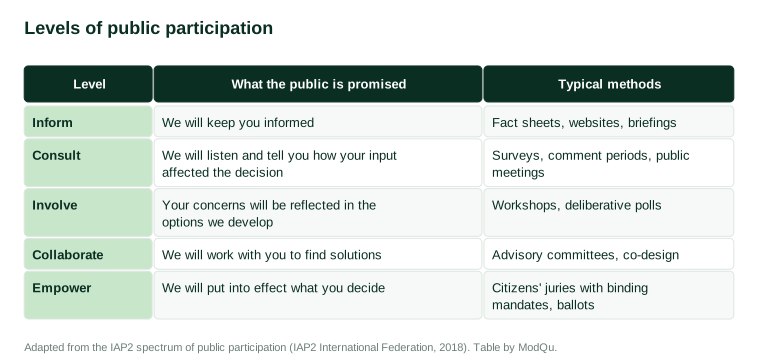
Later frameworks have been less polemical. The International Association for Public Participation describes a spectrum of five levels, from informing the public to empowering it to decide, each with a different promise about how public input will be used (IAP2 International Federation, 2018). Figure 1 summarises the spectrum.
Archon Fung (2006) proposed a more detailed framework, describing participation along three dimensions: who participates, how participants communicate and make decisions, and how much authority they have. He argued that different combinations suit different problems, and that no single form of participation is best for all purposes. Rowe and Frewer (2005) classified more than 100 engagement mechanisms according to the direction of information flow: communication, from the authority to the public; consultation, from the public to the authority; and participation, in which information is exchanged in both directions through dialogue.
Who takes part
The most persistent problem with consultation is that those who respond are rarely representative of those affected. Verba et al. (1995) showed that political participation of all kinds is unequal, with people who have more education, income and free time much more likely to take part. Consultations that rely on people choosing to respond inherit this inequality. They also attract those with the strongest views and the greatest stake, including organised interest groups, who may submit large numbers of similar responses. Campaign groups often provide template responses that supporters can submit with a single click. Such responses show the strength of organised feeling, which is itself useful information, but they should not be counted as if each represented an independent judgement. Good practice is to report them separately and to give more weight to the arguments they contain than to their number.
Irvin and Stansbury (2004) reviewed the benefits and costs of citizen participation and concluded that it was most valuable where citizens were willing and able to take part and where the issue was one on which they had relevant knowledge. Where these conditions did not hold, participation could be costly, slow and dominated by a few, without improving decisions. Lowndes et al. (2001) found that many citizens who did not take part in consultations had doubts that their views would make any difference.
Consultation as evidence
As a source of evidence about public opinion, open consultation has clear limits. A count of responses for and against a proposal measures the mobilisation of those who chose to respond, not the views of the population. Groves and Peytcheva (2008) showed in a meta-analysis of survey research that nonresponse bias depends on whether the reasons people respond are related to the topic being studied. In open consultations, they almost always are, since people respond precisely because they care about the issue.
The wording of consultation questions also matters. Schuman and Presser (1981) showed in a series of experiments that small changes in question wording, order and response options could substantially change survey answers. George Bishop (2005) argued that many apparent public opinions are artefacts of how questions were asked, especially on issues about which people have thought little. Consultation questions written by those who have already developed a proposal often frame the issue in ways that favour it.
For these reasons, consultation is best treated not as a vote but as a source of qualitative evidence: arguments, local knowledge, concerns and alternatives that decision makers may not have considered. Where representative evidence about public views is needed, it should come from properly sampled surveys or from deliberative methods with randomly selected participants, such as those described by James Fishkin (2009).
Does consultation make a difference?
Evaluations of consultation have often found that it has limited influence on decisions. Rowe and Frewer (2000) proposed criteria for judging participation methods, distinguishing acceptance criteria, such as representativeness, independence and transparency, from process criteria, such as access to resources, clear task definition and cost-effectiveness. They noted that few consultations were evaluated against any explicit criteria.
Innes and Booher (2004) argued that traditional consultation methods, such as public hearings and comment periods, often fail to improve decisions or to build trust, because they set citizens and officials against each other and leave no room for genuine dialogue. They recommended collaborative approaches in which citizens, officials and interest groups work together on shared problems. Shipley and Utz (2012) reviewed the literature on consultation in planning and found that its value depends on timing, with consultation early in the process more likely to influence decisions than consultation on finished proposals.
Even where it does not change decisions, consultation can affect how decisions are received. Tom Tyler (2006) showed that people's acceptance of decisions depends partly on whether they see the process as fair, including whether they had a chance to express their views and whether those views were considered. A consultation that is genuinely listened to may make an unwelcome decision more acceptable; one that is seen as a sham may make matters worse.
Designing better consultation
Research and practice suggest several principles. The United Kingdom government's consultation principles, for example, call for consultations to be clear and concise, to have a purpose, to be informative, to take place at a formative stage and to last for a proportionate time (Cabinet Office, 2018). Drawing these together:
- Consult early, while options are genuinely open.
- Be clear about the promise. Say what level of influence the public will have, and keep to it.
- Ask neutral, specific questions, tested in advance for bias and clarity.
- Reach beyond the usual voices, through targeted outreach to groups less likely to respond.
- Combine methods. Use open consultation for arguments and local knowledge, representative surveys for the distribution of views and deliberative methods for considered judgements.
- Analyse arguments, not just numbers. Report what was said and why, not only how many responses favoured each option.
- Close the loop. Publish a response that explains how the input affected the decision, and where it did not, why.
A hypothetical example
A city council proposes to close a branch library and expand online services. Its open consultation receives 2,000 responses, 90% opposed. A council officer notes that most respondents are regular library users who live nearby, and that the consultation questions did not ask about the proposed online services. The council then commissions a representative survey of residents, which finds that most residents rarely use the branch but that those who do are disproportionately older and on low incomes. It also holds a small deliberative workshop with randomly selected residents, who propose keeping the building open as a community hub with reduced hours. The open consultation identified the concerns; the survey measured how widely they were shared; the workshop produced a better option.
Conclusion
Public consultation is a valuable form of inquiry when it is used for what it does well: gathering arguments, local knowledge and concerns from those who care most about a decision, and showing that their views have been heard. It is a poor measure of public opinion, because those who respond are self-selected and the questions are often shaped by the proposal under discussion. Consultation works best when it is early, honest about the influence it offers, carefully worded, combined with representative and deliberative methods, and followed by a public explanation of what difference it made. John Dryzek (2000) argued that the legitimacy of collective decisions depends on the ability of those affected to take part in meaningful deliberation about them. Well-designed consultation is one way of making that possible.
References
Arnstein, S. R. (1969). A ladder of citizen participation. Journal of the American Institute of Planners, 35(4), 216–224. https://doi.org/10.1080/01944366908977225
Bishop, G. F. (2005). The illusion of public opinion: Fact and artifact in American public opinion polls. Rowman & Littlefield.
Cabinet Office. (2018). Consultation principles 2018. HM Government.
Dryzek, J. S. (2000). Deliberative democracy and beyond: Liberals, critics, contestations. Oxford University Press.
Fishkin, J. S. (2009). When the people speak: Deliberative democracy and public consultation. Oxford University Press.
Fung, A. (2006). Varieties of participation in complex governance. Public Administration Review, 66(s1), 66–75. https://doi.org/10.1111/j.1540-6210.2006.00667.x
Groves, R. M., & Peytcheva, E. (2008). The impact of nonresponse rates on nonresponse bias: A meta-analysis. Public Opinion Quarterly, 72(2), 167–189. https://doi.org/10.1093/poq/nfn011
IAP2 International Federation. (2018). IAP2 spectrum of public participation. International Association for Public Participation.
Innes, J. E., & Booher, D. E. (2004). Reframing public participation: Strategies for the 21st century. Planning Theory & Practice, 5(4), 419–436. https://doi.org/10.1080/1464935042000293170
Irvin, R. A., & Stansbury, J. (2004). Citizen participation in decision making: Is it worth the effort? Public Administration Review, 64(1), 55–65. https://doi.org/10.1111/j.1540-6210.2004.00346.x
Lowndes, V., Pratchett, L., & Stoker, G. (2001). Trends in public participation: Part 2 – citizens' perspectives. Public Administration, 79(2), 445–455. https://doi.org/10.1111/1467-9299.00264
Rowe, G., & Frewer, L. J. (2000). Public participation methods: A framework for evaluation. Science, Technology, & Human Values, 25(1), 3–29. https://doi.org/10.1177/016224390002500101
Rowe, G., & Frewer, L. J. (2005). A typology of public engagement mechanisms. Science, Technology, & Human Values, 30(2), 251–290. https://doi.org/10.1177/0162243904271724
Schuman, H., & Presser, S. (1981). Questions and answers in attitude surveys: Experiments on question form, wording, and context. Academic Press.
Shipley, R., & Utz, S. (2012). Making it count: A review of the value and techniques for public consultation. Journal of Planning Literature, 27(1), 22–42. https://doi.org/10.1177/0885412211413133
Tyler, T. R. (2006). Why people obey the law. Princeton University Press.
Verba, S., Schlozman, K. L., & Brady, H. E. (1995). Voice and equality: Civic voluntarism in American politics. Harvard University Press.