
Inquiry · Philosophy of inquiry
Philosophical Inquiry and the Clarification of Conceptual Knowledge
Before we can measure or test something, we need to know what we mean by it. This article explains how philosophical inquiry clarifies concepts through definitions, cases and counterexamples, and why that matters for research.
Many disputes that look like disagreements about facts are really disagreements about meaning. Two analysts arguing over whether customer "loyalty" is rising may be using the word for different things: repeat purchasing for one, emotional attachment for the other. No amount of data will settle the dispute until the concept is clarified. Philosophical inquiry specialises in this work. Its methods for analysing and refining concepts are among the oldest tools of inquiry, and they remain directly useful to anyone who designs research.
Analysis by cases and counterexamples
The classic method is to propose a definition and test it against cases. Socrates asked "What is courage?" and showed that each proposed definition admitted counterexamples. A famous modern instance concerns knowledge itself. Philosophers had long treated knowledge as justified true belief. Edmund Gettier (1963) described, in a three-page paper, cases in which someone has a justified true belief that is true only by luck, and which we would not call knowledge. The paper started decades of attempts to repair the definition, and showed how a single well-chosen counterexample can overturn a long-accepted analysis.
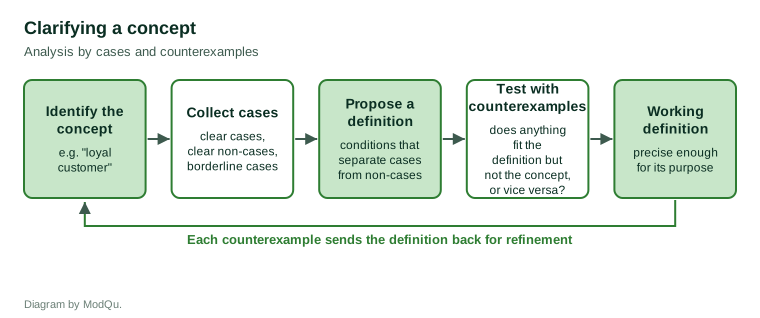
The procedure is general (Figure 1). Collect clear cases where the concept applies and clear cases where it does not; propose conditions that separate them; then search for cases that meet the conditions but plainly fall outside the concept, or fall inside it but fail the conditions. Each counterexample forces a refinement.
Not every concept has a definition
Ludwig Wittgenstein (1953) warned that many everyday concepts cannot be captured by a neat set of necessary and sufficient conditions. There is no single feature shared by all games; instead, games are linked by overlapping "family resemblances". Gilbert Ryle (1949) identified another source of confusion, the category mistake: treating a concept as if it belonged to the wrong logical type, like a visitor who sees the colleges and libraries of Oxford and then asks where the university is.
These insights led to a more practical aim. Rudolf Carnap (1950) proposed explication: replacing a vague everyday concept with a more precise one that is similar enough to serve the same purposes and exact enough to be used in scientific work. More recently, philosophers have described conceptual engineering, deliberately improving concepts for particular purposes (Cappelen, 2018). Sally Haslanger (2000) argued that the question is sometimes not what a concept means but what we want it to do.
Why it matters for research
Every survey question and every metric embodies a concept. Defining "active user", "household" or "satisfied customer" is philosophical work, whether or not it is recognised as such. Take "active user" as an example. A first definition might be "anyone who logged in during the past month". Counterexamples appear quickly. A person who logged in once to cancel their subscription meets the definition but is plainly not active in the intended sense. A person who receives and acts on the service's email alerts every day, but never logs in, fails the definition while being highly engaged. Each case forces a refinement: perhaps "anyone who used a core feature at least twice in the past month, through any channel". Whether that is the right explication depends on the purpose. A measure for forecasting revenue may need a different concept of activity from one for planning server capacity. The work is short, but skipping it can make a year of tracking data impossible to interpret.
Clarifying the concept first, by listing clear cases, borderline cases and the purpose the measure must serve, prevents the most expensive kind of research error: precise answers to the wrong question. It also makes results comparable over time and between teams, because everyone is measuring the same thing, and it exposes disagreements early, when they are cheap to resolve.
References
Cappelen, H. (2018). Fixing language: An essay on conceptual engineering. Oxford University Press. https://doi.org/10.1093/oso/9780198814719.001.0001
Carnap, R. (1950). Logical foundations of probability. University of Chicago Press.
Gettier, E. L. (1963). Is justified true belief knowledge? Analysis, 23(6), 121–123. https://doi.org/10.1093/analys/23.6.121
Haslanger, S. (2000). Gender and race: (What) are they? (What) do we want them to be? Noûs, 34(1), 31–55. https://doi.org/10.1111/0029-4624.00201
Ryle, G. (1949). The concept of mind. Hutchinson.
Wittgenstein, L. (1953). Philosophical investigations (G. E. M. Anscombe, Trans.). Blackwell.