
Inquiry · Philosophy of inquiry
Historical Evolution of Inquiry Traditions Across Cultures and Disciplines
Organised inquiry did not begin in one place. This article traces traditions of questioning, argument and evidence across ancient Greece, China, India and the Islamic world, through the scientific revolution and the rise of the disciplines, to the open research culture of today.
It is common to tell the history of inquiry as a single line running from ancient Greece through the European scientific revolution to modern science. That story is not wrong, but it leaves out most of the world and much of the past. Several civilisations developed sophisticated traditions of asking questions, weighing evidence and arguing about conclusions, and they did so in different ways that reflected their institutions and concerns. Comparing these traditions shows both what is common to careful inquiry everywhere and how much its form depends on the society that practises it. It also corrects a common misunderstanding: that rigorous inquiry is the property of one culture, which others have simply borrowed. The record shows independent invention, long periods of exchange and translation, and repeated rediscovery of the same basic disciplines of argument and evidence, adapted to very different settings. This article offers a brief tour, with a timeline in Figure 1.
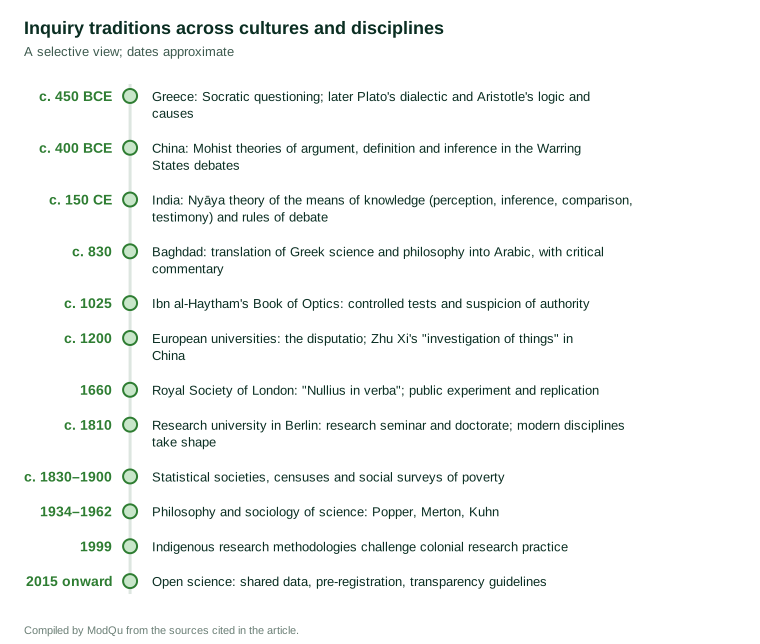
Greece: argument, debate and the search for causes
In the Greek city-states of the fifth and fourth centuries BCE, inquiry took the form of public argument. Geoffrey Lloyd (1979) argues that the competitive, adversarial character of Greek political and legal life shaped its intellectual life. Speakers had to persuade audiences who could answer back, and this encouraged the development of explicit standards of proof. Socrates questioned his fellow citizens; Plato developed dialectic as a method of testing definitions; Aristotle systematised logic, collected observations of animals and set out a theory of explanation through causes. The Greek legacy to inquiry included the idea that claims must be defended by reasons open to challenge, and the ideal of demonstration from first principles, best realised in Euclid's geometry. Greek medicine contributed a further strand. The Hippocratic writings insisted that diseases have natural causes rather than divine ones and recommended careful observation of the patient's symptoms, surroundings and course of illness. Lloyd (1979) shows that medical writers argued fiercely with one another about method, some favouring theory and others experience, a debate that anticipates later arguments between rationalists and empiricists.
China: correlative thinking and the investigation of things
Chinese traditions of inquiry developed in a different setting. Lloyd and Sivin (2002) compare early Chinese and Greek science and argue that Chinese thinkers, often serving as advisers to rulers, sought consensus and practical guidance more than adversarial proof. In the Warring States period, rival schools debated vigorously. The Mohists developed theories of argument, definition and inference, and studied optics and mechanics; A. C. Graham (1989) describes their logic as among the most rigorous in the ancient world. Joseph Needham's (1954) monumental study documented Chinese achievements in astronomy, medicine, mathematics and technology that were often centuries ahead of Europe.
Later Neo-Confucian thinkers, especially Zhu Xi in the twelfth century, made "the investigation of things and the extension of knowledge" (gewu zhizhi) a central ideal. Inquiry meant studying the principles underlying things, through reading and reflection as well as observation, as part of moral self-cultivation. Benjamin Elman (2005) shows how this tradition later engaged with European science on its own terms, rather than simply adopting it. Chinese states also developed large-scale systems of record-keeping, astronomical observation and population registration, which made empirical knowledge an instrument of government long before comparable systems appeared in Europe. The imperial examination system, which selected officials through written tests of learning, created a vast class of literate scholars, although its emphasis on classical texts tended to reward mastery of established knowledge over new inquiry.
India: means of knowledge and the rules of debate
Classical Indian philosophy developed one of the most detailed theories of evidence in any tradition. The Nyāya school asked what the reliable pramāṇas, or means of knowledge, are, and generally recognised four: perception, inference, comparison and reliable testimony (Matilal, 1986). Indian logicians analysed inference with great precision, including the role of examples and the conditions under which an inference fails. They also codified the rules of debate, distinguishing honest discussion aimed at truth from debate aimed only at victory and from destructive argument aimed at refuting an opponent without defending any view. Jonardon Ganeri (2001) shows how this framework treated inquiry as a public, rule-governed practice in which the burden of proof could be clearly assigned.
A standard example from the Nyāya texts shows the style. To establish that there is fire on a distant hill, the debater states the thesis ("the hill has fire"), the reason ("because it has smoke"), an example ("wherever there is smoke there is fire, as in a kitchen"), the application ("the hill has smoke of that kind") and the conclusion. Each step can be challenged, and the texts catalogue the ways an inference can go wrong, for instance when the reason is found where the conclusion does not hold. The five-step form makes the structure of an argument visible to both sides, which is precisely what makes a disagreement resolvable.
The Islamic world: translation, synthesis and experiment
Between the eighth and tenth centuries, scholars in Baghdad and other centres translated a large body of Greek philosophical and scientific writing into Arabic, supported by caliphs and wealthy patrons. Dimitri Gutas (1998) argues that this translation movement was driven by practical and political needs as well as curiosity, and that it created a lasting tradition of critical engagement with Greek thought. Scholars writing in Arabic did not merely preserve these works; they criticised and extended them in mathematics, astronomy, medicine and philosophy.
The eleventh-century scholar Ibn al-Haytham, known in Latin as Alhazen, is often singled out for his Book of Optics. He rejected the ancient theory that vision works by rays emitted from the eye and argued, on the basis of systematic observation and controlled tests with darkened rooms and apertures, that light enters the eye from objects. A. I. Sabra (1989), who translated the work, emphasises Ibn al-Haytham's use of what he called i'tibār, testing or experimental verification, and his insistence that the inquirer should be suspicious of authorities, including his own conclusions.
Medieval Europe: disputation and the universities
In medieval Europe, inquiry was institutionalised in the new universities of the twelfth and thirteenth centuries. Its characteristic form was the disputatio, in which a question was posed, arguments on both sides were set out, a resolution was given and each objection was answered. Edward Grant (1996) argues that this method, together with the universities' independence and the recovery of Aristotle, created a culture of systematic questioning that laid foundations for later science. Medieval scholars asked how motion works, whether the earth could rotate and what can be known by natural reason, and their questions shaped the agenda of the scientific revolution.
Medieval inquiry also had its own experimentalists. In the thirteenth century, Robert Grosseteste and Roger Bacon wrote on optics, drawing on Ibn al-Haytham, and argued for the importance of experience in establishing natural knowledge. Medieval commentators on Aristotle's physics developed concepts of motion and quantity that later figures, including Galileo, would build on. The once common picture of the Middle Ages as a period of stagnation between ancient and modern science has been largely abandoned by historians (Grant, 1996).
The scientific revolution: experiment and the community of witnesses
The sixteenth and seventeenth centuries brought new emphases. Francis Bacon called for inquiry based on systematic observation and experiment rather than on ancient authority, and proposed organised collaboration in collecting and testing facts (Bacon, 1620/2000). The Royal Society of London, founded in 1660, took as its motto Nullius in verba, "take nobody's word for it".
Steven Shapin and Simon Schaffer (1985) showed that the new experimental science needed social technologies as well as instruments. Robert Boyle's air-pump experiments were performed before witnesses, reported in detailed prose so that readers could imagine having seen them, and offered for replication. Matters of fact were established not by individual certainty but by a community of credible observers. Shapin (1996) cautions against treating the "scientific revolution" as a single event, but the period clearly produced durable institutions of inquiry: scientific societies, journals and the norm of public replication.
These institutions also changed the scale of inquiry. Correspondence networks linked naturalists across Europe and, increasingly, across the world, as reports, specimens and instruments travelled along trade and colonial routes. Journals such as the Royal Society's Philosophical Transactions, first published in 1665, created a permanent public record in which claims could be dated, credited and checked. The idea that a discovery is not complete until it has been published and exposed to criticism dates from this period and remains central to research today.
The nineteenth century: disciplines, universities and statistics
The modern disciplines took shape in the nineteenth century. German universities, following reforms associated with Wilhelm von Humboldt, made original research, not only teaching, a duty of professors, and developed the research seminar and the doctoral degree. William Clark (2006) traces how these institutions created the figure of the professional researcher. Physics, chemistry, history, philology and later psychology and sociology became separate fields with their own methods, journals and standards.
The same century saw the rise of statistical inquiry. Theodore Porter (1986) and Ian Hacking (1990) describe how governments and reformers began counting populations, crimes, diseases and deaths, and how the regularities they found changed ideas about society and chance. Social surveys of poverty in London and other cities, pioneered by investigators such as Charles Booth, combined counting with observation to document conditions that had been invisible to policy makers (Bulmer et al., 1991). Lorraine Daston and Peter Galison (2007) show that the very ideal of "objectivity", in the sense of knowledge free from the observer's influence, emerged in this period, alongside new techniques such as photography and mechanical recording.
The Needham question
Why did the experimental science of the seventeenth century, with its societies, journals and mathematical laws, take shape in Europe rather than in China or the Islamic world, which had led in many fields for centuries? Joseph Needham posed the question so forcefully that it now bears his name (Needham, 1954). Historians have offered many answers, none of them settled. Toby Huff (2003) emphasises institutions: European universities and corporations enjoyed legal autonomy, which allowed communities of scholars to set their own questions and standards, whereas comparable centres elsewhere depended more heavily on state or religious patronage. Lloyd and Sivin (2002) caution against treating the question as one of failure, since Chinese and Islamic inquiry pursued different goals with considerable success. Others point to economic factors, to printing, or to the particular combination of craft knowledge and academic learning in early modern European cities.
Whatever the answer, the debate is useful for thinking about inquiry today. It suggests that the methods of inquiry cannot be separated from the institutions that support them. Ideas about evidence and argument flourish where there are communities with the independence to test them, means to communicate results widely and rewards for finding errors as well as for producing new claims.
The twentieth century: reflecting on inquiry
In the twentieth century, inquiry turned its tools on itself. Robert Merton (1942/1973) described the norms of science: universalism, communal sharing of results, disinterestedness and organised scepticism. Karl Popper (1959) proposed falsification as the mark of science. Thomas Kuhn (1962) argued that science alternates between periods of "normal" puzzle-solving within a paradigm and revolutionary changes in which the paradigm itself is replaced. Randall Collins (1998) studied philosophical communities across world history and argued that intellectual creativity arises from networks of rival schools in competition for attention, a pattern visible in classical Greece, Warring States China, medieval India and modern Europe alike.
Indigenous scholars challenged the assumption that Western academic research is the only legitimate form of inquiry. Linda Tuhiwai Smith (1999) showed how research had often been done on Indigenous peoples in ways that served colonial interests, and set out methodologies grounded in Indigenous knowledge, values and self-determination.
Today: open science and global networks
Contemporary inquiry is shaped by digital communication, very large collaborations and renewed attention to reliability. The open science movement, prompted partly by failures to replicate published findings, promotes sharing of data, methods and pre-registered plans. Nosek et al. (2015) set out guidelines for transparency and openness that hundreds of journals have since adopted. At the same time, inquiry has become more global. Research teams now routinely span continents, and the share of scientific publications from China, India and other countries outside Europe and North America has grown rapidly. Large language models and other machine-learning tools are changing how literature is searched and how data are analysed, raising new questions about how claims generated or summarised by machines should be checked. Each of these developments renews old questions about who counts as a credible witness, how claims are tested and how results are shared. These reforms recall older ideals: the Royal Society's insistence on public witnessing, Merton's communal sharing and Indian rules distinguishing honest inquiry from debate for victory.
Lessons for research organisations
The history of inquiry offers practical lessons for anyone who runs research today, whether in a university, a government agency or a business.
First, methods travel, but they are adapted. Greek logic was transformed by scholars writing in Arabic, and European science was engaged by Chinese scholars on their own terms. Organisations that borrow research methods, for example from academic social science or from another industry, get the most from them when they adapt them to their own questions rather than copying them wholesale.
Second, standards of evidence are social achievements. The Royal Society's witnesses, the Nyāya rules of debate and modern peer review all exist because individual judgement is not enough. Research functions need explicit standards, such as clear sampling rules, documented analyses and independent review of important findings, and a culture in which those standards are enforced.
Third, diverse traditions catch different errors. A research team that includes people trained in statistics, in interviewing and in the business itself will notice problems that any one of them would miss, much as the competition between rival schools sharpened argument in ancient Greece, China and India.
What the comparison shows
Several features recur across traditions:
- Rules for argument. Greek dialectic, Indian debate manuals, Mohist logic and medieval disputation all set explicit standards for what counts as a good reason.
- Communities of critics. In each tradition, knowledge is established through scrutiny by others: rival schools, university masters, witnesses or peer reviewers.
- Multiple sources of evidence. Perception, inference and testimony appear, under different names, in almost every theory of knowledge.
- Institutional support. Patrons, academies, universities and journals shape what questions are asked and how answers are tested.
The differences are equally instructive. Traditions vary in how much they value adversarial debate versus consensus, practical usefulness versus pure understanding, and individual reasoning versus inherited authority. Modern research organisations face the same choices. Knowing that other traditions have answered them differently is a reminder that the current form of inquiry is one historical solution among several, and that it can be improved.
References
Bacon, F. (2000). The new organon (L. Jardine & M. Silverthorne, Eds.). Cambridge University Press. https://doi.org/10.1017/CBO9781139164030 (Original work published 1620)
Bulmer, M., Bales, K., & Sklar, K. K. (Eds.). (1991). The social survey in historical perspective, 1880–1940. Cambridge University Press.
Clark, W. (2006). Academic charisma and the origins of the research university. University of Chicago Press.
Collins, R. (1998). The sociology of philosophies: A global theory of intellectual change. Harvard University Press.
Daston, L., & Galison, P. (2007). Objectivity. Zone Books.
Elman, B. A. (2005). On their own terms: Science in China, 1550–1900. Harvard University Press.
Ganeri, J. (2001). Philosophy in classical India: The proper work of reason. Routledge.
Graham, A. C. (1989). Disputers of the Tao: Philosophical argument in ancient China. Open Court.
Grant, E. (1996). The foundations of modern science in the Middle Ages: Their religious, institutional, and intellectual contexts. Cambridge University Press.
Gutas, D. (1998). Greek thought, Arabic culture: The Graeco-Arabic translation movement in Baghdad and early ʿAbbāsid society. Routledge.
Hacking, I. (1990). The taming of chance. Cambridge University Press. https://doi.org/10.1017/CBO9780511819766
Huff, T. E. (2003). The rise of early modern science: Islam, China, and the West (2nd ed.). Cambridge University Press.
Kuhn, T. S. (1962). The structure of scientific revolutions. University of Chicago Press.
Lloyd, G. E. R. (1979). Magic, reason and experience: Studies in the origins and development of Greek science. Cambridge University Press.
Lloyd, G. E. R., & Sivin, N. (2002). The way and the word: Science and medicine in early China and Greece. Yale University Press.
Matilal, B. K. (1986). Perception: An essay on classical Indian theories of knowledge. Clarendon Press.
Merton, R. K. (1973). The normative structure of science. In N. W. Storer (Ed.), The sociology of science: Theoretical and empirical investigations (pp. 267–278). University of Chicago Press. (Original work published 1942)
Needham, J. (1954). Science and civilisation in China: Vol. 1. Introductory orientations. Cambridge University Press.
Nosek, B. A., Alter, G., Banks, G. C., Borsboom, D., Bowman, S. D., Breckler, S. J., Buck, S., Chambers, C. D., Chin, G., Christensen, G., Contestabile, M., Dafoe, A., Eich, E., Freese, J., Glennerster, R., Goroff, D., Green, D. P., Hesse, B., Humphreys, M., … Yarkoni, T. (2015). Promoting an open research culture. Science, 348(6242), 1422–1425. https://doi.org/10.1126/science.aab2374
Popper, K. R. (1959). The logic of scientific discovery. Hutchinson.
Sabra, A. I. (Trans.). (1989). The optics of Ibn al-Haytham: Books I–III, On direct vision. Warburg Institute.
Shapin, S. (1996). The scientific revolution. University of Chicago Press.
Shapin, S., & Schaffer, S. (1985). Leviathan and the air-pump: Hobbes, Boyle, and the experimental life. Princeton University Press.
Smith, L. T. (1999). Decolonizing methodologies: Research and Indigenous peoples. Zed Books.