
Inquiry · Philosophy of inquiry
Dialogic Inquiry Processes for Co-Constructed Knowledge
Dialogic inquiry builds knowledge through conversation in which participants think together rather than simply exchange views. This article explains its roots, the research on productive talk in classrooms and teams, and practical ways to make group inquiry more dialogic.
Much of what passes for discussion is really a sequence of monologues. Each person states a view, waits for others to finish and then restates it, perhaps more forcefully. Dialogic inquiry describes something different: a conversation in which participants build on, question and transform one another's ideas, so that the group arrives at an understanding none of its members held at the start. The idea has roots in philosophy, linguistics and psychology, and over the past three decades it has been studied closely in classrooms and workplaces. The findings show that the quality of talk can be described, taught and improved, and that it makes a measurable difference to what groups learn.
Roots of the idea
The Russian literary theorist Mikhail Bakhtin argued that all language is dialogic. Every utterance responds to earlier utterances and anticipates responses, and meaning arises in the interaction between voices rather than residing in any single one (Bakhtin, 1981). The psychologist Lev Vygotsky (1978) held that higher thinking develops first between people, in social interaction, and only later within the individual mind. On this view, learning to reason is largely learning to take part in, and then internalise, good conversations.
The physicist David Bohm (1996) proposed dialogue as a practice for groups. In Bohm's dialogue, participants suspend their assumptions, holding them up for examination rather than defending them, and attend to the meaning that flows through the group as a whole. William Isaacs (1999) adapted Bohm's ideas for organisations, describing dialogue as "the art of thinking together". Paulo Freire (1970) gave dialogue a central place in education, arguing that genuine learning requires teachers and learners to inquire together into problems that matter to them. Jürgen Habermas (1984) described an ideal of communicative action in which participants seek mutual understanding through the exchange of reasons, rather than trying to manipulate one another.
Dialogic inquiry in the classroom
The educational researcher Gordon Wells (1999) brought these strands together in the idea of dialogic inquiry. Drawing on Vygotsky, Wells argued that classrooms should be organised as communities in which knowledge is constructed through collaborative talk about questions that students care about. The teacher's role shifts from transmitting answers to orchestrating inquiry.
Neil Mercer and colleagues studied how primary school children actually talk when working in groups, and identified three types of talk (Mercer, 2000). Figure 1 summarises them.
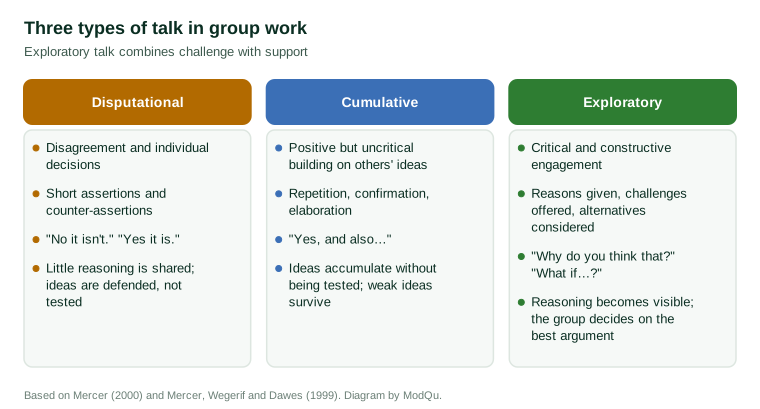
In disputational talk, participants disagree and make individual decisions, with short assertions and counter-assertions but little reasoning. In cumulative talk, participants build positively but uncritically on what others say, agreeing and repeating, so that ideas accumulate without being tested. In exploratory talk, participants engage critically but constructively with one another's ideas: they offer reasons, challenge claims, consider alternatives and seek agreement on the basis of the best argument. Mercer described exploratory talk as making reasoning visible in the conversation.
Crucially, exploratory talk can be taught. In the "Thinking Together" programme, teachers worked with children to agree ground rules for talk, such as sharing all relevant information, giving reasons, asking for others' views, and accepting that the group, not individuals, is responsible for its decisions. Mercer et al. (1999) found that children who took part used more exploratory talk and performed better on a standard test of non-verbal reasoning, both in groups and when tested individually afterwards. The individual gains suggest that children had internalised the patterns of reasoning practised in their groups, as Vygotsky's theory predicts.
The wider evidence
Research on classroom dialogue has grown substantially. Christine Howe and Manzoorul Abedin (2013) reviewed four decades of studies and found strong evidence that the quality of classroom dialogue is related to learning, while noting that many studies were descriptive and that more experimental evidence was needed. Robin Alexander (2020) developed principles of dialogic teaching, emphasising that classroom talk should be collective, reciprocal, supportive, cumulative and purposeful. A volume edited by Resnick et al. (2015) brought together evidence that structured academic discussion, in which students explain and justify their reasoning, improves learning across subjects and can raise achievement for students who are usually less successful.
Dialogue in teams and organisations
The same principles apply to adult teams. Woolley et al. (2010) studied groups working on a range of tasks and found evidence of a general "collective intelligence" factor that predicted group performance across tasks. It was only weakly related to the average or maximum intelligence of group members, but more strongly related to the members' social sensitivity and to how evenly they took turns in conversation. Groups in which a few people dominated the discussion performed worse. Amy Edmondson (1999) showed that teams learn more when members feel safe to speak up, ask questions and admit mistakes, a condition she called psychological safety. Dialogic inquiry depends on such safety, because exploratory talk requires people to voice tentative ideas and challenge others without fear.
Rupert Wegerif (2007) argues that digital technology can support dialogic inquiry by creating shared spaces in which ideas are visible and can be built upon over time, although technology can equally amplify disputational or cumulative patterns if the norms of good dialogue are absent.
Dialogue in research practice
Dialogic principles also shape how researchers gather knowledge from other people. A focus group is, at its best, a structured dialogue: participants respond to one another as well as to the moderator, and the interaction brings out views, reasons and disagreements that individual interviews might miss. David Morgan (1996) notes that this interaction is the distinctive source of focus group data, but also its main risk, since a dominant participant or a drift towards agreement can make the group appear more unanimous than its members really are. Skilled moderators therefore work much as Mercer's teachers did, inviting reasons, drawing in quieter participants and asking for alternative views.
Co-design workshops, in which customers, staff and researchers develop solutions together, rely on the same dynamics. So do internal analysis sessions in which a research team interprets its findings. In each case the question is whether the conversation is exploratory or merely cumulative. Deanna Kuhn (2015) argues that the capacity to reason well together is learned through practice, and that people who argue productively with peers also become better at reasoning alone, which is a strong reason for organisations to cultivate it.
Making group inquiry more dialogic
The research suggests several practical steps for anyone leading a meeting, workshop or research team:
- Agree ground rules for talk. Simple, explicit norms, such as giving reasons, inviting quieter members to contribute and treating challenges as contributions rather than attacks, change how groups talk.
- Start from a genuine question. Dialogue is most productive when the group faces a real problem whose answer is not known in advance.
- Ask for reasons and alternatives. Questions such as "Why do you think that?" and "What else might explain this?" shift talk from cumulative to exploratory.
- Balance turn-taking. Notice who is speaking and who is not. Structured rounds can prevent a few voices from dominating.
- Make thinking visible. Writing ideas and arguments where everyone can see them helps the group build on them.
- Summarise and test agreement. Before concluding, check whether the group's shared view has been tested against objections, or whether it has simply accumulated.
An example shows the difference these steps make. A product team meets to decide why a new feature has low uptake. In a cumulative version of the meeting, the first suggestion, that customers have not noticed the feature, is quickly echoed and elaborated, and the team leaves agreeing to run an awareness campaign. In an exploratory version, someone asks for the evidence that customers have not noticed it; another points out that usage logs show many customers opened the feature once and never returned, which suggests a different problem; a third asks what else could explain one-time use. The conclusion is now a sharper question about the feature's first-use experience, which the team can test before spending money on promotion.
Limits
Dialogic inquiry is not always the right tool. It takes time, and some questions are better settled by data, expertise or a decision by someone accountable. Dialogue can also drift without a clear purpose, or produce a comfortable consensus that is really cumulative talk in disguise. The research is clear that the benefits come from talk that is both supportive and critical. Groups that only support each other, or only argue, learn less than groups that do both.
Conclusion
Dialogic inquiry treats conversation as a method of generating knowledge, not just of sharing it. Its insight, supported by evidence from classrooms and teams, is that the way people talk together shapes what they can discover. When participants give reasons, challenge one another constructively and take responsibility for a shared conclusion, a group can reason better than its individual members, and those members carry better habits of reasoning away with them.
References
Alexander, R. J. (2020). A dialogic teaching companion. Routledge. https://doi.org/10.4324/9781351040143
Bakhtin, M. M. (1981). The dialogic imagination: Four essays (M. Holquist, Ed.; C. Emerson & M. Holquist, Trans.). University of Texas Press.
Bohm, D. (1996). On dialogue (L. Nichol, Ed.). Routledge.
Edmondson, A. (1999). Psychological safety and learning behavior in work teams. Administrative Science Quarterly, 44(2), 350–383. https://doi.org/10.2307/2666999
Freire, P. (1970). Pedagogy of the oppressed (M. B. Ramos, Trans.). Herder and Herder.
Habermas, J. (1984). The theory of communicative action: Vol. 1. Reason and the rationalization of society (T. McCarthy, Trans.). Beacon Press.
Howe, C., & Abedin, M. (2013). Classroom dialogue: A systematic review across four decades of research. Cambridge Journal of Education, 43(3), 325–356. https://doi.org/10.1080/0305764X.2013.786024
Isaacs, W. (1999). Dialogue and the art of thinking together. Currency.
Kuhn, D. (2015). Thinking together and alone. Educational Researcher, 44(1), 46–53. https://doi.org/10.3102/0013189X15569530
Mercer, N. (2000). Words and minds: How we use language to think together. Routledge.
Mercer, N., Wegerif, R., & Dawes, L. (1999). Children's talk and the development of reasoning in the classroom. British Educational Research Journal, 25(1), 95–111. https://doi.org/10.1080/0141192990250107
Morgan, D. L. (1996). Focus groups. Annual Review of Sociology, 22, 129–152. https://doi.org/10.1146/annurev.soc.22.1.129
Resnick, L. B., Asterhan, C. S. C., & Clarke, S. N. (Eds.). (2015). Socializing intelligence through academic talk and dialogue. American Educational Research Association. https://doi.org/10.3102/978-0-935302-43-1
Vygotsky, L. S. (1978). Mind in society: The development of higher psychological processes (M. Cole, V. John-Steiner, S. Scribner, & E. Souberman, Eds.). Harvard University Press.
Wegerif, R. (2007). Dialogic education and technology: Expanding the space of learning. Springer. https://doi.org/10.1007/978-0-387-71142-3
Wells, G. (1999). Dialogic inquiry: Towards a sociocultural practice and theory of education. Cambridge University Press. https://doi.org/10.1017/CBO9780511605895
Woolley, A. W., Chabris, C. F., Pentland, A., Hashmi, N., & Malone, T. W. (2010). Evidence for a collective intelligence factor in the performance of human groups. Science, 330(6004), 686–688. https://doi.org/10.1126/science.1193147