
Inquiry · Public and formal inquiry
Parliamentary and Congressional Inquiries
Legislatures investigate government and public problems through committees that gather evidence, question witnesses and publish reports. This article explains how parliamentary and congressional inquiries work, what research shows about their influence, and what makes them effective.
Legislatures do more than pass laws. They also inquire. In Westminster-style parliaments, such as those of the United Kingdom, Canada and Australia, committees of members examine government departments, investigate policy problems and question ministers and officials. In the United States, congressional committees hold hearings, issue subpoenas and conduct investigations into the executive branch and private organisations. These inquiries are among the most public forms of evidence gathering in a democracy. They differ from academic research and from independent commissions in an important way: they are carried out by elected politicians, whose purposes include accountability and persuasion as well as finding out what is true.
Why legislatures inquire
Kaare Strøm (2000) described parliamentary democracy as a chain of delegation, from voters to legislators to ministers to civil servants, in which each link creates a risk that those given power will not act as intended. Inquiry is one of the main ways legislatures hold the next link to account. Committees find out what government is doing, expose failures and press for change.
Mathew McCubbins and Thomas Schwartz (1984) distinguished two styles of oversight. In police-patrol oversight, the legislature examines government activity routinely and systematically, looking for problems. In fire-alarm oversight, it relies on citizens, interest groups and the media to raise concerns, and investigates when an alarm sounds. They argued that legislators often prefer fire-alarm oversight, because it focuses their limited time on the issues voters care about. Joel Aberbach (1990) found that oversight in the United States Congress increased substantially from the 1970s, as Congress gained staff and as conflict with the executive grew.
How committee inquiries work
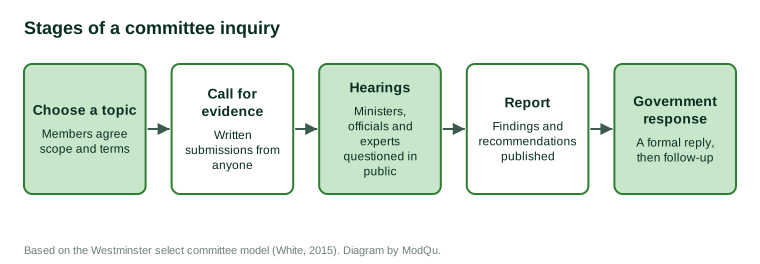
Westminster select committees follow a broadly similar process, shown in Figure 1. The committee chooses a topic and sets its scope, then issues a public call for written evidence, which anyone can answer. It holds oral evidence sessions at which ministers, officials, experts and affected people are questioned in public. Finally, it publishes a report with findings and recommendations, and the government is expected to reply formally, usually within two months in the United Kingdom.
United States congressional committees have stronger formal powers. They can compel witnesses to testify and to produce documents by subpoena, and can hold those who refuse in contempt (Fisher, 2003). Some congressional investigations have had historic effects. The Senate Select Committee on Presidential Campaign Activities (1974), which investigated the Watergate affair, gathered evidence that contributed to the resignation of President Nixon.
Kinds of legislative inquiry
Legislative inquiries take several forms, and each serves a different purpose.
Scrutiny of departments. Many committees are tied to a government department and examine its spending, administration and policy on a regular basis. This is the closest form to police-patrol oversight. Its value lies in steady accumulation of knowledge: committee members and staff come to understand the department well and can recognise when something is going wrong.
Policy inquiries. Committees also investigate broader policy problems, such as housing supply or the regulation of new technologies, often before the government has decided what to do. These inquiries resemble research projects. They gather evidence from many sources, weigh competing views and make recommendations, and they can shape the agenda by bringing an issue to public attention.
Investigations of failures and scandals. When something goes badly wrong, such as a financial collapse, a public health failure or misconduct by officials, committees may launch investigations into what happened and who was responsible. These are the most visible and the most politically charged inquiries, because their findings can damage reputations and careers.
Pre-legislative scrutiny. Some committees examine draft laws before they are formally introduced, gathering evidence on how the proposed law would work in practice. This allows problems to be identified while the law can still easily be changed.
Questioning as a method
The oral evidence session is the most distinctive feature of legislative inquiry. Unlike a research interview, it takes place in public, and the person being questioned may have strong reasons to avoid giving clear answers. Effective committee questioning therefore relies on preparation: committee staff brief members on the evidence already received, identify the points on which witnesses' accounts differ and suggest questions designed to establish specific facts. Open questions invite witnesses to explain; precise follow-up questions test their explanations against documents and other testimony. Geddes (2020) found that members who prepared carefully and worked together across party lines tended to obtain more useful evidence than those who used hearings mainly to make political points. The public setting adds a further dimension: a minister who gives an evasive answer to a direct question in a televised hearing pays a political price, which gives committees leverage that private researchers lack.
Do inquiries make a difference?
It is difficult to measure the influence of legislative inquiries, because many of their effects are indirect. Meg Russell and Meghan Benton (2011) studied seven House of Commons select committees and traced what happened to their recommendations. They found that about 40% were accepted by the government and that a similar proportion were eventually implemented, in whole or in part. Benton and Russell (2013) argued that committees also had less visible effects: influencing policy debate, improving the quality of evidence used by government, deterring poor decisions because ministers and officials anticipated scrutiny, and holding the government to account in public.
Hindmoor et al. (2009) studied the House of Commons Education and Skills Committee and found that its influence lay partly in shaping the agenda, drawing attention to issues before they became priorities for government. Marc Geddes (2020) studied how select committee members and staff work and found that committees' authority depends heavily on their perceived independence and on the cross-party consensus their reports achieve. Hannah White (2015) reviewed the work of select committees and recommended clearer objectives for inquiries and more systematic follow-up of recommendations.
In the United States, Kriner and Schickler (2016) analysed congressional investigations over more than a century and found that investigations into the executive branch, especially during periods of divided government, reduced public approval of the president and could constrain presidential action. David Mayhew (2005) found that major investigations occurred at a similar rate whether or not the presidency and Congress were controlled by the same party, although later research has suggested that partisan conflict affects their intensity and tone.
Strengths and weaknesses as inquiry
As forms of inquiry, legislative investigations have distinctive strengths. They take place in public, so evidence and reasoning are open to scrutiny. They can compel information that others cannot obtain. And their conclusions carry democratic legitimacy, which can make it harder for governments to ignore them.
They also have weaknesses. Members are politicians, and questioning may be designed to score points rather than establish facts. Committees have limited time and staff, so inquiries may be brief and selective. Monk (2010) proposed criteria for evaluating committee performance, including the quality of evidence gathered, the extent of cross-party agreement and the government's response, and noted that these vary widely. David Smith (2007) observed that in Canada, as in other parliamentary systems, the effectiveness of committees depends heavily on the degree of party discipline, which can limit members' independence. Pelizzo and Stapenhurst (2012) compared oversight tools across many countries and found that having formal powers is not enough: their effective use depends on political will, resources and the wider political context.
Lessons for other inquiries
Legislative inquiries show the value of several practices that apply to inquiries of any kind: an open call for evidence, which brings in knowledge from unexpected sources; public questioning, which tests claims against challenge; a written report that sets out evidence and reasoning; and a formal requirement for the body being investigated to respond. They also show the risks when inquiry is mixed with advocacy, and the importance of independence and consensus for the credibility of conclusions.
A hypothetical example illustrates the point. A provincial legislature's health committee investigates long waiting times for hip and knee surgery. Its open call for evidence brings submissions from surgeons, patients, hospital managers and physiotherapists. Public hearings reveal that operating theatres are idle for part of each week because of shortages of anaesthetists, an issue that had not appeared in official statistics. The committee's unanimous report recommends a staffing plan, and the government's formal response commits to it. A year later, the committee holds a follow-up hearing to check progress, and finds that waiting times have begun to fall in the hospitals where the plan was put in place first.
References
Aberbach, J. D. (1990). Keeping a watchful eye: The politics of congressional oversight. Brookings Institution.
Benton, M., & Russell, M. (2013). Assessing the impact of parliamentary oversight committees: The select committees in the British House of Commons. Parliamentary Affairs, 66(4), 772–797. https://doi.org/10.1093/pa/gss009
Fisher, L. (2003). Congressional investigations: Subpoenas and contempt power (CRS Report No. RL31836). Congressional Research Service.
Geddes, M. (2020). Dramas at Westminster: Select committees and the quest for accountability. Manchester University Press.
Hindmoor, A., Larkin, P., & Kennon, A. (2009). Assessing the influence of select committees in the UK: The Education and Skills Committee, 1997–2005. The Journal of Legislative Studies, 15(1), 71–89. https://doi.org/10.1080/13572330802666893
Kriner, D. L., & Schickler, E. (2016). Investigating the president: Congressional checks on presidential power. Princeton University Press.
Mayhew, D. R. (2005). Divided we govern: Party control, lawmaking, and investigations, 1946–2002 (2nd ed.). Yale University Press.
McCubbins, M. D., & Schwartz, T. (1984). Congressional oversight overlooked: Police patrols versus fire alarms. American Journal of Political Science, 28(1), 165–179. https://doi.org/10.2307/2110792
Monk, D. (2010). A framework for evaluating the performance of committees in Westminster parliaments. The Journal of Legislative Studies, 16(1), 1–13. https://doi.org/10.1080/13572330903541904
Pelizzo, R., & Stapenhurst, F. (2012). Parliamentary oversight tools: A comparative analysis. Routledge.
Russell, M., & Benton, M. (2011). Selective influence: The policy impact of House of Commons select committees. Constitution Unit, University College London.
Senate Select Committee on Presidential Campaign Activities. (1974). Final report (S. Rep. No. 93-981). U.S. Government Printing Office.
Smith, D. E. (2007). The people's House of Commons: Theories of democracy in contention. University of Toronto Press.
Strøm, K. (2000). Delegation and accountability in parliamentary democracies. European Journal of Political Research, 37(3), 261–289. https://doi.org/10.1023/A:1007064803327
White, H. (2015). Select committees under scrutiny. Institute for Government.