
Inquiry · Philosophy of inquiry
John Dewey's Logic of Inquiry
John Dewey described inquiry as the controlled transformation of an unsettled situation into a settled one. This article explains his pattern of inquiry, his idea of warranted assertibility and why the theory still shapes research and education.
John Dewey (1859–1952) is best known as an educational reformer, but he regarded his theory of inquiry as the centre of his philosophy. Over four decades, from How We Think (Dewey, 1910) to Logic: The Theory of Inquiry (Dewey, 1938), he argued that logic should describe how successful inquiry is actually conducted, in science and in everyday life, rather than set out timeless rules of thought. His account remains one of the most complete descriptions of what it means to investigate a problem.
From reflex arc to problematic situation
Dewey's view of inquiry grew out of his early psychology. In a famous paper, he criticised the idea that behaviour is a simple chain of stimulus, sensation and response (Dewey, 1896). Instead, he argued, organisms are constantly coordinating their activity with their surroundings, and what counts as a "stimulus" depends on what the organism is trying to do. Thinking starts when that coordination breaks down.
This idea carried over into his logic. Like Charles Sanders Peirce (1877), Dewey held that inquiry begins with doubt. But Dewey located the doubt in the situation, not just in the inquirer's mind. A situation is indeterminate when its elements do not hang together: we do not know what is going on or what to do. Inquiry is "the controlled or directed transformation of an indeterminate situation into one that is so determinate in its constituent distinctions and relations as to convert the elements of the original situation into a unified whole" (Dewey, 1938, pp. 104–105).
The pattern of inquiry
Dewey argued that all inquiry, whether a scientist investigating a disease or a mechanic diagnosing an engine, follows a common pattern (Figure 1).
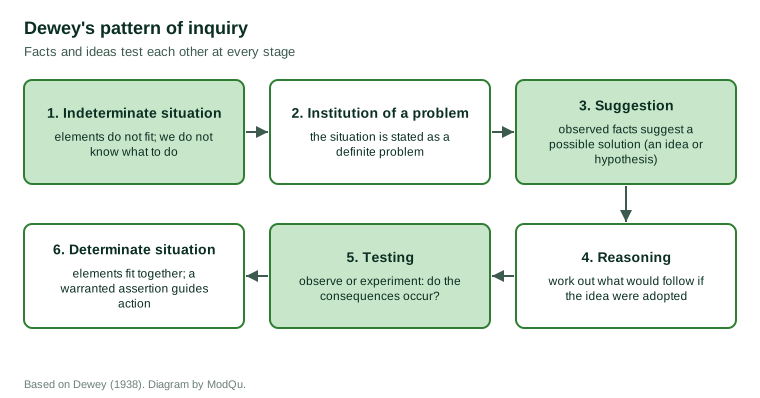
- The indeterminate situation. Something is unsettled, confused or conflicting.
- The institution of a problem. The inquirer recognises the situation as problematic and states what the problem is. Dewey insisted that this step is decisive: "a problem well put is half-solved" (Dewey, 1938, p. 108). An incorrectly stated problem sends inquiry in the wrong direction.
- Suggestion of a solution. Observation of the facts of the case suggests possible solutions, which Dewey called ideas or hypotheses. Ideas are not mental pictures but proposals for action: plans for what to do or look for next.
- Reasoning. The inquirer works out what would follow if the idea were adopted. Reasoning often transforms a vague suggestion into a precise hypothesis that can be tested.
- Testing. Observation or experiment determines whether the predicted consequences actually occur. Facts and ideas are tested against each other: facts select ideas, and ideas direct which facts to collect.
- A determinate situation. When the elements fit together, the situation is resolved and action can proceed.
The earlier five-step version in How We Think described the same process for teachers: a felt difficulty, its location and definition, a possible solution, the development of its implications by reasoning, and further observation leading to acceptance or rejection (Dewey, 1910).
The pattern in a practical case
Dewey's own examples were often ordinary. In How We Think he described a man who notices, while walking, that the air has turned cool, wonders whether it is about to rain, looks up at the clouds and decides to hurry home (Dewey, 1910). A more modern case shows the same structure in a research setting.
Suppose a company's customer satisfaction scores fall sharply in one quarter. At first the situation is simply indeterminate: managers are uneasy, and several explanations circulate. Inquiry starts in earnest when someone institutes a definite problem, for example: "Did satisfaction fall among all customers, or only among those who contacted support after the new phone system was introduced?" That question immediately suggests what data to look at. Observation suggests an idea, perhaps that waiting times rose. Reasoning works out its implications: if waiting times are the cause, the fall should be concentrated among customers who phoned, and it should be larger for longer waits. Testing checks those consequences against the records. If they hold, the situation becomes determinate, the company knows what to fix, and its conclusion is warranted. If they do not, the problem is restated and the cycle continues.
Two features of this example are characteristic of Dewey. First, the problem statement does real work: a vague question ("why are customers unhappy?") would not have pointed to any particular evidence. Second, ideas and facts are interwoven. The hypothesis directs which records to examine, and the records decide whether the hypothesis survives.
Warranted assertibility
Dewey was wary of the word "knowledge", because it suggested something finished and certain. He preferred the term warranted assertibility for the outcome of inquiry (Dewey, 1938). A conclusion is warranted when it has been reached by competent inquiry and has survived testing. It is assertible, meaning it can be relied on in further inquiry and action, but it remains open to revision if future inquiry finds problems with it. Matthew Brown (2012) argues that this makes Dewey's logic a theory of scientific practice: it describes how inquiry builds on earlier results while treating them as provisional.
Criticism and debate
Dewey's logic was not universally welcomed. Bertrand Russell (1939) complained that it confused logic with psychology and replaced truth with whatever settles a practical problem. He feared that the theory implied that a belief was true simply because it worked. Tom Burke (1994) later defended Dewey, arguing that Russell misread him: Dewey did not deny that conclusions can be true or false, but held that the meaning of truth must be explained by reference to the process of inquiry that establishes it. Cheryl Misak (2013) places the dispute in the wider history of American pragmatism.
A second debate concerns scope. Dewey insisted that the same pattern applies to moral and social questions as to scientific ones. In The Quest for Certainty (Dewey, 1929), he argued that values, too, should be treated as hypotheses about what will improve a situation, and tested by their consequences. Robert Westbrook (1991) shows how this conviction linked Dewey's logic to his democratic politics: a democratic society is one organised to inquire into its own problems. Larry Hickman (1990) reads the theory as an account of inquiry as a kind of technology, a set of tools for transforming situations.
Dewey's influence today
Dewey's ideas spread far beyond philosophy. His model of reflective thinking is the ancestor of many teaching approaches based on problem solving and inquiry. David Kolb's (1984) cycle of experiential learning draws explicitly on Dewey. Donald Schön (1983) used Dewey's ideas to describe how professionals "reflect in action" when a situation surprises them. Richard Bernstein (2010) traces a broader "pragmatic turn" in philosophy that owes much to Dewey's logic.
For researchers and analysts, three of Dewey's points remain especially useful:
- Spend time defining the problem. Much wasted research comes from answering a badly framed question. Dewey's insistence that problem formulation is part of inquiry, not a preliminary to it, applies to every brief and survey.
- Let facts and ideas test each other. Data collection should be guided by hypotheses, and hypotheses should be revised by data. Neither comes first.
- Treat conclusions as warranted, not final. A well-supported finding is a sound basis for action, but it should be recorded with the evidence behind it so it can be revisited.
Dewey's central claim was that inquiry is not a special activity confined to laboratories but the way intelligent beings deal with any situation they do not yet understand. The quality of an inquiry lies in how carefully that transformation is carried out.
References
Bernstein, R. J. (2010). The pragmatic turn. Polity Press.
Brown, M. J. (2012). John Dewey's logic of science. HOPOS: The Journal of the International Society for the History of Philosophy of Science, 2(2), 258–306. https://doi.org/10.1086/666843
Burke, T. (1994). Dewey's new logic: A reply to Russell. University of Chicago Press.
Dewey, J. (1896). The reflex arc concept in psychology. Psychological Review, 3(4), 357–370. https://doi.org/10.1037/h0070405
Dewey, J. (1910). How we think. D. C. Heath. https://doi.org/10.1037/10903-000
Dewey, J. (1929). The quest for certainty: A study of the relation of knowledge and action. Minton, Balch.
Dewey, J. (1938). Logic: The theory of inquiry. Henry Holt.
Hickman, L. A. (1990). John Dewey's pragmatic technology. Indiana University Press.
Kolb, D. A. (1984). Experiential learning: Experience as the source of learning and development. Prentice-Hall.
Misak, C. (2013). The American pragmatists. Oxford University Press.
Peirce, C. S. (1877). The fixation of belief. Popular Science Monthly, 12, 1–15.
Russell, B. (1939). Dewey's new logic. In P. A. Schilpp (Ed.), The philosophy of John Dewey (pp. 135–156). Northwestern University.
Schön, D. A. (1983). The reflective practitioner: How professionals think in action. Basic Books.
Westbrook, R. B. (1991). John Dewey and American democracy. Cornell University Press.