
Inquiry · Inquiry in practice
Integrating Indigenous and Local Knowledge Systems into Formal Inquiry Frameworks
Indigenous and local knowledge systems hold detailed, long-term understanding of places and practices. This article explains how such knowledge can be brought into formal inquiry respectfully and effectively, drawing on approaches such as Two-Eyed Seeing, the multiple evidence base and Indigenous data governance.
People who have lived in and depended on a place for generations often know things about it that formal research has missed: how animal populations have changed over decades, which plants grow where after a fire, how ice behaves in different winds. Fikret Berkes (2018) describes such knowledge as a cumulative body of knowledge, practice and belief, handed down through generations and evolving through adaptive processes. Formal inquiry increasingly seeks to include it. Doing so well raises questions not only of method but of respect, ownership and power.
What local knowledge offers
Henry Huntington (2000) reviewed methods for documenting traditional ecological knowledge, including semi-directive interviews, workshops and joint fieldwork, and showed how such knowledge had improved scientific understanding of Arctic wildlife and environments. Local observers often hold long time series of observations that no research programme has funded, and detailed knowledge of particular places that sampling-based studies cannot match. Arun Agrawal (1995) cautioned, however, against drawing a sharp line between "indigenous" and "scientific" knowledge. Both are varied, both change, and both are shaped by the settings in which they are produced. The useful question is not which kind of knowledge is superior, but how different ways of knowing can inform one another.
The risk of extraction
Inclusion can go wrong. Paul Nadasdy (1999) studied efforts to "integrate" traditional knowledge into wildlife management in the Yukon and found that integration often meant extracting pieces of knowledge that fitted scientific categories while leaving out the relationships, values and practices that gave them meaning. Decisions remained with institutions, and the knowledge holders gained little influence. Linda Tuhiwai Smith (2012) documented a long history of research that took knowledge from Indigenous communities without their consent, control or benefit, and argued for research methods grounded in Indigenous priorities. Shawn Wilson (2008) described Indigenous research as relational: knowledge is held in relationships with people, land and ideas, and the researcher is accountable to those relationships.
Approaches that bring knowledge systems together
Figure 1 summarises three approaches that aim to avoid extraction.
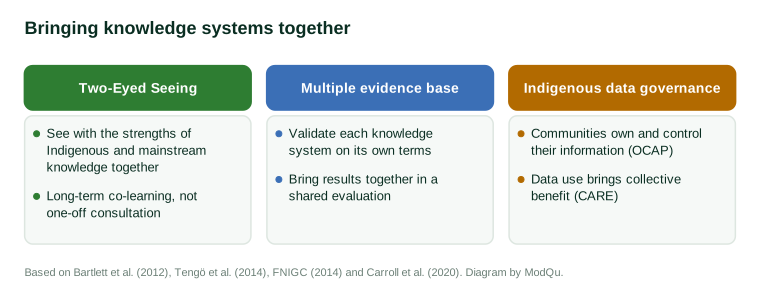
Two-Eyed Seeing. Mi'kmaw Elder Albert Marshall introduced the guiding principle Etuaptmumk, or Two-Eyed Seeing: learning to see with the strengths of Indigenous knowledge through one eye and the strengths of mainstream knowledge through the other, and using both eyes together. Bartlett et al. (2012) describe how the principle shaped an integrative science programme at Cape Breton University, emphasising co-learning over many years rather than one-off consultation.
The multiple evidence base. Tengö et al. (2014) proposed that knowledge systems be connected in parallel rather than merged. Each system is validated on its own terms, by its own criteria, and the results are then brought together in a shared evaluation. This avoids forcing local knowledge through scientific tests that it was never designed to pass, while still allowing comparison and synthesis.
Indigenous data governance. In Canada, the First Nations Information Governance Centre (2014) set out the OCAP principles of ownership, control, access and possession, which assert that First Nations communities own and control information about themselves. Carroll et al. (2020) proposed the CARE principles of collective benefit, authority to control, responsibility and ethics, designed to complement open-data principles so that data sharing serves Indigenous peoples' interests.
Practical principles
For any organisation designing an inquiry that involves Indigenous or local knowledge, the research suggests several principles:
- Involve knowledge holders from the start, in framing the question, not only in collecting data.
- Agree on ownership and use of information before it is gathered, following principles such as OCAP and CARE.
- Respect each knowledge system on its own terms, and avoid judging one solely by the standards of the other.
- Share benefits and results with the communities whose knowledge contributed.
- Allow time. Trust and co-learning develop over years, not weeks.
An example
The following example is hypothetical. A regional utility plans a study of how a river's flow and fish populations have changed, to inform the operation of a dam. Its consultants hold twenty years of gauge records and fish counts. A neighbouring First Nation holds knowledge, passed down over many generations, of spawning sites, past floods and changes in fish condition. In an extractive version of the study, the consultants would hold a single community meeting, record a few observations that fit their data categories and publish a report the community had not seen. In a collaborative version, community members help set the study's questions, decide with the utility how their knowledge will be recorded and used, and review the findings before release. The two bodies of evidence are analysed on their own terms and then compared. Where they agree, confidence grows; where they differ, the difference becomes a new question to investigate together, such as whether gauge stations missed changes in side channels that community members observed directly.
Brought together with care, different ways of knowing can produce a fuller understanding than either could alone. Brought together carelessly, they repeat old harms. The difference lies less in technique than in who decides, who benefits and whose standards count.
References
Agrawal, A. (1995). Dismantling the divide between indigenous and scientific knowledge. Development and Change, 26(3), 413–439. https://doi.org/10.1111/j.1467-7660.1995.tb00560.x
Bartlett, C., Marshall, M., & Marshall, A. (2012). Two-Eyed Seeing and other lessons learned within a co-learning journey of bringing together indigenous and mainstream knowledges and ways of knowing. Journal of Environmental Studies and Sciences, 2(4), 331–340. https://doi.org/10.1007/s13412-012-0086-8
Berkes, F. (2018). Sacred ecology (4th ed.). Routledge. https://doi.org/10.4324/9781315114644
Carroll, S. R., Garba, I., Figueroa-Rodríguez, O. L., Holbrook, J., Lovett, R., Materechera, S., Parsons, M., Raseroka, K., Rodriguez-Lonebear, D., Rowe, R., Sara, R., Walker, J. D., Anderson, J., & Hudson, M. (2020). The CARE principles for Indigenous data governance. Data Science Journal, 19, Article 43. https://doi.org/10.5334/dsj-2020-043
First Nations Information Governance Centre. (2014). Ownership, control, access and possession (OCAP™): The path to First Nations information governance. First Nations Information Governance Centre.
Huntington, H. P. (2000). Using traditional ecological knowledge in science: Methods and applications. Ecological Applications, 10(5), 1270–1274. https://doi.org/10.1890/1051-0761(2000)010[1270:UTEKIS]2.0.CO;2
Nadasdy, P. (1999). The politics of TEK: Power and the "integration" of knowledge. Arctic Anthropology, 36(1/2), 1–18.
Smith, L. T. (2012). Decolonizing methodologies: Research and Indigenous peoples (2nd ed.). Zed Books.
Tengö, M., Brondizio, E. S., Elmqvist, T., Malmer, P., & Spierenburg, M. (2014). Connecting diverse knowledge systems for enhanced ecosystem governance: The multiple evidence base approach. Ambio, 43(5), 579–591. https://doi.org/10.1007/s13280-014-0501-3
Wilson, S. (2008). Research is ceremony: Indigenous research methods. Fernwood Publishing.