
Inquiry · Ethics and limits
Inquiry into Values and Normative Knowledge Claims
Questions about what is good, right or fair cannot be answered by observation alone, yet they can be inquired into carefully. This article explains the difference between factual and normative claims, how philosophers and social scientists have studied values, what research shows about how moral judgments are formed and measured, and how organisations can reason well about questions of value.
Much inquiry asks what is the case: how many customers left, what caused a failure, which product sells best. But many of the most important questions ask what ought to be: whether a policy is fair, whether a business practice is acceptable, which of several goals should take priority, what a company owes its customers or employees. These are normative questions, and the claims that answer them are normative claims. They cannot be settled simply by collecting data, yet they are not beyond reasoned inquiry. Philosophers have debated their status for centuries, and social scientists have developed ways to study how people hold and form values. This article explains what is distinctive about inquiry into values, what can and cannot be established, and how to reason well when questions of value arise.
Facts, values and the gap between them
The Scottish philosopher David Hume (2000), writing in 1739–1740, observed that authors often move from statements about what is to statements about what ought to be without explaining how the second follows from the first. No set of purely factual premises, he suggested, logically entails a conclusion about what one ought to do. This observation, often called the is–ought gap, remains a starting point for discussions of normative knowledge.
G. E. Moore (1903) argued that goodness cannot be defined in terms of any natural property, such as pleasure or what people desire. For any such definition, he noted, it remains an open question whether that property is really good, which shows that the definition does not capture what "good" means. He called the attempt to define goodness in natural terms the naturalistic fallacy.
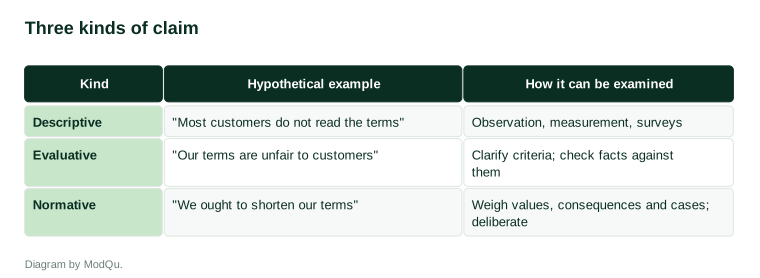
Figure 1 distinguishes three kinds of claim. Descriptive claims state what is the case. Evaluative claims judge something as good or bad, better or worse. Normative claims state what ought to be done. The kinds of evidence relevant to each differ.
Values in science
Max Weber (1949) argued that social science should be value-free in a specific sense: the researcher's own values should not determine the conclusions drawn from evidence, and empirical findings cannot by themselves tell people what they ought to value. Weber did not claim that values play no part in research. They inevitably guide the choice of questions, since researchers study what they consider significant. But once a question has been chosen, the answer should be determined by evidence that anyone could check, whatever their values.
Later philosophers questioned how sharply facts and values can be separated. Bernard Williams (1985) drew attention to thick ethical concepts, such as cruelty, courage, betrayal and honesty, which both describe and evaluate. To say that an act was cruel is to make a claim about what happened and to condemn it at the same time. Hilary Putnam (2002) argued that the existence of such concepts, and the role of values such as coherence and simplicity in scientific reasoning itself, shows that the fact–value dichotomy cannot be maintained in a strict form. Facts and values are entangled, even if they can be distinguished.
Can normative claims be known?
Philosophers disagree about whether normative claims can be true or false in the way that factual claims can. J. L. Mackie (1977) argued that ordinary moral judgments claim to be objectively true, but that there are no objective values for them to be true of, so that they are systematically mistaken, a position known as error theory. Many others have defended the view that some moral claims are objectively correct. Derek Parfit (2011) argued that the major ethical traditions, properly understood, converge more than is commonly thought, and that this convergence is evidence that ethical inquiry can make progress.
Whatever position one takes on these deep questions, there is wide agreement that normative claims can be examined rationally. They can be checked for consistency, tested against their consequences, compared with considered judgments about particular cases and discussed in ways that change minds for good reasons.
Methods of normative inquiry
Reflective equilibrium
John Rawls (1971) described a method of moral reasoning called reflective equilibrium. We begin with our considered judgments about particular cases, such as that it would be wrong to punish an innocent person to calm a crowd, and with general principles that might explain them. Where principles and judgments conflict, we revise one or the other, moving back and forth until they fit together coherently. Norman Daniels (1979) extended this to wide reflective equilibrium, which also brings in relevant background theories, including empirical knowledge about human nature and society. Figure 2 shows the process.
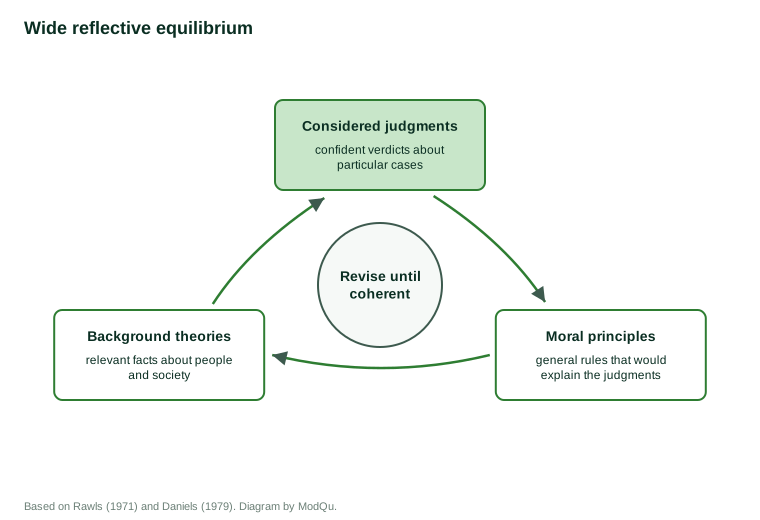
Reflective equilibrium resembles inquiry in other fields. Theories are tested against observations, and observations are sometimes reinterpreted in the light of well-supported theories. Neither side has absolute authority.
Inquiry into consequences
John Dewey (1939) argued that values are not fixed in advance but can be investigated like other matters of fact. When people value something, they adopt it as an end and choose means to reach it. Whether the means actually produce the end, and whether reaching the end produces the satisfactions expected, are questions that experience can answer. Value judgments can therefore be revised in the light of their consequences, much as hypotheses are revised in the light of evidence. Dewey did not claim that this settles every disagreement, but he showed that inquiry into values need not be mere assertion of preference.
Deliberation
Many normative questions concern how people should live together, and so they must be settled among people who disagree. Jürgen Habermas (1990) proposed that a moral norm is valid only if all those affected by it could accept it in a practical discourse free from coercion, in which the only force is that of the better argument. Amy Gutmann and Dennis Thompson (1996) developed a theory of deliberative democracy in which citizens and officials justify their positions to one another with reasons that others could accept, even when disagreement remains. Amartya Sen (2009) argued that reasoning about justice should focus on comparing realistic alternatives and removing clear injustices, rather than on identifying a perfectly just society, and that such reasoning should be open to the views of people outside one's own community.
Living with disagreement
Not every disagreement about values can be resolved, even by careful and honest reasoners. Rawls (1993) called this the fact of reasonable pluralism: in a free society, people exercising their reason in good faith will come to hold different comprehensive views about what makes life good. He attributed this partly to the burdens of judgment: evidence on value questions is often complex and conflicting, people weigh considerations differently, concepts are vague at the edges, and each person's judgment is shaped by their whole experience of life. Such disagreement is not a sign that someone has made an error.
Recognising reasonable pluralism changes the aim of normative inquiry in shared settings. Instead of seeking a single answer that everyone must accept for the same reasons, the aim may be an overlapping consensus: agreement on practical arrangements that people can endorse from within their different views. In organisations, this often means agreeing on a policy and the reasons that can be publicly stated for it, while accepting that colleagues may support it for somewhat different reasons of their own.
How people form moral judgments
Alongside philosophical inquiry, psychologists have studied how people actually make moral judgments. Lawrence Kohlberg (1981) proposed that moral reasoning develops through stages, from avoiding punishment to following conventions and, for some people, to reasoning from universal principles. Carol Gilligan (1982) criticised Kohlberg's account for neglecting an ethic of care, centred on relationships and responsibilities, which she argued was undervalued by his framework.
More recent research emphasises intuition. Jonathan Haidt (2001) proposed a social intuitionist model in which moral judgments are usually produced quickly by intuitions, with reasoning typically constructed afterwards to justify them. He reported cases of moral dumbfounding, in which people firmly condemned an act but could not give reasons that survived questioning. Greene et al. (2001) used brain imaging to study responses to moral dilemmas and found that dilemmas involving direct personal harm, such as pushing a person to their death to save others, engaged brain regions associated with emotion more than similar dilemmas involving impersonal harm.
Graham et al. (2009) found that people differ systematically in which moral concerns they emphasise. In their studies, people who described themselves as politically liberal placed most weight on care and fairness, while conservatives gave more evenly balanced weight to a wider set of concerns that also included loyalty, authority and purity. Philip Tetlock (2003) studied sacred values, values that people treat as beyond trade-off, and found that proposals to trade them against money or convenience provoke moral outrage, even when the trade-off would produce better outcomes. Peter Singer (1981) argued that over history, the range of beings whose interests people regard as morally important has tended to expand, from the family and tribe to the nation and humanity, and that reason has played a part in this expansion.
These findings have practical implications for inquiry into values. If moral judgments often arise as quick intuitions, then an argument that ignores those intuitions is unlikely to persuade, and a decision that violates them is likely to meet resistance whatever its justification. At the same time, intuitions can be inconsistent, shaped by framing and limited to people like ourselves. Good normative inquiry takes intuitions seriously as evidence about what people care about, while testing them against principles, consequences and the intuitions of others, much as reflective equilibrium recommends.
Measuring values
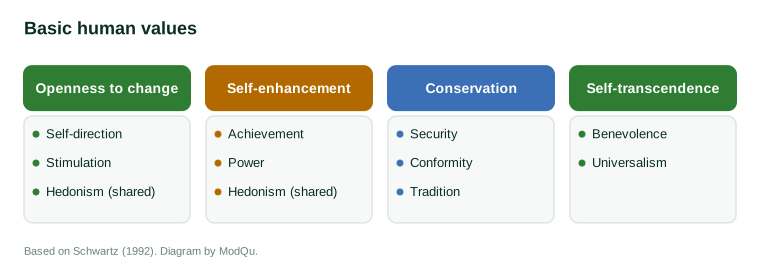
Social scientists have also developed ways to measure what people value. Milton Rokeach (1973) distinguished terminal values, desirable end states such as freedom or security, from instrumental values, desirable ways of behaving such as honesty or ambition, and asked people to rank lists of each. Shalom Schwartz (1992) identified ten basic human values, including security, achievement, benevolence and self-direction, and showed in samples from twenty countries that they formed a consistent circular structure: values next to each other in the circle tend to be pursued together, while values opposite each other tend to conflict. Figure 3 groups them into four higher-order types.
Ronald Inglehart and Christian Welzel (2005), drawing on decades of international survey data, found that values change systematically with economic development, with societies tending to move from an emphasis on survival and traditional authority towards an emphasis on self-expression and secular-rational values as prosperity and security grow.
Large-scale studies can also reveal both shared and diverse values. Awad et al. (2018) collected millions of decisions from people in 233 countries and territories about how self-driving cars should act in unavoidable accidents. Some preferences were widely shared, such as sparing humans over animals and sparing more lives rather than fewer, while others varied between cultural clusters.
Measurement has limits. Henrich et al. (2010) pointed out that much research in psychology has been conducted with participants from societies that are Western, educated, industrialised, rich and democratic, and that these populations are unusual in many respects, including some moral judgments. Claims about human values in general need samples that reflect human diversity.
Asking about values well
Surveys about values present particular challenges. When people are asked to rate the importance of a list of values one at a time, they tend to rate most of them as important, because most values are desirable in the abstract. Rokeach (1973) asked people to rank values instead, forcing them to express priorities. Modern approaches use ranking, forced choices between pairs, or questions about concrete trade-offs, such as whether a person would accept a higher price for a product made under better working conditions. Trade-off questions reveal priorities that simple ratings conceal, though they may still differ from what people do when they face the trade-off in reality.
Wording also matters more than usual. Value-laden words in a question, such as "fair", "natural" or "exploitative", can shift answers by signalling which response is approved. Neutral descriptions of the options, balanced statements of the arguments on each side and pre-testing with people who hold different views all help to make value questions measure the respondent's values rather than the researcher's.
Measuring values is not settling them
An important distinction runs through this research. Surveys can establish what people value, how strongly and how values differ between groups. They cannot by themselves establish what people ought to value. That 70% of people favour a policy is a fact about opinion, not a proof that the policy is right; majorities have supported practices that later generations judged deeply wrong. But measurement is far from irrelevant to normative inquiry. It shows where agreement already exists, where disagreements lie, which considerations people find compelling and how values relate to circumstances. Normative reasoning that ignores what people actually value, and why, is likely to be both mistaken and ineffective.
Values in the design of research
Values enter inquiry not only as its subject but in its design. Deciding what to measure, which outcomes count as success, whose views to include and how to report uncertainty are all choices that reflect judgments about what matters. A customer satisfaction study that surveys only current customers implicitly treats former customers' views as less important. A study of a new policy that measures average effects may overlook harms concentrated in a small group. Weber's (1949) insistence that values guide the choice of problems applies equally to the many smaller choices within a study.
Making these choices explicit is the best safeguard. A research plan can state which values shaped its design and why, so that readers can judge whether the study's conclusions depend on choices they would make differently.
Values in organisations
Organisations face normative questions constantly: how to treat customers fairly, what to disclose, how to balance profit against other goals, what to do when stakeholders disagree. The research suggests several practices for reasoning well about them.
- Separate the factual from the normative. Many disagreements that appear to be about values are partly about facts, such as the likely consequences of a decision. Investigating the facts can narrow the disagreement.
- Make values explicit. State which values are at stake and how they conflict, rather than leaving them implicit in a recommendation.
- Test principles against cases. Check whether a proposed rule gives acceptable answers in concrete situations, and revise it if it does not.
- Examine consequences. Track whether decisions made on the basis of values produce the outcomes they were meant to produce.
- Hear those affected. Include the views of people who will bear the consequences, and justify decisions with reasons they could accept.
- Measure, but do not mistake measurement for justification. Surveys of stakeholder values inform decisions; they do not make them.
Consider a hypothetical example. A company debates whether to use customer purchase data to set individual prices. The marketing team argues that it would increase revenue; the customer service team argues that it would be unfair. A facilitator separates the questions. Factual questions include how much revenue would change and how customers would react if they learned of the practice; a survey and a small trial can address these. Normative questions include whether charging different customers different prices for the same product is fair, and under what conditions. Testing principles against cases helps: most staff accept discounts for students and older customers, but reject charging more to customers whose data suggests they will not compare prices. The distinction they arrive at, between offering targeted discounts and exploiting a lack of information, becomes the basis of a policy that the company can explain to customers and defend. The company then repeats the customer survey a year later to check that customers understand the policy and regard it as fair, treating its normative conclusion, like any other, as open to revision in the light of experience.
Conclusion
Normative claims, about what is good, right or fair, differ from factual claims and cannot be settled by observation alone. Yet they can be examined with care: by testing principles against considered judgments, by investigating the consequences of acting on values, by deliberating with those affected and by drawing on research about how people actually form and hold their values. Philosophy and social science together show that inquiry into values is neither the simple measurement of opinion nor the mere assertion of preference, but a disciplined form of reasoning in its own right. For organisations, as for individuals, the questions of what ought to be done deserve the same rigour as the questions of what is.
References
Awad, E., Dsouza, S., Kim, R., Schulz, J., Henrich, J., Shariff, A., Bonnefon, J.-F., & Rahwan, I. (2018). The Moral Machine experiment. Nature, 563(7729), 59–64. https://doi.org/10.1038/s41586-018-0637-6
Daniels, N. (1979). Wide reflective equilibrium and theory acceptance in ethics. The Journal of Philosophy, 76(5), 256–282. https://doi.org/10.2307/2025881
Dewey, J. (1939). Theory of valuation. University of Chicago Press.
Gilligan, C. (1982). In a different voice: Psychological theory and women's development. Harvard University Press.
Graham, J., Haidt, J., & Nosek, B. A. (2009). Liberals and conservatives rely on different sets of moral foundations. Journal of Personality and Social Psychology, 96(5), 1029–1046. https://doi.org/10.1037/a0015141
Greene, J. D., Sommerville, R. B., Nystrom, L. E., Darley, J. M., & Cohen, J. D. (2001). An fMRI investigation of emotional engagement in moral judgment. Science, 293(5537), 2105–2108. https://doi.org/10.1126/science.1062872
Gutmann, A., & Thompson, D. (1996). Democracy and disagreement. Belknap Press of Harvard University Press.
Habermas, J. (1990). Moral consciousness and communicative action (C. Lenhardt & S. W. Nicholsen, Trans.). MIT Press.
Haidt, J. (2001). The emotional dog and its rational tail: A social intuitionist approach to moral judgment. Psychological Review, 108(4), 814–834. https://doi.org/10.1037/0033-295X.108.4.814
Henrich, J., Heine, S. J., & Norenzayan, A. (2010). The weirdest people in the world? Behavioral and Brain Sciences, 33(2–3), 61–83. https://doi.org/10.1017/S0140525X0999152X
Hume, D. (2000). A treatise of human nature (D. F. Norton & M. J. Norton, Eds.). Oxford University Press. (Original work published 1739–1740)
Inglehart, R., & Welzel, C. (2005). Modernization, cultural change, and democracy: The human development sequence. Cambridge University Press.
Kohlberg, L. (1981). Essays on moral development: Vol. 1. The philosophy of moral development. Harper & Row.
Mackie, J. L. (1977). Ethics: Inventing right and wrong. Penguin.
Moore, G. E. (1903). Principia ethica. Cambridge University Press.
Parfit, D. (2011). On what matters (Vols. 1–2). Oxford University Press.
Putnam, H. (2002). The collapse of the fact/value dichotomy and other essays. Harvard University Press.
Rawls, J. (1971). A theory of justice. Belknap Press of Harvard University Press.
Rawls, J. (1993). Political liberalism. Columbia University Press.
Rokeach, M. (1973). The nature of human values. Free Press.
Schwartz, S. H. (1992). Universals in the content and structure of values: Theoretical advances and empirical tests in 20 countries. Advances in Experimental Social Psychology, 25, 1–65. https://doi.org/10.1016/S0065-2601(08)60281-6
Sen, A. (2009). The idea of justice. Belknap Press of Harvard University Press.
Singer, P. (1981). The expanding circle: Ethics and sociobiology. Clarendon Press.
Tetlock, P. E. (2003). Thinking the unthinkable: Sacred values and taboo cognitions. Trends in Cognitive Sciences, 7(7), 320–324. https://doi.org/10.1016/S1364-6613(03)00135-9
Weber, M. (1949). The methodology of the social sciences (E. A. Shils & H. A. Finch, Eds. & Trans.). Free Press.
Williams, B. (1985). Ethics and the limits of philosophy. Harvard University Press.