
Inquiry · Philosophy of inquiry
Fallibilism: Holding Knowledge Open to Revision
Fallibilism is the view that any of our beliefs could turn out to be wrong, even the well-supported ones. This article explains where the idea comes from, the evidence that established knowledge is regularly revised, and how to hold conclusions firmly but open to correction.
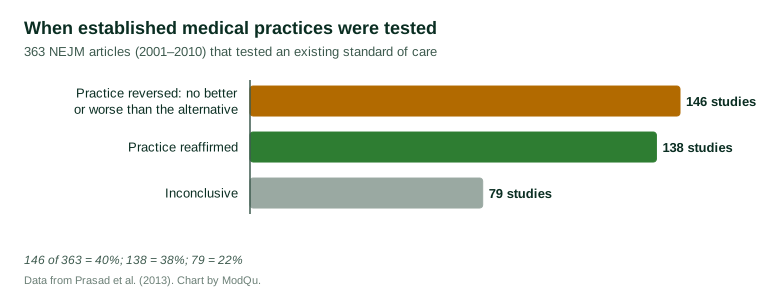
In 2013 a team of physicians reviewed ten years of articles in one of the world's leading medical journals. They looked for studies that tested a medical practice already in common use. Of 363 such studies, 146 found that the established practice was no better, or was worse, than a previous or lesser alternative (Prasad et al., 2013). In other words, about 40% of the tested practices that doctors were confidently using turned out to be mistaken. Results like this illustrate an idea that philosophers call fallibilism: the recognition that even our best-supported beliefs might be wrong.
What fallibilism claims
Fallibilism is the view that no belief about the world is immune from revision. It does not say that we know nothing, or that all beliefs are equally doubtful. It says that the justification we have for our beliefs, however strong, does not guarantee their truth, and that any belief might in principle be overturned by new evidence or better reasoning. Fallibilism is therefore distinct from scepticism, which denies that we have knowledge at all. A fallibilist can be highly confident and still accept that confidence is not certainty.
Origins: Peirce and Popper
The term was coined by Charles Sanders Peirce, who described his philosophy as having grown out of "contrite fallibilism, combined with a high faith in the reality of knowledge" (Peirce, 1931–1958, Vol. 1, para. 14). For Peirce, fallibilism followed from his view of inquiry. Since knowledge grows through a long, self-correcting process carried out by many inquirers, any present belief is a stage in that process, not its end. That is why he insisted on his "first rule of reason": never block the way of inquiry.
Karl Popper made fallibilism central to his philosophy of science. Scientific theories, he argued, can never be proved true by any number of confirming observations, but they can be shown false by a single well-established counterexample (Popper, 1959). Science advances by bold conjectures and attempted refutations, and the theories we accept are those that have so far survived serious testing (Popper, 1963). Even these remain provisional. An older parallel is John Stuart Mill's argument in On Liberty that we can never be sure an opinion we suppress is false, and that even true beliefs held without challenge become "dead dogma" (Mill, 1859).
The historical evidence
Fallibilism is supported by the history of knowledge itself. Thomas Kuhn (1962) showed that science has passed through revolutions in which established frameworks, such as Newtonian mechanics or the phlogiston theory of combustion, were replaced. Larry Laudan (1981) listed many theories that were successful in their day and are now regarded as false, arguing that past success is no guarantee of truth. Samuel Arbesman (2012) describes how facts in many fields have a measurable "half-life", as a share of what was once accepted is later revised.
Medicine offers the clearest modern evidence, because its claims are tested by controlled trials (Figure 1). Practices such as hormone replacement therapy for preventing heart disease and certain routine surgical procedures were widely recommended before trials showed they did not deliver the expected benefits (Prasad et al., 2013).
Two misunderstandings
Fallibilism is sometimes confused with two other attitudes that it does not support. The first is relativism, the idea that because no belief is certain, all beliefs are equally valid. Fallibilism implies the opposite: precisely because we can be wrong, it matters which beliefs have survived the most demanding tests, and some clearly have more support than others. The second is paralysis, the idea that we should not act until we are sure. Since certainty is not available, waiting for it means never acting. Peirce and Popper both held that we should act on our best-tested beliefs while continuing to test them, and that the readiness to revise is what makes it reasonable to act at all.
Fallibilism and good judgement
Fallibilism is not only a philosophical position; it is associated with better judgement. Philip Tetlock (2005) followed hundreds of experts making thousands of political and economic forecasts over many years. Those he called "hedgehogs", who knew one big thing and held it with confidence, forecast less accurately than "foxes", who drew on many ideas, expressed uncertainty and changed their minds when evidence changed. In later forecasting tournaments, Mellers et al. (2015) found that the most accurate forecasters scored high on open-mindedness and updated their estimates frequently in small steps.
Research on intellectual humility points the same way. Leary et al. (2017) found that people who recognise that their beliefs might be wrong evaluate the strength of arguments more accurately and are less hostile to people who disagree with them. Fallibilism, in other words, is a practical virtue as well as a theory of knowledge.
Holding knowledge open in practice
How can an organisation or a researcher act decisively while accepting that they might be wrong? Several habits help:
- Express confidence in degrees. Replace "we know" with statements of probability or strength of evidence. This makes revision easier when new evidence arrives.
- Name what would change your mind. Before adopting a conclusion, write down the evidence that would overturn it. This turns fallibilism from an attitude into a test.
- Keep records of reasoning. A decision recorded with its evidence can be revisited intelligently when circumstances change; a bare conclusion cannot.
- Revisit established assumptions on a schedule. The medical reversal research shows that standard practices can persist for years without being tested. Periodically testing what "everyone knows" is one of the most valuable things research can do.
Conclusion
Fallibilism asks for a combination that is psychologically difficult: enough confidence to act, and enough humility to keep checking. The history of science and medicine suggests that this combination is warranted. Much of what was once known with confidence has been revised, and some of what we now know will be too. The fallibilist response is not to stop believing but to keep inquiring, so that errors are found sooner rather than later.
References
Arbesman, S. (2012). The half-life of facts: Why everything we know has an expiration date. Current.
Kuhn, T. S. (1962). The structure of scientific revolutions. University of Chicago Press.
Laudan, L. (1981). A confutation of convergent realism. Philosophy of Science, 48(1), 19–49. https://doi.org/10.1086/288975
Leary, M. R., Diebels, K. J., Davisson, E. K., Jongman-Sereno, K. P., Isherwood, J. C., Raimi, K. T., Deffler, S. A., & Hoyle, R. H. (2017). Cognitive and interpersonal features of intellectual humility. Personality and Social Psychology Bulletin, 43(6), 793–813. https://doi.org/10.1177/0146167217697695
Mellers, B., Stone, E., Atanasov, P., Rohrbaugh, N., Metz, S. E., Ungar, L., Bishop, M. M., Horowitz, M., Merkle, E., & Tetlock, P. (2015). The psychology of intelligence analysis: Drivers of prediction accuracy in world politics. Journal of Experimental Psychology: Applied, 21(1), 1–14. https://doi.org/10.1037/xap0000040
Mill, J. S. (1859). On liberty. John W. Parker and Son.
Peirce, C. S. (1931–1958). Collected papers of Charles Sanders Peirce (C. Hartshorne, P. Weiss, & A. W. Burks, Eds.; Vols. 1–8). Harvard University Press.
Popper, K. R. (1959). The logic of scientific discovery. Hutchinson.
Popper, K. R. (1963). Conjectures and refutations: The growth of scientific knowledge. Routledge & Kegan Paul.
Prasad, V., Vandross, A., Toomey, C., Cheung, M., Rho, J., Quinn, S., Chacko, S. J., Borkar, D., Gall, V., Selvaraj, S., Ho, N., & Cifu, A. (2013). A decade of reversal: An analysis of 146 contradicted medical practices. Mayo Clinic Proceedings, 88(8), 790–798. https://doi.org/10.1016/j.mayocp.2013.05.012
Tetlock, P. E. (2005). Expert political judgment: How good is it? How can we know? Princeton University Press.