
Inquiry · Inquiry in practice
Embodied and Practice-Based Inquiry Approaches
Some knowledge is gained through the body and through doing rather than through reading or asking. This article explains embodied and practice-based inquiry, from the philosophy of embodied perception to apprenticeship, craft, practice-based research and prototyping, and what these approaches add to how organisations learn.
Much of what people know cannot be found in documents or surveys. A nurse senses that a patient is deteriorating before the monitors show it. An engineer hears that a machine is running badly. A designer understands a problem only after building a rough model and handling it. This knowledge is gained through the body and through practice, and it often resists being put into words. Embodied and practice-based inquiry are approaches that take such knowledge seriously, treating doing, making and sensing as legitimate ways of finding things out.
Knowing through the body
The philosopher Maurice Merleau-Ponty (2012), in work first published in 1945, argued that perception is not the passive reception of information by a mind, but an active engagement of a living body with its world. We understand a space by moving through it and a tool by using it. Francisco Varela, Evan Thompson and Eleanor Rosch (1991) brought this idea into cognitive science, proposing that cognition is enactive: it arises from the ongoing interaction between an organism and its environment, not from abstract representations alone. Margaret Wilson (2002) reviewed the claims of this embodied cognition research and distinguished several, including that cognition is situated in real environments, that people use the environment to reduce mental work, and that even abstract thought draws on bodily processes.
Experiments support some of these claims. David Kirsh and Paul Maglio (1994) studied players of a computer game in which falling shapes must be rotated to fit together. They found that skilled players often rotated pieces physically on the screen not to move them into place, but to see more quickly where they would fit. Kirsh and Maglio called these epistemic actions: actions taken to gain information rather than to change the world. Goldin-Meadow et al. (2001) found that people who were allowed to gesture while explaining how they had solved a mathematics problem remembered more from a separate memory task than those asked to keep their hands still, suggesting that gesture reduced the mental effort of explanation.
Tacit knowledge and expertise
Michael Polanyi (1966) argued that "we can know more than we can tell". A person can recognise a face among thousands without being able to say how. Much skilled knowledge is of this kind: tacit, held in perception and action, and learned through practice rather than instruction.
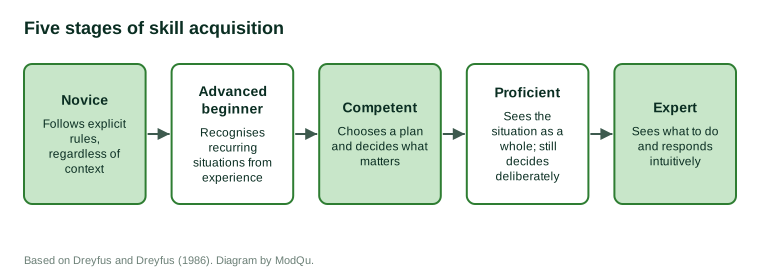
Hubert and Stuart Dreyfus (1986) described how expertise develops through five stages, shown in Figure 1. Novices follow explicit rules without regard to context. As they gain experience, they learn to recognise situations, to choose what matters and finally, as experts, to respond intuitively to the whole situation without consciously applying rules. On this account, expertise is not a large store of rules but a refined capacity to perceive and respond, built through embodied experience.
Charles Goodwin (1994) showed that this kind of perception is learned within professions. Studying archaeologists classifying soil colours and lawyers analysing video evidence, he described professional vision: socially organised ways of seeing that members of a profession acquire, which allow them to notice and interpret features that others miss.
Learning through participation
If much expertise is tacit, it must be learned largely by doing alongside those who have it. Jean Lave and Etienne Wenger (1991) studied apprenticeships among tailors, midwives, butchers and others, and described learning as legitimate peripheral participation: newcomers begin with simple but genuine tasks at the edge of a community of practice and gradually move towards full participation. Learning is not the transfer of information from master to apprentice, but a change in how the learner takes part in the community's work.
The sociologist Richard Sennett (2008) examined craft work, from medieval workshops to modern software development, and argued that the craftsman's knowledge develops through a continual dialogue between hand and head. Making something well involves repeated practice, attention to resistance and ambiguity in materials, and the gradual development of judgment. Tim Ingold (2013) similarly describes making as a process of thinking through making, in which the maker follows and responds to the materials rather than imposing a form planned in advance.
Some researchers have used their own bodies as instruments of inquiry. Loïc Wacquant (2004) trained for three years as a boxer in a Chicago gym to understand the social world of boxing from the inside. He argued that the knowledge of boxing is acquired through the body, by sparring and training, and could not have been learned by interview alone.
Practice-based research
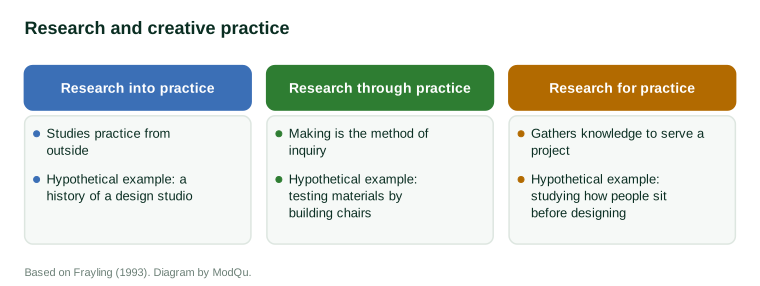
In art and design, practice-based research treats the making of works as a method of inquiry. Christopher Frayling (1993) distinguished three relationships between research and creative practice: research into art and design, such as historical study; research through art and design, in which making is the means of inquiry; and research for art and design, which serves the practice. Linda Candy and Ernest Edmonds (2018) describe how practice-based research has developed into a recognised approach in which the creative work and a reflective account of its making together contribute new knowledge. Figure 2 summarises Frayling's distinction.
Prototyping as embodied inquiry
In product and service design, the same ideas appear in the practice of prototyping. Tim Brown (2008) described design thinking as an approach in which designers build quick, rough prototypes early and often, learning from how people interact with them. A prototype is a question in physical form: it allows a team to discover what works by trying it, rather than by discussing it. Klemmer et al. (2006) argued that interaction design should take account of how people think with their bodies and hands, since physical engagement with objects supports understanding, learning and the exploration of ideas.
Consider a hypothetical example. A company designing a new checkout process for its shops asks customers in a survey what they want, and they request speed. The design team then builds a rough mock-up from cardboard in an empty room and asks staff and customers to act out checkouts. Within an hour it becomes clear that the real problem is where people put their bags while paying, a detail nobody mentioned in the survey because it was too ordinary to recall. The physical rehearsal revealed knowledge that questioning had not.
Donald Schön (1983) described this kind of learning as reflection-in-action. A practitioner acts, notices that the situation responds unexpectedly, and adjusts their understanding on the spot. Schön called it a "conversation with the situation". Practice-based inquiry makes this conversation deliberate and records what it reveals.
Making tacit knowledge visible
If embodied knowledge is hard to put into words, how can an inquiry capture it? Several methods have been developed for this purpose. In think-aloud studies, people describe what they are thinking while they perform a task, rather than explaining it afterwards. K. Anders Ericsson and Herbert Simon (1993) showed that such concurrent reports, collected carefully, provide valid evidence about the steps of a person's thinking, whereas explanations given later are more likely to be reconstructed or rationalised.
Cognitive task analysis goes further. Beth Crandall, Gary Klein and Robert Hoffman (2006) describe methods for eliciting the knowledge that experts use in demanding situations, such as asking them to walk through a specific challenging incident step by step, noting what cues they noticed, what options they considered and what they expected to happen. Experienced firefighters, nurses and pilots often cannot state general rules for what they do, but they can describe in detail what they saw and did on a particular occasion, and from many such accounts the underlying expertise can be reconstructed.
Video recording, combined with review sessions in which practitioners watch themselves at work and comment on what they were attending to, offers another route. So does working alongside practitioners for a period, as an apprentice would. Each method trades some precision for access to knowledge that would otherwise stay hidden.
Strengths and limits
Embodied and practice-based approaches give access to knowledge that other methods miss: tacit skill, the feel of materials, the ordinary details of real use. They are also well suited to the early stages of inquiry, when the right questions are not yet clear. Their limits lie in generalisation and communication. Knowledge held in one person's body or one team's practice may not transfer, and it can be hard to evaluate claims that are difficult to put into words. Careful documentation, reflection and comparison with other methods help address these limits.
Implications for organisations
Organisations that rely only on reports, surveys and data risk overlooking what their most experienced people know but cannot easily say. Some practical steps follow. Pair newcomers with experienced staff on real tasks. Observe work as it is done, not only as it is described. Build rough prototypes early and test them with real users. Ask experienced staff to talk through what they notice while they work, and record it. Treat the workplace itself as a source of evidence: the workarounds staff have invented, the notes taped to machines and the shortcuts worn into floors all record practical knowledge that no one has written down. Embodied knowledge is not a substitute for systematic evidence, but systematic inquiry is incomplete without it.
References
Brown, T. (2008). Design thinking. Harvard Business Review, 86(6), 84–92.
Candy, L., & Edmonds, E. (2018). Practice-based research in the creative arts: Foundations and futures from the front line. Leonardo, 51(1), 63–69. https://doi.org/10.1162/LEON_a_01471
Crandall, B., Klein, G., & Hoffman, R. R. (2006). Working minds: A practitioner's guide to cognitive task analysis. MIT Press.
Dreyfus, H. L., & Dreyfus, S. E. (1986). Mind over machine: The power of human intuition and expertise in the era of the computer. Free Press.
Ericsson, K. A., & Simon, H. A. (1993). Protocol analysis: Verbal reports as data (Rev. ed.). MIT Press.
Frayling, C. (1993). Research in art and design. Royal College of Art Research Papers, 1(1), 1–5.
Goldin-Meadow, S., Nusbaum, H., Kelly, S. D., & Wagner, S. (2001). Explaining math: Gesturing lightens the load. Psychological Science, 12(6), 516–522. https://doi.org/10.1111/1467-9280.00395
Goodwin, C. (1994). Professional vision. American Anthropologist, 96(3), 606–633. https://doi.org/10.1525/aa.1994.96.3.02a00100
Ingold, T. (2013). Making: Anthropology, archaeology, art and architecture. Routledge.
Kirsh, D., & Maglio, P. (1994). On distinguishing epistemic from pragmatic action. Cognitive Science, 18(4), 513–549. https://doi.org/10.1207/s15516709cog1804_1
Klemmer, S. R., Hartmann, B., & Takayama, L. (2006). How bodies matter: Five themes for interaction design. In Proceedings of the 6th Conference on Designing Interactive Systems (pp. 140–149). Association for Computing Machinery. https://doi.org/10.1145/1142405.1142429
Lave, J., & Wenger, E. (1991). Situated learning: Legitimate peripheral participation. Cambridge University Press.
Merleau-Ponty, M. (2012). Phenomenology of perception (D. A. Landes, Trans.). Routledge. (Original work published 1945)
Polanyi, M. (1966). The tacit dimension. Doubleday.
Schön, D. A. (1983). The reflective practitioner: How professionals think in action. Basic Books.
Sennett, R. (2008). The craftsman. Yale University Press.
Varela, F. J., Thompson, E., & Rosch, E. (1991). The embodied mind: Cognitive science and human experience. MIT Press.
Wacquant, L. (2004). Body and soul: Notebooks of an apprentice boxer. Oxford University Press.
Wilson, M. (2002). Six views of embodied cognition. Psychonomic Bulletin & Review, 9(4), 625–636. https://doi.org/10.3758/BF03196322