
Inquiry · Philosophy of inquiry
Critical Inquiry: Examining Power, Evidence, and Taken-for-Granted Claims
Critical inquiry asks not only whether a claim is supported by evidence but whose interests it serves, how the problem has been framed and what is being taken for granted. This article explains its roots, its methods and how to apply it to research and business claims.
Ordinary inquiry asks whether a claim is true. Critical inquiry asks additional questions: why is this claim being made, by whom and for whom? How has the problem been framed, and what alternatives does that framing hide? What is being taken for granted? These questions come from several traditions, including critical theory in philosophy and sociology, critical pedagogy in education and the critical thinking movement in psychology. Together they form a style of inquiry that examines evidence, power and assumptions at the same time. This article sets out where critical inquiry comes from, what it involves and how it can be applied without sliding into cynicism.
Two meanings of "critical"
The word "critical" is used in two related ways. In the critical thinking tradition, it means careful evaluation of reasons and evidence. A panel of experts convened by the American Philosophical Association described critical thinking as purposeful, self-regulatory judgement that results in interpretation, analysis, evaluation and inference, together with explanation of the evidential, conceptual and methodological considerations on which the judgement is based (Facione, 1990). Stephen Toulmin's (1958) model of argument, which separates a claim from its data, the warrant connecting them and the qualifications that limit it, became a standard tool for this kind of evaluation.
In the critical theory tradition, "critical" means something broader: questioning the social conditions that shape knowledge itself. Critical inquiry in the sense of this article draws on both meanings. It evaluates evidence carefully, and it also asks how social position, interest and power affect what counts as evidence and which questions get asked.
Roots in critical theory
In 1937 the philosopher Max Horkheimer, director of the Institute for Social Research in Frankfurt, distinguished "traditional" from "critical" theory (Horkheimer, 1937/1972). Traditional theory, modelled on natural science, describes the world as it is and treats its own concepts as neutral. Critical theory recognises that social knowledge is produced within a particular society, shaped by its arrangements of power and interest, and it aims not only to describe that society but to help change it for the better.
Jürgen Habermas (1971) developed this idea into a theory of knowledge-constitutive interests. Different kinds of inquiry, he argued, serve different human interests: the empirical sciences serve an interest in prediction and control, the interpretive disciplines an interest in mutual understanding, and critical inquiry an emancipatory interest in freeing people from constraints they do not recognise. Michel Foucault (1977) approached the same theme differently, tracing how knowledge and power are intertwined in institutions such as prisons, hospitals and schools, where systems of classification and examination shape how people are seen and how they see themselves.
Earlier, C. Wright Mills (1959) had called for a "sociological imagination": the ability to see how personal troubles, such as unemployment, are connected to public issues, such as the structure of the economy. Seeing that connection is itself a form of critical inquiry, because it questions the taken-for-granted assumption that individual problems have only individual causes.
Critical pedagogy and reflection
In education, the Brazilian educator Paulo Freire (1970) criticised "banking" education, in which teachers deposit information into passive students, and proposed instead a "problem-posing" education in which learners examine the conditions of their own lives. Freire's term conscientização, usually translated as critical consciousness, describes learning to perceive social and economic contradictions and to act against them.
Later writers adapted these ideas to professional and adult learning. Jack Mezirow (1991) described transformative learning as the process by which adults critically examine the assumptions behind their beliefs and revise them. Stephen Brookfield (1995) urged teachers to identify and test their assumptions by viewing their practice through several "lenses": their own autobiography, their students' eyes, colleagues' perceptions and theoretical literature. These approaches turn critical inquiry inwards, towards the inquirer's own taken-for-granted beliefs.
Methods of critical inquiry
Critical inquiry has produced several methods that researchers can use.
Critical discourse analysis examines how language in texts, such as news reports, policy documents and advertising, constructs particular views of the world and supports particular relations of power. Norman Fairclough (1995) showed how choices of vocabulary, grammar and framing can present contested positions as common sense.
Problem-representation analysis examines how policies define the problems they claim to solve. Carol Bacchi (2009) proposed a set of questions, beginning with "What's the problem represented to be?" A policy that treats youth unemployment as a problem of young people's skills implies different solutions from one that treats it as a problem of employer demand. Asking how the problem has been represented, what assumptions underlie the representation and what it leaves unproblematic reveals choices that the policy presents as obvious.
Analysis of interests and power. Steven Lukes (2005) argued that power has three dimensions: winning open conflicts, keeping issues off the agenda, and shaping people's preferences so that conflicts do not arise at all. Critical inquiry pays attention to all three, asking not only who won a decision but which options were never considered.
Analysis of social construction. Many categories that seem natural are products of social processes (Berger & Luckmann, 1966). Ian Hacking (1999) argued that the useful question is not whether something is "socially constructed" in general but what, exactly, is constructed, how and with what effects, since a classification can change the behaviour of the people it classifies.
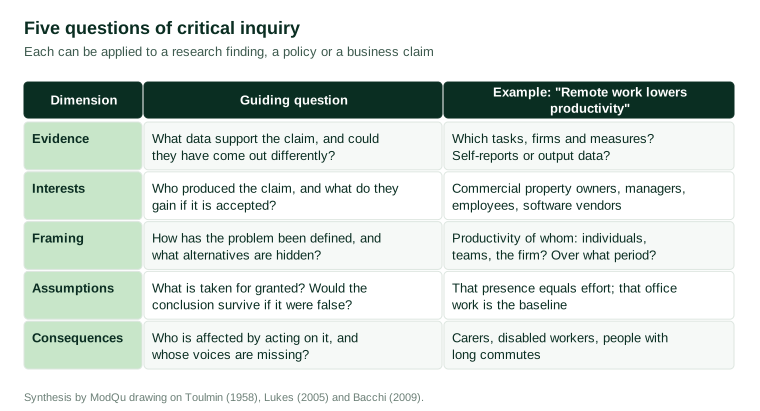
Figure 1 brings these strands together as a set of questions that can be put to any claim.
Why interests matter: the evidence
Critical inquiry's attention to interests is not a matter of political preference; it is supported by evidence about how research is actually produced. A Cochrane systematic review found that drug and device studies sponsored by manufacturers more often reported favourable efficacy results and conclusions than studies with other sources of funding, even when the risk of bias in their methods was similar (Lundh et al., 2017). An earlier review had reached similar conclusions (Lexchin et al., 2003). Naomi Oreskes and Erik Conway (2010) documented how a small number of scientists, working with industry, manufactured public doubt about the harms of tobacco smoke and the reality of climate change, despite the state of the evidence.
Interests also act on audiences. Dan Kahan (2013) found that people with higher scores on a test of reflective thinking were more, not less, likely to interpret evidence in line with their political identity. Being skilled at reasoning does not protect people from motivated interpretation; it can make them better at it. Critical inquiry therefore has to be applied to the inquirer's own conclusions as well as to other people's.
A worked example
Consider a hypothetical but typical industry report concluding that "customers prefer chatbots to human agents". Critical inquiry begins with the evidence. The report is based on an online survey of a vendor's own customers, a group already using chatbots, and the headline figure comes from a question asking whether respondents "would be happy to use a chatbot for simple queries". That is a much narrower claim than the headline suggests.
The question of interests follows naturally: the report was published by a company that sells chatbot software. That does not make the finding false, but it explains why the headline was phrased broadly and why no independent study is cited. The framing deserves attention too. The report treats the choice as chatbot versus human, when many customers might prefer a chatbot that hands over quickly to a human when needed. The assumption that customers' stated preferences for simple queries apply to complex or emotional ones is never tested. And the consequences of acting on the claim fall unevenly: older customers and those with complex problems are the ones most likely to be poorly served if human support is cut.
None of these observations proves the report wrong. Together they turn a confident headline into a set of specific questions that an organisation could answer with its own data before making a decision.
Critical inquiry without cynicism
Critical inquiry can be misused. Asking "who benefits?" is a valuable question, but it is not a refutation. A claim made by an interested party may still be true, and a claim made by a disinterested one may be false. The genetic fallacy, judging a claim by its source rather than its merits, is a constant temptation. A purely suspicious stance can also become a way of avoiding evidence altogether, dismissing every inconvenient finding as the product of someone's agenda.
The remedy is to keep the two meanings of "critical" together. Attention to interests and framing should lead to closer examination of evidence, not to its dismissal. If a study was funded by a party with a stake in its outcome, the critical response is to check its methods, look for independent replication and examine what was not reported, not simply to discard it. Ioannidis (2005) argued that financial and other interests are one of several factors, alongside small samples and flexible analyses, that make published findings less likely to be true; each factor calls for scrutiny, not automatic rejection.
Applying critical inquiry in organisations
Businesses encounter claims every day that benefit from critical inquiry: vendor case studies, industry reports, consultants' benchmarks and internal proposals. A short routine helps:
- Evidence. What data support the claim? How were they collected, and could they have come out differently?
- Interests. Who produced the claim, and what do they gain if it is accepted? Has anyone without that interest checked it?
- Framing. How has the problem been defined? What other definitions are possible, and what solutions would they suggest?
- Assumptions. What is being taken for granted? Would the conclusion survive if that assumption were false?
- Consequences. Who is affected by acting on the claim, and whose voices are missing from the discussion?
The same routine applies to one's own research. A survey questionnaire frames issues through its choice of questions and answer categories; a report frames findings through its headlines. Asking how a different researcher, or a different stakeholder, would have framed the same inquiry is a powerful check on blind spots.
Conclusion
Critical inquiry extends ordinary inquiry by asking how knowledge is shaped by the circumstances of its production: who asks, who benefits, how problems are framed and what is assumed. Its roots lie in critical theory, critical pedagogy and the study of argument, and its relevance is confirmed by evidence on how funding, framing and identity influence research and its reception. Applied with discipline, it does not replace careful evaluation of evidence. It makes that evaluation more complete.
References
Bacchi, C. (2009). Analysing policy: What's the problem represented to be? Pearson Australia.
Berger, P. L., & Luckmann, T. (1966). The social construction of reality: A treatise in the sociology of knowledge. Doubleday.
Brookfield, S. D. (1995). Becoming a critically reflective teacher. Jossey-Bass.
Facione, P. A. (1990). Critical thinking: A statement of expert consensus for purposes of educational assessment and instruction. California Academic Press.
Fairclough, N. (1995). Critical discourse analysis: The critical study of language. Longman.
Foucault, M. (1977). Discipline and punish: The birth of the prison (A. Sheridan, Trans.). Pantheon Books.
Freire, P. (1970). Pedagogy of the oppressed (M. B. Ramos, Trans.). Herder and Herder.
Habermas, J. (1971). Knowledge and human interests (J. J. Shapiro, Trans.). Beacon Press.
Hacking, I. (1999). The social construction of what? Harvard University Press.
Horkheimer, M. (1972). Traditional and critical theory. In Critical theory: Selected essays (M. J. O'Connell et al., Trans.; pp. 188–243). Herder and Herder. (Original work published 1937)
Ioannidis, J. P. A. (2005). Why most published research findings are false. PLoS Medicine, 2(8), Article e124. https://doi.org/10.1371/journal.pmed.0020124
Kahan, D. M. (2013). Ideology, motivated reasoning, and cognitive reflection. Judgment and Decision Making, 8(4), 407–424. https://doi.org/10.1017/S1930297500005271
Lexchin, J., Bero, L. A., Djulbegovic, B., & Clark, O. (2003). Pharmaceutical industry sponsorship and research outcome and quality: Systematic review. BMJ, 326(7400), 1167–1170. https://doi.org/10.1136/bmj.326.7400.1167
Lukes, S. (2005). Power: A radical view (2nd ed.). Palgrave Macmillan.
Lundh, A., Lexchin, J., Mintzes, B., Schroll, J. B., & Bero, L. (2017). Industry sponsorship and research outcome. Cochrane Database of Systematic Reviews, 2017(2), Article MR000033. https://doi.org/10.1002/14651858.MR000033.pub3
Mezirow, J. (1991). Transformative dimensions of adult learning. Jossey-Bass.
Mills, C. W. (1959). The sociological imagination. Oxford University Press.
Oreskes, N., & Conway, E. M. (2010). Merchants of doubt: How a handful of scientists obscured the truth on issues from tobacco smoke to global warming. Bloomsbury Press.
Toulmin, S. (1958). The uses of argument. Cambridge University Press.