
Inquiry · Public and formal inquiry
Commissions of Inquiry and Truth Commissions
Commissions of inquiry investigate disasters and failures; truth commissions examine past abuses so that societies can acknowledge and move beyond them. This article explains how each works, what they have achieved and what limits their impact.
When a disaster, scandal or period of abuse shakes public trust, governments often respond by appointing a commission: an independent body with the task of finding out what happened, why, and what should change. Commissions are among the most visible forms of public inquiry. Two broad types can be distinguished, as Figure 1 shows: commissions of inquiry, which examine specific events or policy failures, and truth commissions, which examine patterns of abuse during conflict or repression.
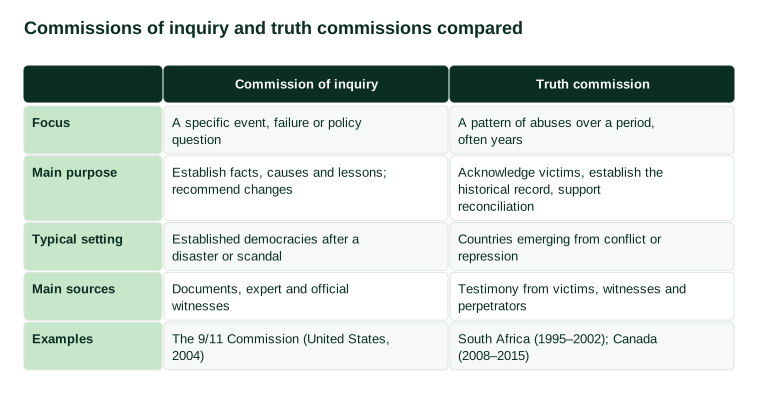
Commissions of inquiry
A commission of inquiry is usually appointed by a government and given terms of reference, powers to obtain documents and testimony, and a deadline for its report. Its strength lies in independence and thoroughness. The National Commission on Terrorist Attacks upon the United States (2004), known as the 9/11 Commission, reviewed millions of pages of documents and interviewed more than a thousand people before concluding that the attacks revealed failures of imagination, policy, capability and management across government. Its recommendations led to a major reorganisation of the United States intelligence services, including the creation of a single office to coordinate them. The report was also published as a book and read widely, showing that a commission can inform the public as well as the government.
Commissions do not always lead to change. Inwood and Johns (2014) compared commissions in several countries and found that their influence on policy depended on factors such as timing, political support and whether their recommendations fitted the priorities of the government of the day. Manson and Mullan (2003) collected Canadian assessments of commissions, which praised their ability to establish facts and educate the public while noting their cost, length and occasional use by governments to delay action.
How a commission works
Although procedures vary, most commissions follow a similar sequence. The appointing authority sets terms of reference that define the questions to be answered, and these terms shape everything that follows: a narrow mandate may exclude the most important causes. The commission then gathers evidence, often holding public hearings at which witnesses give testimony and may be questioned. It commissions research, visits affected places and invites written submissions from the public. Finally, it deliberates and publishes a report setting out its findings of fact, its conclusions about causes and responsibility, and its recommendations. Many commissions balance two aims that can pull against each other: establishing facts rigorously and giving affected people a public voice.
Truth commissions
Truth commissions examine human rights abuses, usually after a transition from conflict or authoritarian rule. Priscilla Hayner (2011) identified more than 40 such commissions and described their main purposes: to establish an authoritative record of what happened, to give victims a voice, to recommend reforms and reparations, and to support reconciliation. The South African Truth and Reconciliation Commission, which offered amnesty to perpetrators in exchange for full disclosure, is the best known. The Truth and Reconciliation Commission of Canada (2015) documented the experiences of Indigenous children in residential schools and issued 94 calls to action.
Evidence on their effects is mixed. James Gibson (2004) surveyed South Africans and found that people who accepted the commission's account of the past were more likely to hold reconciled attitudes, although causation is hard to establish. Critics have pointed out that many victims felt the process favoured perpetrators, who could receive amnesty, while reparations to victims were delayed and smaller than recommended. Such criticisms show that a commission's public account of the past can be valued even when its other promises are only partly kept. Eric Brahm (2007) argued that claims about truth commissions' effects often go beyond the evidence, and that success should be judged against realistic goals. Olsen et al. (2010) compared transitional justice measures across countries and found that truth commissions alone were not associated with improvements in human rights, but that they were when combined with trials and amnesties.
What makes commissions effective
Several conditions recur in successful commissions: genuine independence from those being investigated, adequate powers and resources, a clear mandate, a transparent process and a commitment by government to respond publicly to recommendations. Commissions also need time, but not unlimited time: an inquiry that takes many years may report after public attention, and the political will to act, have moved on. Onur Bakiner (2016) found that truth commissions gained influence when civil society groups continued to press for their recommendations after the report was published.
Lessons for organisational inquiry
The experience of commissions offers lessons for any organisation investigating its own failures. Independence matters: an inquiry run by those whose decisions are under examination will struggle to be believed, however careful it is. The terms of reference should be wide enough to reach underlying causes, not only the immediate failure. Listening to those affected, such as customers or front-line staff, adds knowledge that documents do not contain and builds trust in the findings. Above all, an inquiry has value only if its recommendations are acted on and the response is made public. Commissions whose reports were shelved show how quickly the work of establishing what went wrong can be wasted.
References
Bakiner, O. (2016). Truth commissions: Memory, power, and legitimacy. University of Pennsylvania Press.
Brahm, E. (2007). Uncovering the truth: Examining truth commission success and impact. International Studies Perspectives, 8(1), 16–35. https://doi.org/10.1111/j.1528-3585.2007.00267.x
Gibson, J. L. (2004). Overcoming apartheid: Can truth reconcile a divided nation? Russell Sage Foundation.
Hayner, P. B. (2011). Unspeakable truths: Transitional justice and the challenge of truth commissions (2nd ed.). Routledge.
Inwood, G. J., & Johns, C. M. (Eds.). (2014). Commissions of inquiry and policy change: A comparative analysis. University of Toronto Press.
Manson, A., & Mullan, D. (Eds.). (2003). Commissions of inquiry: Praise or reappraise? Irwin Law.
National Commission on Terrorist Attacks upon the United States. (2004). The 9/11 Commission report. W. W. Norton.
Olsen, T. D., Payne, L. A., & Reiter, A. G. (2010). Transitional justice in balance: Comparing processes, weighing efficacy. United States Institute of Peace Press.
Truth and Reconciliation Commission of Canada. (2015). Honouring the truth, reconciling for the future: Summary of the final report of the Truth and Reconciliation Commission of Canada. Truth and Reconciliation Commission of Canada.