
The Generation of Knowledge · History of knowledge
The Rise of the Research University
How the university changed from a place that transmitted established learning into an engine of new knowledge, from Berlin in 1810 to the American graduate school and the post-war research system, and what that model means today.
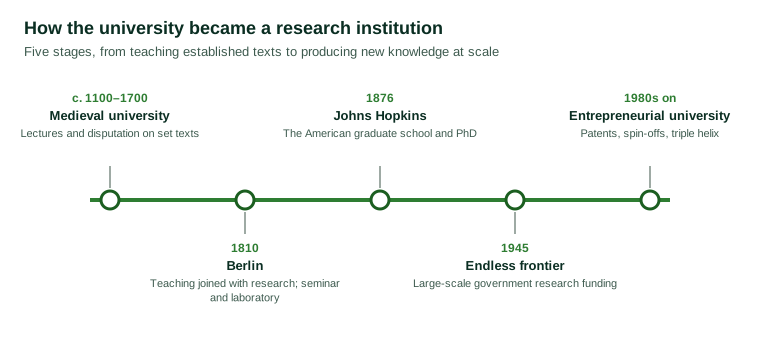
For most of their history, universities taught knowledge more than they created it. Medieval universities trained clergy, lawyers and physicians through lectures on authoritative texts and formal disputations. Much of the new science of the seventeenth century took place outside them, in academies, private laboratories and correspondence networks. Only in the nineteenth century did the university become the main home of original research. That change created the institution that dominates knowledge production today: the research university.
Berlin and the Humboldtian ideal
The University of Berlin, founded in 1810, is usually taken as the starting point. Its design is associated with the Prussian official and scholar Wilhelm von Humboldt, who wrote that higher institutions of learning should treat knowledge as a problem that is never completely solved, and should therefore combine teaching with continual inquiry (Humboldt, 1970). Professors were to be researchers, and students were to learn by taking part in the search for new knowledge.
The ideal was put into practice through new forms of teaching. The seminar trained advanced students to criticise sources and produce original work; the laboratory did the same for the experimental sciences. Turner (1971) showed that research became an expected part of a Prussian professor's career only gradually, between about 1818 and 1848, as appointments and promotions came to depend on published work. Clark (2006) traces how the modern academic's prestige, based on original research and publications, emerged from these German practices.
Historians now treat the "Humboldtian model" partly as a myth. Ash (2006) argues that Humboldt's memorandum was little known until the twentieth century, and that the idea of a single Humboldtian model was largely constructed later to defend particular visions of the university. The German research university was the product of many reforms and competitive pressures, not one man's plan.
Competition and the spread of research
Ben-David (1971) explained the success of German universities partly through competition. Germany was divided into many states, each with its own universities, and they competed for the best professors. Universities that hired productive researchers gained prestige, so research became a route to advancement. By the late nineteenth century, German universities led the world in many sciences, and students came from across Europe and North America to study in their seminars and laboratories.
The American graduate school
American reformers adapted the German model. Johns Hopkins University, founded in 1876, was the first American university organised mainly around graduate education and research. Veysey (1965) describes how American universities combined research with older ideals of practical service and liberal education, producing a distinctive and sometimes uneasy mixture. Geiger (1986) traces how, between 1900 and 1940, a small group of American universities built the departments, graduate schools and funding relationships with foundations that made them leading research institutions.
The post-war research system
The Second World War transformed the scale of university research. Vannevar Bush's report Science, the Endless Frontier argued that basic research in universities was the source of new knowledge on which national health, prosperity and security depended, and that government should fund it (Bush, 1945). Federal funding for university research grew enormously in the following decades. Kerr (1963) described the result as the "multiversity": a large, complex institution serving many purposes and many sponsors, from undergraduate teaching to government-funded laboratories.
More recently, universities have been drawn into closer relationships with industry and government. Etzkowitz and Leydesdorff (2000) described a "triple helix" in which universities, industry and government interact in producing and applying knowledge, and in which universities take on an entrepreneurial role through patents, spin-off companies and partnerships.
Disciplines and specialisation
The research university also created the modern academic discipline. As research became the basis of academic careers, knowledge was divided into specialised fields, each with its own departments, professional associations, journals and doctoral programmes. Ben-David (1971) argued that this specialisation was a source of productivity: a specialist community could set clear standards, recognise significant contributions and train new members efficiently. Many of the social sciences on which modern survey and market research rely, including statistics, economics, sociology and psychology, took their academic form in research universities between about 1870 and 1930.
Tensions in the model
The research university has always carried tensions. The first is between teaching and research. Humboldt's ideal held that the two strengthen each other, but in practice research often brings more prestige, and teaching can be neglected. The second is between curiosity and use. Bush (1945) defended basic research driven by curiosity, while governments and companies increasingly expect universities to deliver practical results. The third is between openness and ownership. The scientific ideal of publishing everything openly sits uneasily with patents, confidential industry contracts and commercial spin-offs, a tension that Etzkowitz and Leydesdorff (2000) acknowledge in their account of the entrepreneurial university.
A further concern is the pressure to publish. When careers depend on the number of publications, researchers may be tempted to divide work into many small papers or to report only positive results. These pressures, often summed up as "publish or perish", are one reason why concerns about the reliability of published research have grown.
What the research university contributes
The research university's distinctive contribution is the combination of training and discovery. Each generation of researchers learns by doing research under the supervision of the previous one, so the skills and tacit knowledge needed to produce new knowledge are passed on. The doctorate, the peer-reviewed publication and the academic career built on research are its central institutions.
For organisations outside universities, including research firms, the model offers two lessons. Knowledge production depends on training people through supervised practice, not only on hiring them. And reputations built on published, scrutinised work are a powerful incentive for quality. Universities also remain the main source of the methods, from sampling theory to statistical modelling, on which applied research depends.
References
Ash, M. G. (2006). Bachelor of what, master of whom? The Humboldt myth and historical transformations of higher education in German-speaking Europe and the US. European Journal of Education, 41(2), 245–267. https://doi.org/10.1111/j.1465-3435.2006.00258.x
Ben-David, J. (1971). The scientist's role in society: A comparative study. Prentice-Hall.
Bush, V. (1945). Science, the endless frontier: A report to the President. United States Government Printing Office.
Clark, W. (2006). Academic charisma and the origins of the research university. University of Chicago Press.
Etzkowitz, H., & Leydesdorff, L. (2000). The dynamics of innovation: From National Systems and "Mode 2" to a Triple Helix of university–industry–government relations. Research Policy, 29(2), 109–123. https://doi.org/10.1016/S0048-7333(99)00055-4
Geiger, R. L. (1986). To advance knowledge: The growth of American research universities, 1900–1940. Oxford University Press.
Humboldt, W. von. (1970). On the spirit and the organisational framework of intellectual institutions in Berlin. Minerva, 8(2), 242–250. https://doi.org/10.1007/BF01553214
Kerr, C. (1963). The uses of the university. Harvard University Press.
Turner, R. S. (1971). The growth of professorial research in Prussia, 1818 to 1848: Causes and context. Historical Studies in the Physical Sciences, 3, 137–182. https://doi.org/10.2307/27757317
Veysey, L. R. (1965). The emergence of the American university. University of Chicago Press.