
The Generation of Knowledge · Knowledge production
The Lifecycle of Knowledge from Collection to Use
The stages through which research knowledge passes, from planning and collection to analysis, sharing, use, preservation and eventual revision, and the points in that lifecycle where value is most often lost.
Knowledge produced by research has a life. It begins with a question, is gathered as data, is processed and analysed, is shared with those who need it, is used in decisions, is stored for future reference and, eventually, is revised or retired. Each stage adds value, and each is a point at which value can be lost. Thinking of knowledge as passing through a lifecycle helps organisations see where their efforts produce lasting results and where they are wasted.
Stages of the lifecycle
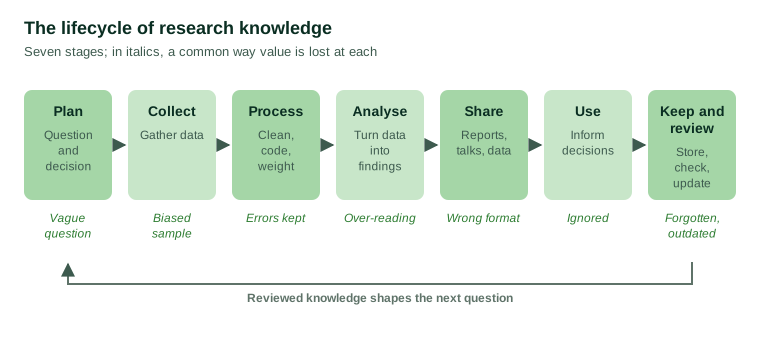
Models of the lifecycle come from several fields. In data management, Higgins (2008) described a curation lifecycle in which digital data are conceived, created, appraised, preserved, accessed, reused and transformed. In knowledge management, Alavi and Leidner (2001) identified four processes through which organisations handle knowledge: creating it, storing and retrieving it, transferring it and applying it. In survey research, Groves et al. (2009) described the stages of a survey from defining the population and questions through data collection, processing and analysis. Combining these models gives a lifecycle of seven stages.
1. Plan. The cycle begins by defining the question, the decision it should inform and the evidence required. Choices made here limit everything that follows.
2. Collect. Data are gathered through surveys, experiments, observation, interviews or the reuse of existing sources.
3. Process. Raw responses are checked, cleaned, coded, weighted and documented, so that they can be analysed reliably.
4. Analyse. Data are summarised, modelled and interpreted, turning them into findings.
5. Share. Findings are communicated through reports, presentations, dashboards and conversations, in forms suited to their users.
6. Use. Findings inform decisions, actions and further questions.
7. Preserve and review. Data, methods and findings are stored so that they can be found, checked and reused, and they are reviewed as circumstances change.
Where value is lost
The early stages have their own familiar failures. A vague question leads to data that answer nothing in particular. A sample that misses part of the population produces findings that do not apply to it. Errors left in the data during processing pass silently into every later analysis, and an analyst eager for a clear story may read more into a pattern than the evidence supports. These failures are well understood and are guarded against by sound research methods. Yet even when they are avoided, much knowledge is lost after the analysis is complete. Three later stages deserve particular attention.
From findings to use
Research is often produced but not used. Weiss (1979) showed that research influences decisions in several different ways. Sometimes it solves a specific problem directly, but more often it shapes how decision-makers think about issues over time, or is used selectively to support positions already taken. Nutley et al. (2007) reviewed how research is used in public services and concluded that use depends heavily on relationships, timing and the format in which findings arrive, not only on their quality.
Delays can be long. In health research, Morris et al. (2011) reviewed estimates of how long it takes for research findings to reach practice, and found that the frequently quoted figure of about seventeen years is an average around which delays vary greatly. Graham et al. (2006) proposed a "knowledge-to-action" framework to help close the gap, in which knowledge is tailored to the local context, barriers to its use are assessed and its uptake is monitored.
From use to memory
Organisations forget. Walsh and Ungson (1991) described organisational memory as stored information that can be brought to bear on present decisions, held in individuals, culture, procedures, structures and records. When reports are not filed where they can be found, or when the people who understood a study leave, the organisation loses the ability to use what it has learned. Davenport and Prusak (1998) emphasised that knowledge is held largely in people and moves through conversation, so that documentation alone is rarely enough.
From memory to revision
Knowledge also ages. Arbesman (2012) described how findings in many fields are steadily revised, giving facts something like a half-life. Market conditions, attitudes and technologies change, so that a finding that was true three years ago may no longer hold. A healthy lifecycle includes periodic review, in which old findings are checked, updated or marked as superseded.
Managing the lifecycle
Organisations that generate knowledge can strengthen each stage.
- Plan for use from the start. Identify who will use the findings and how, and design the study and its outputs accordingly.
- Document as you go. Record decisions about sampling, questions, cleaning and weighting while they are fresh.
- Communicate in layers. Provide short summaries for decision-makers, fuller reports for specialists and data for analysts.
- Follow up. Ask users what they did with the findings and what they still need to know.
- Store for retrieval. Keep data, questionnaires and reports in a system where colleagues can find them.
- Review regularly. Revisit important findings and update them when new evidence arrives.
Conclusion
Research knowledge does not end with a report. It passes through a lifecycle in which it is planned, collected, processed, analysed, shared, used, preserved and revised. Much of its value is created or lost in the later stages, when findings must reach decision-makers, enter organisational memory and stay up to date. Managing the whole lifecycle, rather than only the collection of data, is what turns research into lasting knowledge.
References
Alavi, M., & Leidner, D. E. (2001). Review: Knowledge management and knowledge management systems: Conceptual foundations and research issues. MIS Quarterly, 25(1), 107–136. https://doi.org/10.2307/3250961
Arbesman, S. (2012). The half-life of facts: Why everything we know has an expiration date. Current.
Davenport, T. H., & Prusak, L. (1998). Working knowledge: How organizations manage what they know. Harvard Business School Press.
Graham, I. D., Logan, J., Harrison, M. B., Straus, S. E., Tetroe, J., Caswell, W., & Robinson, N. (2006). Lost in knowledge translation: Time for a map? Journal of Continuing Education in the Health Professions, 26(1), 13–24. https://doi.org/10.1002/chp.47
Groves, R. M., Fowler, F. J., Jr., Couper, M. P., Lepkowski, J. M., Singer, E., & Tourangeau, R. (2009). Survey methodology (2nd ed.). Wiley.
Higgins, S. (2008). The DCC curation lifecycle model. International Journal of Digital Curation, 3(1), 134–140. https://doi.org/10.2218/ijdc.v3i1.48
Morris, Z. S., Wooding, S., & Grant, J. (2011). The answer is 17 years, what is the question: Understanding time lags in translational research. Journal of the Royal Society of Medicine, 104(12), 510–520. https://doi.org/10.1258/jrsm.2011.110180
Nutley, S. M., Walter, I., & Davies, H. T. O. (2007). Using evidence: How research can inform public services. Policy Press.
Walsh, J. P., & Ungson, G. R. (1991). Organizational memory. Academy of Management Review, 16(1), 57–91. https://doi.org/10.5465/amr.1991.4278992
Weiss, C. H. (1979). The many meanings of research utilization. Public Administration Review, 39(5), 426–431. https://doi.org/10.2307/3109916