
The Generation of Knowledge · History of knowledge
The Information Age and the Knowledge Society
How economists and sociologists came to describe modern societies as information or knowledge societies, the evidence for and against the idea, how the digital revolution changed the scale of information, and the new problems of attention, inequality and trust it created.
Since the 1960s, scholars, governments and business writers have claimed that advanced societies are undergoing a transformation as profound as the Industrial Revolution. Information and knowledge, they argue, have replaced land, labour and physical capital as the main sources of wealth and power. The resulting society has been given many names: the information society, the post-industrial society, the network society and the knowledge society. This article traces the development of these ideas, examines the evidence behind them, describes the digital explosion of information since the 1980s, and considers the problems that an abundance of information has created.
Measuring the knowledge economy
The idea began with an attempt at measurement. In 1962 the economist Fritz Machlup published The Production and Distribution of Knowledge in the United States (Machlup, 1962). He defined knowledge production broadly to include education, research and development, communications media, information machines such as computers and typewriters, and information services such as law, finance and accounting. By his estimate, these industries accounted for about 29% of United States gross national product in 1958, and their share was growing faster than the economy as a whole.
Porat (1977) refined Machlup's approach for the United States Department of Commerce. He distinguished a primary information sector, of firms selling information goods and services, from a secondary information sector, the information work done inside other organisations, such as planning, accounting and management. On his estimates, the two sectors together accounted for nearly half of national income, and information workers had become the largest occupational group.
These measurements were influential but contested. Critics pointed out that the definitions were very broad, that much "information work", such as routine clerical tasks, involved little real knowledge, and that the boundary between information and other activities was arbitrary (Webster, 2014). The numbers nonetheless supported a growing conviction that something fundamental was changing.
Theories of the new society
The knowledge worker
Peter Drucker, the management writer, argued in The Age of Discontinuity that knowledge had become the central capital and the crucial resource of the economy (Drucker, 1969). He popularised the term knowledge worker for people who work mainly with ideas and information rather than their hands, and argued that managing their productivity would be the central challenge for organisations.
Post-industrial society
The sociologist Daniel Bell offered the most systematic early theory. In The Coming of Post-Industrial Society, Bell (1973) argued that advanced economies were shifting from manufacturing to services, that professional and technical occupations were becoming dominant, and, most importantly, that theoretical knowledge was becoming the central source of innovation and policy. Whereas industrial society had been organised around machines and the coordination of labour, post-industrial society would be organised around knowledge, with universities and research institutes as key institutions.
The control revolution
Beniger (1986) offered a historical explanation. He argued that the information society did not begin with computers but with the nineteenth-century crisis of control caused by industrialisation. As production, transport and distribution speeded up, organisations needed new ways to gather, process and act on information: railway timetables, telegraphs, bureaucracy, accounting, market research and advertising. The computer, on this view, was the latest stage in a control revolution that had been underway for more than a century.
The network society
Castells (1996) argued that the information technology revolution of the late twentieth century had produced a new form of social organisation: the network society. Economic activity, he argued, was increasingly organised in global networks of firms, markets and flows of capital and information, made possible by digital communications. Power lay with those who could program and connect networks. Exclusion from networks, of regions, groups or individuals, became a central form of inequality.
From information society to knowledge society
Some writers distinguished information from knowledge. Stehr (1994) argued that modern societies are best understood as knowledge societies, in which knowledge, the capacity for action, has become the basis of economic activity, social organisation and political conflict. UNESCO (2005) argued that the goal should be inclusive knowledge societies, not merely societies with more information technology: a society can be rich in information while poor in the education, freedom and diversity needed to turn information into knowledge.
The digital explosion
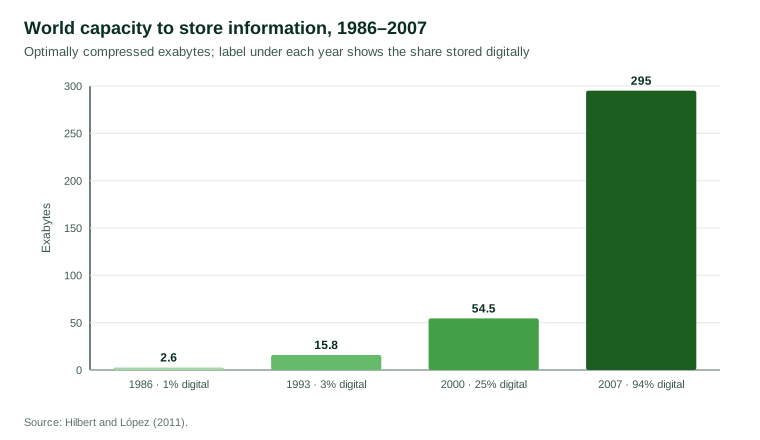
Whatever the theories, the quantity of recorded information has grown at an extraordinary rate. Hilbert and López (2011) estimated the world's technological capacity to store information from 1986 to 2007. Total storage capacity grew from about 2.6 exabytes in 1986 to about 295 exabytes in 2007, a more than hundredfold increase. Just as striking was the shift to digital storage: about 1% of stored information was digital in 1986, a quarter in 2000 and 94% in 2007.
The economics of information also changed. Shapiro and Varian (1999) explained that information goods have high fixed costs of production but almost zero costs of reproduction, which creates strong pressures towards differentiated pricing, bundling and network effects. Benkler (2006) argued that cheap computing and communication had made possible a new mode of production, commons-based peer production, in which large numbers of people cooperate to produce information goods without markets or managers, as in free software and Wikipedia.
Has knowledge really become central?
The evidence is mixed. Powell and Snellman (2004) reviewed research on the knowledge economy and concluded that there has been a real shift towards production based on intellectual capabilities rather than physical inputs, visible in patenting, the growth of knowledge-intensive industries and the rising returns to education. But they also noted that the effects are concentrated in particular industries, firms and places.
The OECD (1996) argued that economies are increasingly "directly based on the production, distribution and use of knowledge and information", and called for policies to strengthen education, research and the diffusion of knowledge. Autor et al. (2003) showed how computerisation changed the demand for skills. Computers substituted for workers doing routine tasks, both manual and cognitive, that could be expressed as explicit rules, while complementing workers doing non-routine analytical and interactive tasks. This helped explain why demand for highly educated workers rose while many middle-skill jobs declined. Brynjolfsson and McAfee (2014) argued that advances in digital technology were extending automation into tasks once thought to require human judgement.
Mokyr (2002) placed these changes in a longer perspective. The modern economy, he argued, has been knowledge-based since the Industrial Enlightenment of the eighteenth century; what has changed is the speed and falling cost with which knowledge can be accessed and combined.
Continuity or transformation?
Not everyone accepts that a new kind of society has arrived. Webster (2014) distinguishes theorists who see a genuine break with the past, such as Bell and Castells, from those who stress continuity, arguing that information has always been central to capitalism, to government administration and to warfare. On the second view, the growth of information work reflects the long-run expansion of markets, bureaucracies and surveillance rather than a new social order. Beniger's (1986) control revolution fits this reading: the problems that computers solve were created by industrialisation, not by computers themselves.
Webster (2014) also points out that quantitative measures of information can mislead. Counting the number of information workers, the volume of stored data or the share of national income spent on communications says little about the quality or meaning of the information involved. A society that produces vast quantities of advertising, entertainment and routine records is information-rich in a narrow sense, but that does not mean it is better informed. Stehr (1994) makes a similar point from the other direction: knowledge matters because it is a capacity for action, and its value depends on whether people and organisations are able to use it.
These criticisms do not deny that change has taken place. They warn against treating the volume of information as a measure of progress, and against assuming that technology alone determines how societies use knowledge.
New problems of the information age
The abundance of information has created problems as well as opportunities.
The poverty of attention
Herbert Simon foresaw one of them in 1971. "A wealth of information creates a poverty of attention", he wrote, and organisations would need to design systems that filter information rather than simply supply more of it (Simon, 1971). The scarce resource in an information-rich world is not information but the capacity to make sense of it. Every new channel of communication, from email to social media, competes for the same limited hours of human attention.
Divides
Access to information technology and the skills to use it are unequally distributed. Norris (2001) analysed the global digital divide between rich and poor countries and within societies. Van Dijk (2020) argued that the divide has moved from physical access to differences in skills and in the benefits people gain from using digital technology, so that inequalities can grow even as access becomes nearly universal.
Surveillance and the value of personal data
The same technologies that make information abundant also make it possible to collect information about people on a vast scale. Zuboff (2019) argued that a new economic logic, which she called surveillance capitalism, treats people's behavioural data as raw material for predicting and influencing their behaviour. Whatever one thinks of her argument, it highlights questions of consent, ownership and power that knowledge-generating organisations must address.
Trust
In an information-rich environment, the difficulty shifts from obtaining information to knowing which information to trust. The volume of claims, the ease of publishing and the speed of circulation make it harder to distinguish reliable from unreliable sources. When anyone can publish and every claim can circulate widely within hours, the traditional signals of reliability, such as the reputation of a publisher or the cost of producing a printed book, lose much of their force. Readers must judge credibility for themselves, often with little information about who produced a claim or how. Institutions that can demonstrate how they produced their findings, and that accept correction when they are wrong, become more valuable, not less, as the volume of information grows.
What this means for knowledge-generating organisations
The information age has transformed the context in which research organisations work. Several implications stand out.
Data are abundant; good questions and sound methods are scarce. When information is everywhere, the value lies in asking the right questions, collecting data that answer them and analysing them rigorously. A carefully designed survey can be worth more than a mountain of incidental data, because it is built to answer a specific question.
Filtering and synthesis are services. Simon's insight means that organisations will pay for knowledge that saves attention: clear findings, honest summaries and well-designed reports.
Credibility is a competitive advantage. In a world of unreliable information, the organisations that are trusted are those that are transparent about their methods, sources and limitations.
Ethics are part of quality. Collecting information about people carries obligations of consent, privacy and fair use. Respecting them is not only right; it sustains the trust on which willingness to take part in research depends. Organisations that treat personal data carelessly put at risk the cooperation that research needs.
Inclusion improves knowledge. Digital divides mean that data collected only from the most connected groups will misrepresent the population. Good research takes deliberate steps to include those who are hardest to reach.
Conclusion
The claim that we live in an information or knowledge society contains both insight and exaggeration. Knowledge has long been central to economic and social life, but the scale, speed and cost of handling information have changed dramatically in the past half-century. The result is not simply more knowledge. It is a world in which information is abundant and attention, trust and understanding are scarce. Organisations that generate knowledge succeed in this world by supplying what is scarce: rigorous answers to well-chosen questions, from sources that people can trust.
References
Autor, D. H., Levy, F., & Murnane, R. J. (2003). The skill content of recent technological change: An empirical exploration. The Quarterly Journal of Economics, 118(4), 1279–1333. https://doi.org/10.1162/003355303322552801
Bell, D. (1973). The coming of post-industrial society: A venture in social forecasting. Basic Books.
Beniger, J. R. (1986). The control revolution: Technological and economic origins of the information society. Harvard University Press.
Benkler, Y. (2006). The wealth of networks: How social production transforms markets and freedom. Yale University Press.
Brynjolfsson, E., & McAfee, A. (2014). The second machine age: Work, progress, and prosperity in a time of brilliant technologies. W. W. Norton.
Castells, M. (1996). The rise of the network society. Blackwell.
Drucker, P. F. (1969). The age of discontinuity: Guidelines to our changing society. Harper & Row.
Hilbert, M., & López, P. (2011). The world's technological capacity to store, communicate, and compute information. Science, 332(6025), 60–65. https://doi.org/10.1126/science.1200970
Machlup, F. (1962). The production and distribution of knowledge in the United States. Princeton University Press.
Mokyr, J. (2002). The gifts of Athena: Historical origins of the knowledge economy. Princeton University Press.
Norris, P. (2001). Digital divide: Civic engagement, information poverty, and the Internet worldwide. Cambridge University Press. https://doi.org/10.1017/CBO9781139164887
OECD. (1996). The knowledge-based economy (OCDE/GD(96)102). Organisation for Economic Co-operation and Development.
Porat, M. U. (1977). The information economy: Definition and measurement (OT Special Publication 77-12(1)). U.S. Department of Commerce, Office of Telecommunications.
Powell, W. W., & Snellman, K. (2004). The knowledge economy. Annual Review of Sociology, 30, 199–220. https://doi.org/10.1146/annurev.soc.29.010202.100037
Shapiro, C., & Varian, H. R. (1999). Information rules: A strategic guide to the network economy. Harvard Business School Press.
Simon, H. A. (1971). Designing organizations for an information-rich world. In M. Greenberger (Ed.), Computers, communications, and the public interest (pp. 37–72). Johns Hopkins Press.
Stehr, N. (1994). Knowledge societies. SAGE.
UNESCO. (2005). Towards knowledge societies. UNESCO Publishing.
van Dijk, J. (2020). The digital divide. Polity Press.
Webster, F. (2014). Theories of the information society (4th ed.). Routledge. https://doi.org/10.4324/9781315867854
Zuboff, S. (2019). The age of surveillance capitalism: The fight for a human future at the new frontier of power. PublicAffairs.