
The Generation of Knowledge · Knowledge production
The DIKW Pyramid: Data, Information, Knowledge, Wisdom
Where the data-information-knowledge-wisdom hierarchy came from, what each level means, how it applies to survey research, and why its critics argue the pyramid should also be read from the top down.
Organisations today hold more data than at any time in history, yet many still struggle to turn it into good decisions. One of the most widely used models for thinking about this problem is the DIKW pyramid, a hierarchy that runs from data at the base, through information and knowledge, to wisdom at the top. The model appears in textbooks on information management, knowledge management and data science, and it shapes how many businesses describe the value of their data. This article traces the model's origins, explains each of its levels with an example from survey research, and considers the serious criticisms that have been made of it.
Origins
The idea that information, knowledge and wisdom form a ladder is older than the information age. The poet T. S. Eliot wrote in his 1934 pageant play The Rock: "Where is the wisdom we have lost in knowledge? / Where is the knowledge we have lost in information?" (Eliot, 1934). The lines are often quoted as an early statement of the hierarchy, and as a warning that more of a lower level does not automatically produce more of a higher one.
In the 1980s several writers in management and information science turned the idea into a model. Cleveland (1982) argued that information should be treated as an economic resource and described a progression from facts and ideas to information, knowledge and wisdom. Zeleny (1987) linked the levels to different kinds of knowing: data as "know-nothing", information as "know-what", knowledge as "know-how" and wisdom as "know-why". The best-known version is by the systems theorist Russell Ackoff. In his 1988 address to the International Society for General Systems Research, published the following year, Ackoff (1989) proposed five levels, data, information, knowledge, understanding and wisdom, and argued that most of what organisations call management information systems deal only with the lower levels. Zins (2007) later asked 45 scholars to define data, information and knowledge and received 130 different definitions.
Rowley (2007) surveyed how the hierarchy was presented in textbooks on information systems and knowledge management. She found broad agreement that the levels exist and are ordered, and frequent use of the pyramid shape, but much less agreement on how each level should be defined and on the processes that turn one level into the next. The model is still being extended, for example to "wisdom cities" (Jifa, 2013).
The four levels
Data
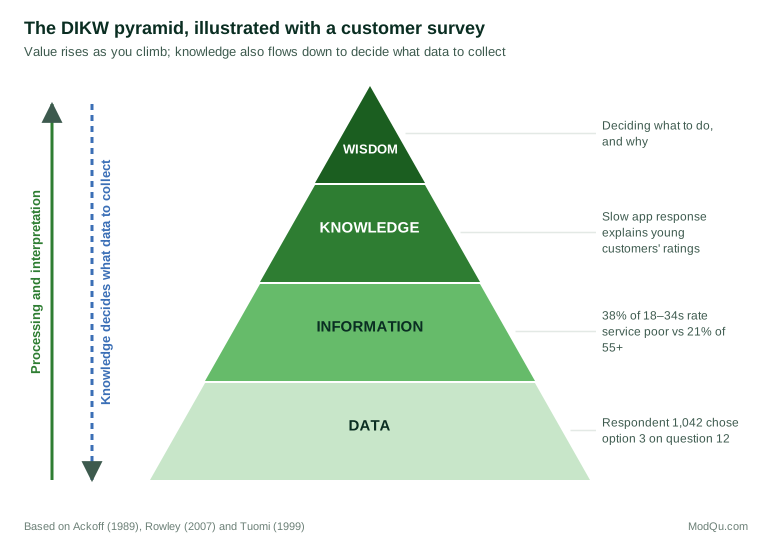
Data are symbols or recorded observations: numbers, codes, words and measurements, without context or interpretation. Ackoff (1989) described data as products of observation that are of no value until they are processed into a usable form. In a survey, the data are the raw responses: respondent 1,042 selected option 3 on question 12. Kitchin (2014) stresses that data are never simply given; they are produced by choices about what to record and how.
Information
Information is data that has been organised, processed and given context so that it answers questions such as who, what, where, when and how many. Ackoff (1989) distinguished information from data by its usefulness: it is contained in descriptions. In engineering, Shannon (1948) defined information as a measurable reduction in uncertainty, without regard to meaning; Floridi (2005) argues that information in the everyday sense is data that is well formed, meaningful and true. In survey research, tabulating and weighting the raw responses (Lohr, 2021) gives information: 38% of respondents aged 18 to 34 rate the service as poor, compared with 21% of those aged 55 and over.
Knowledge
Knowledge is information that has been understood and connected with experience, theory and other information so that it can guide action. Ackoff (1989) described knowledge as know-how, the ability to turn information into instructions. Alavi and Leidner (2001) describe knowledge as information held in the minds of individuals, which is why it cannot simply be stored and transferred like data. In the survey example, knowledge is the recognition, drawing on open-ended comments, comparisons with earlier waves and an understanding of the business, that younger customers rate the service poorly mainly because of slow response times in the mobile app.
Wisdom
Wisdom is the ability to judge what is worth doing, drawing on knowledge, values and an understanding of long-term consequences. Ackoff (1989) placed understanding, the capacity to explain why, between knowledge and wisdom, and described wisdom as evaluated understanding, the level at which questions of value enter. Baltes and Staudinger (2000) describe it as expert knowledge about the conduct and meaning of life, and Sternberg (1998) as the use of knowledge to balance competing interests over the short and long term. In the survey example, wisdom is deciding whether to invest in rebuilding the app, how that fits the company's strategy and obligations to its customers, and what the right balance is between short-term cost and long-term trust.
Why the model is popular
The DIKW pyramid has lasted because it captures several things that experienced practitioners recognise.
Value increases as you climb. Raw data on their own rarely change decisions. Their value comes from processing, interpretation and judgement. The model makes this visible and helps explain why organisations that invest only in collecting and storing data often see little return.
Each level needs different work. Turning data into information is largely a technical task of cleaning, coding and tabulating. Turning information into knowledge requires interpretation, context and expertise. Turning knowledge into wisdom requires judgement about goals and values. The model helps organisations see which kind of capability they lack.
Quantity falls as you climb. There is far more data than information, more information than knowledge, and little wisdom. The pyramid's shape makes this point intuitively and supports the argument that the scarce resource in modern organisations is not data but the ability to make sense of it.
Criticisms
Despite its popularity, the DIKW model has been criticised strongly by information scientists and philosophers.
The pyramid is unsound as a theory of knowledge
Frické (2009) argues that the hierarchy rests on a mistaken view of how knowledge is produced. The model implies that knowledge is built up from neutral observations, collected first and interpreted later. Philosophers of science have long rejected this picture: observation is guided by theories and questions, and what counts as a relevant observation depends on what one is trying to find out. Frické also points out that the model's definitions are often vague or circular, with information defined as useful data and knowledge as useful information, and that much valuable knowledge, for example in mathematics, does not come from processing data at all.
The hierarchy can be read in reverse
Tuomi (1999) proposes that the hierarchy should be turned upside down. Before any data can be collected, someone must decide what to measure, how to categorise it and what the categories mean. Those decisions require knowledge. In Tuomi's view, data emerge only after knowledge has been articulated and structured, so knowledge comes first and data are a product of it. Boisot and Canals (2004) make a related point: what an observer extracts from data depends on the expectations and knowledge the observer already holds.
This argument is easy to see in survey research. A questionnaire is a store of prior knowledge (Krosnick, 1999): about which topics matter, how people understand particular words, what the plausible answers are and how to group them. A question that offers the wrong response options produces clean, well-organised data that answer the wrong question. The data are only as good as the knowledge built into the instrument that collected them.
Knowledge is not only information
Nonaka (1994) distinguishes between explicit knowledge, which can be written down and shared, and tacit knowledge, which is held in people's skills, experience and intuitions and is hard to express. Polanyi (1966) captured the latter in a famous phrase: "we can know more than we can tell". The DIKW pyramid, with its focus on processing recorded data, has little to say about tacit knowledge, yet tacit knowledge is often what allows an experienced analyst to spot a meaningful pattern or a misleading result. Nonaka's model of knowledge creation stresses the continuous conversion between tacit and explicit forms through socialisation, articulation, combination and practice, a far less linear process than the pyramid suggests.
Wisdom is not a data product
Many critics also question whether wisdom belongs in an information hierarchy at all. Wisdom involves values, ethics and judgement about what ought to be done. It is not obtained by processing more knowledge, and information systems cannot supply it. Ackoff himself suggested that wisdom is the level that cannot be automated (Ackoff, 1989). Treating it as the peak of a data pyramid risks implying that good decisions will follow automatically from enough analysis.
Where organisations get stuck
Read as a set of distinct kinds of value, the pyramid is a useful diagnostic. Organisations often fail at a particular transition, and each failure has a recognisable pattern.
Stuck at data. The organisation collects large amounts of data, from transactions, websites, sensors and surveys, but much of it is never analysed. Data sit in separate systems, are poorly documented, or are recorded in ways that make them hard to combine. The symptom is a common complaint that "we have the data somewhere" but nobody can answer a simple question quickly. The remedy is basic data management: clear definitions, documentation of how each variable was collected and coded, and quality checks.
Stuck at information. Data are processed into reports and dashboards, but these describe what happened without explaining why. Managers receive many charts but find it hard to tell which numbers matter. In survey research this appears as long sets of tables that cross every question by every demographic group, leaving the reader to search for meaning. Summaries can also hide what the data show: Anscombe (1973) demonstrated that very different datasets can share identical summary statistics. The remedy is analysis that is driven by questions: deciding which comparisons matter for the decision at hand and presenting those clearly, with an honest account of uncertainty.
Stuck at knowledge. Analysts produce real insight, but it does not reach the people who make decisions, or it is not retained when those analysts move on. Findings from one project are rediscovered in the next. Nonaka (1994) argues that organisational knowledge is created through continuous movement between individual and shared understanding, and between tacit and explicit forms; when that movement stops, knowledge stays locked in individuals. Choo (1996) describes the "knowing organisation" as one that links sense-making, knowledge creation and decision-making. The remedy is to treat knowledge as something that must be shared, recorded and connected, through briefings, accessible archives of past research and communities of practitioners.
Missing wisdom. The organisation has good knowledge but makes poor choices, because decisions are driven by short-term pressures, internal politics or a narrow view of the organisation's goals. No information system can supply what is missing here. The remedy lies in governance, leadership and a willingness to consider long-term consequences and the interests of customers and society.
A research project seen through the pyramid
It is useful to follow a single research project through the levels, paying attention to the knowledge that flows down as well as the value that flows up.
Defining the question (knowledge and wisdom shaping data). A retailer wants to know why repeat purchases have fallen among younger customers. Before any data are collected, researchers and managers draw on what they already know: previous studies, complaints, competitor changes and their experience of the market. This prior knowledge determines the hypotheses to test, the topics the questionnaire should cover, the wording that respondents will understand, and the groups that should be compared. Tuomi (1999) would describe this as knowledge being articulated so that data can be defined.
Collecting the data. The survey is fielded to a carefully drawn sample. Each completed questionnaire is a set of data: codes, scale values and free-text answers. On their own these mean little.
Producing information. Responses are cleaned, coded and weighted, and tables are produced. The information shows that younger customers rate delivery speed and app usability much lower than older customers, and that those who rate them poorly are less likely to say they will buy again.
Building knowledge. Analysts combine the survey findings with the open-ended comments, with sales records and with what is known about recent changes. They conclude that a redesign of the mobile app made reordering slower, and that younger customers, who rely most on the app, have been most affected. This is knowledge: a causal explanation (Pearl & Mackenzie, 2018) that connects information with context and suggests what could be done.
Exercising wisdom. Managers must now decide what to do. Rolling back the redesign might restore repeat purchases quickly but abandon features that other customers value. A more thorough rebuild would take longer and cost more. The choice involves judgement about priorities, risks, customer relationships and the long-term direction of the business. The research informs that judgement but does not make it.
Feeding back. Whatever is decided, the outcome becomes new knowledge for the next round of questions. If repeat purchases recover, the explanation is supported; if not, the next study begins from a revised understanding. The cycle continues.
Seen this way, the pyramid is not a one-way production process. Knowledge enters at the start, value is added at each stage, and the results flow back to shape what is asked next.
A more useful reading
The criticisms do not mean the model should be discarded. They suggest it is best read as a description of different kinds of value, not as a factory production line. Several practical lessons follow.
Start from the decision, not the data. Because knowledge shapes what data are collected, good research begins at the top of the pyramid: what decision needs to be made, what would someone need to know to make it well, and what information would supply that knowledge? Only then is it clear what data to collect. This reverses the common practice of collecting data first and searching for uses later.
Invest in the middle levels. Many organisations invest heavily in collecting and storing data and in presenting it in dashboards, but much less in the interpretive work that turns information into knowledge. Analysts who understand both the data and the business, and who have time to investigate why patterns occur, are often the scarcest resource.
Keep the people in the loop. Tacit knowledge and judgement cannot be fully captured in systems. Effective knowledge work combines good data with the experience of people who know the context, and gives them ways to share what they know.
Be honest about the limits of each level. Information can be accurate and still incomplete. Knowledge can be well founded and still out of date. The pyramid is a reminder that each step involves choices that can be questioned.
Match tools to levels. Technology is very good at the lower levels of the pyramid: storing, cleaning, combining and summarising data. Modern analytical tools can also help find patterns that point towards knowledge. But interpreting those patterns in context, and deciding what to do about them, still depends on people. Organisations that expect software alone to move them up the pyramid tend to end up with more information and little more understanding.
Value the questions as much as the answers. Since knowledge shapes data, one of the most valuable things an organisation can do is improve the questions it asks. A clear, well-framed question focuses data collection, makes analysis easier and makes it more likely that the results will be used. Poorly framed questions waste effort at every level above them.
The pyramid and the generation of knowledge
For a research organisation, the DIKW model describes much of what its work involves. A survey collects data; tabulation and weighting produce information; analysis, comparison and interpretation produce knowledge; and the client's decisions, informed by that knowledge, are where wisdom is exercised. The critics' contribution is to show that the arrows run both ways. The knowledge embedded in a well-designed questionnaire determines the quality of the data, and the questions that matter to decision-makers should determine what is asked. Generating knowledge is therefore not a matter of piling up data and waiting for meaning to emerge. It is a cycle in which questions, evidence and understanding refine one another.
References
Ackoff, R. L. (1989). From data to wisdom. Journal of Applied Systems Analysis, 16, 3–9.
Alavi, M., & Leidner, D. E. (2001). Review: Knowledge management and knowledge management systems: Conceptual foundations and research issues. MIS Quarterly, 25(1), 107–136. https://doi.org/10.2307/3250961
Anscombe, F. J. (1973). Graphs in statistical analysis. The American Statistician, 27(1), 17–21. https://doi.org/10.1080/00031305.1973.10478966
Baltes, P. B., & Staudinger, U. M. (2000). Wisdom: A metaheuristic (pragmatic) to orchestrate mind and virtue toward excellence. American Psychologist, 55(1), 122–136. https://doi.org/10.1037/0003-066X.55.1.122
Boisot, M., & Canals, A. (2004). Data, information and knowledge: Have we got it right? Journal of Evolutionary Economics, 14(1), 43–67. https://doi.org/10.1007/s00191-003-0181-9
Choo, C. W. (1996). The knowing organization: How organizations use information to construct meaning, create knowledge and make decisions. International Journal of Information Management, 16(5), 329–340. https://doi.org/10.1016/0268-4012(96)00020-5
Cleveland, H. (1982, December). Information as a resource. The Futurist, 16(6), 34–39.
Eliot, T. S. (1934). The rock. Faber & Faber.
Floridi, L. (2005). Is semantic information meaningful data? Philosophy and Phenomenological Research, 70(2), 351–370. https://doi.org/10.1111/j.1933-1592.2005.tb00531.x
Frické, M. (2009). The knowledge pyramid: A critique of the DIKW hierarchy. Journal of Information Science, 35(2), 131–142. https://doi.org/10.1177/0165551508094050
Jifa, G. (2013). Data, information, knowledge, wisdom and meta-synthesis of wisdom: Comment on wisdom global and wisdom cities. Procedia Computer Science, 17, 713–719. https://doi.org/10.1016/j.procs.2013.05.092
Kitchin, R. (2014). The data revolution: Big data, open data, data infrastructures and their consequences. SAGE. https://doi.org/10.4135/9781473909472
Krosnick, J. A. (1999). Survey research. Annual Review of Psychology, 50, 537–567. https://doi.org/10.1146/annurev.psych.50.1.537
Lohr, S. L. (2021). Sampling: Design and analysis (3rd ed.). CRC Press. https://doi.org/10.1201/9780429298899
Nonaka, I. (1994). A dynamic theory of organizational knowledge creation. Organization Science, 5(1), 14–37. https://doi.org/10.1287/orsc.5.1.14
Pearl, J., & Mackenzie, D. (2018). The book of why: The new science of cause and effect. Basic Books.
Polanyi, M. (1966). The tacit dimension. Doubleday.
Rowley, J. (2007). The wisdom hierarchy: Representations of the DIKW hierarchy. Journal of Information Science, 33(2), 163–180. https://doi.org/10.1177/0165551506070706
Shannon, C. E. (1948). A mathematical theory of communication. Bell System Technical Journal, 27(3), 379–423. https://doi.org/10.1002/j.1538-7305.1948.tb01338.x
Sternberg, R. J. (1998). A balance theory of wisdom. Review of General Psychology, 2(4), 347–365. https://doi.org/10.1037/1089-2680.2.4.347
Tuomi, I. (1999). Data is more than knowledge: Implications of the reversed knowledge hierarchy for knowledge management and organizational memory. Journal of Management Information Systems, 16(3), 103–117. https://doi.org/10.1080/07421222.1999.11518258
Zeleny, M. (1987). Management support systems: Towards integrated knowledge management. Human Systems Management, 7(1), 59–70. https://doi.org/10.3233/HSM-1987-7108
Zins, C. (2007). Conceptual approaches for defining data, information, and knowledge. Journal of the American Society for Information Science and Technology, 58(4), 479–493. https://doi.org/10.1002/asi.20508