
The Generation of Knowledge · Trust, quality and the future
Post-Truth and the Crisis of Shared Knowledge
What the term post-truth describes, how misinformation spreads and why corrections often struggle, the role of motivated reasoning and polarisation, what the evidence says about how serious the problem is, and what producers of knowledge can do to rebuild a shared basis of fact.
In 2016, Oxford Dictionaries chose "post-truth" as its word of the year, defining it as describing circumstances in which objective facts are less influential in shaping public opinion than appeals to emotion and personal belief. The choice reflected a widespread sense that something had changed in public life: that disagreements were no longer only about values and policies but about basic facts, and that evidence had lost some of its power to settle arguments. This article examines what the idea of post-truth describes, what research has found about the spread of misinformation and the difficulty of correcting it, how serious the problem really is, and what those who produce knowledge can do to support a shared basis of fact.
What is meant by post-truth
The term is easily misread. It does not mean that truth has ceased to exist, or that people no longer care about it. McIntyre (2018) argued that post-truth describes a situation in which people are willing to subordinate facts to their political or group commitments: to believe, assert or share claims because those claims support a position they already hold, while treating inconvenient evidence as suspect. What is new, he suggested, is not lying, which is as old as politics, but a weakening of the shared expectation that claims should answer to evidence at all.
Frankfurt (2005) drew a related distinction between the liar and the bullshitter. The liar knows the truth and tries to conceal it, and so remains in a sense guided by it. The bullshitter is indifferent to whether what they say is true or false and cares only about the effect it has. Frankfurt argued that this indifference is a greater enemy of truth than lies, because it erodes the very practice of taking truth seriously.
Kavanagh and Rich (2018), in a study for the RAND Corporation, preferred the term truth decay and identified four related trends in American public life: increasing disagreement about facts and analytical interpretations of facts; a blurring of the line between opinion and fact; an increase in the relative volume and influence of opinion over fact; and declining trust in formerly respected sources of factual information. They noted that similar periods had occurred before, for example during the era of sensational "yellow journalism" in the late nineteenth century, but argued that the current period was distinctive in its scale and in the role of new technologies.
Wardle and Derakhshan (2017), in a report for the Council of Europe, proposed a vocabulary for what they called information disorder. Misinformation is false information shared without intent to harm. Disinformation is false information knowingly shared to cause harm. Malinformation is genuine information shared to cause harm, for example by exposing private details. The distinctions matter because each problem calls for different responses.
How falsehood spreads
The largest study of the spread of true and false news online was carried out by Vosoughi et al. (2018). They followed around 126,000 stories that had been checked by independent fact-checking organisations and that were shared on Twitter by about three million people between 2006 and 2017. False stories spread significantly farther, faster, deeper and more broadly than true ones. A false story was about 70% more likely to be shared than a true one, and true stories took about six times as long as false stories to reach 1,500 people. The effect was strongest for political news. The authors found that automated accounts spread true and false news at similar rates, so the difference was due mainly to human behaviour. False stories tended to be more novel and to provoke stronger emotions such as surprise and disgust, which may explain why people chose to share them.
Lazer et al. (2018), in a review for the journal Science, defined fake news as fabricated information that mimics news media content in form but not in organisational process or intent. They noted that news organisations have editorial norms intended to ensure accuracy and credibility, and that fake news borrows the appearance of news without those processes. Their review called for research into how such content spreads and for interventions both at the level of individuals and in the design of online platforms.
Why corrections struggle
If false beliefs could be corrected easily, misinformation would be a smaller problem. Research shows that correction is possible but limited. Lewandowsky et al. (2012) reviewed decades of psychological research on the continued influence effect: even after people accept that a piece of information is false, it often continues to influence their reasoning. A false explanation leaves a gap when it is removed, and unless that gap is filled with a better account, people tend to fall back on what they first heard. Corrections work better when they provide an alternative explanation, when they are repeated, and when they come from sources the audience trusts.
Ecker et al. (2022) updated this review and identified the main psychological drivers of belief in misinformation. They include intuitive rather than analytical thinking, the tendency to judge familiar claims as true, reliance on sources that seem credible, and the pull of claims that fit one's identity and worldview. Repetition plays a particularly important role. A claim heard many times feels more familiar and therefore more likely to be true, which means that even repeating a myth in order to deny it can strengthen it if the correction is not clearly framed.
Nyhan and Reifler (2010) reported a striking result: in some experiments, correcting a false political belief made people who were committed to it hold it more strongly, a so-called backfire effect. The finding was widely cited as evidence that facts cannot change minds. Later research gave a more hopeful picture. Wood and Porter (2019) tested corrections on 52 issues with more than 10,000 participants and found that backfire was very rare. In most cases, people moved towards the correct information, even when it challenged their political commitments. The effects of correction may be modest and may fade over time, but corrections generally do help.
Motivated reasoning and polarisation
Kunda (1990) described motivated reasoning: when people want to reach a particular conclusion, they search memory and evaluate evidence in ways that make that conclusion more likely, while maintaining an illusion of objectivity. People do not simply believe whatever they wish, but they set higher standards for evidence they dislike than for evidence they welcome.
Kahan et al. (2011) showed how this works for scientific questions that have become linked to group identity. People judged whether a scientist with strong credentials was a genuine expert largely according to whether the scientist's stated position matched the one associated with their own cultural group. Disagreement about climate change, gun control or nuclear power was therefore not simply a matter of some people lacking information. It reflected the role those issues had come to play as signals of identity and loyalty.
Not all researchers accept that motivated reasoning is the main driver of belief in false news. Pennycook and Rand (2019) found that people who scored higher on a test of analytical thinking were better at distinguishing real from fake headlines, whether or not the headlines matched their political views. They concluded that much susceptibility to fake news reflects lazy thinking, a failure to stop and consider whether a claim is accurate, rather than a deliberate effort to protect one's beliefs. The two explanations are not mutually exclusive, and both point to ways of improving how people evaluate information.
The background to these patterns is rising polarisation. Iyengar et al. (2019) reviewed evidence that affective polarisation, the tendency of supporters of one party to dislike and distrust supporters of the other, has increased markedly in the United States over several decades. When people distrust the other side, they also distrust the sources of information associated with it, so that experts, journalists and institutions come to be seen as partisan actors. Sunstein (2017) argued that online environments in which people choose what they see make it easier to avoid opposing views and can push groups towards more extreme positions.
How serious is the problem?
Concern about post-truth can itself become exaggerated. Guess et al. (2019) linked survey data to the actual Facebook activity of a sample of Americans during the 2016 presidential election campaign. Sharing articles from fake news websites was rare: fewer than one in ten respondents shared any such article. Sharing was concentrated among a small group, and users over 65 shared nearly seven times as many fake news articles as the youngest group. The problem was real but much smaller and more concentrated than common accounts suggested.
Mercier (2020) argued that people are not as gullible as often assumed. Humans have evolved mechanisms of open vigilance that lead them to accept information from sources they have reason to trust and to reject claims that conflict strongly with what they already believe. On this view, much misinformation does not convert anyone. It mainly reaches people who already hold the beliefs it supports and gives them material to justify those beliefs. The deeper problem is not that people believe anything, but that they distrust the wrong sources and trust the wrong ones.
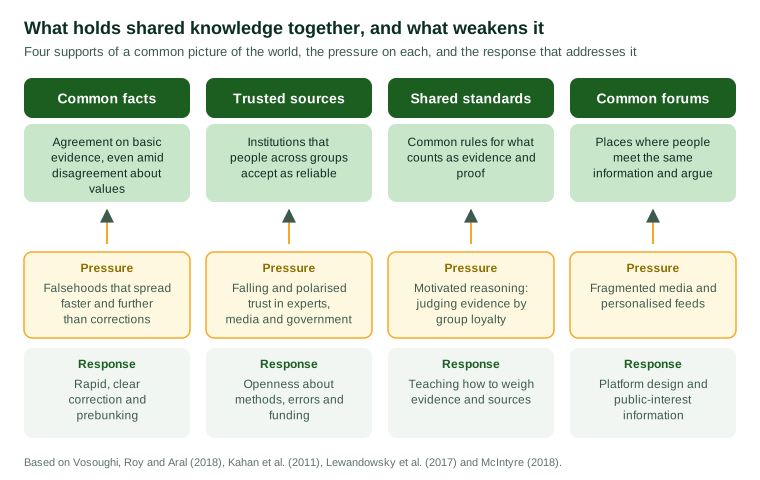
These findings suggest that the crisis of shared knowledge is better understood as a crisis of trust and of the institutions that link people to evidence than as a sudden collapse in human reasoning. Lewandowsky et al. (2017) argued that post-truth must be understood in its political, technological and social context, including growing inequality, declining social capital and a fragmented media landscape, rather than as a purely psychological problem that better individual reasoning could solve.
Manufactured doubt
Some uncertainty in public debate is created on purpose. Oreskes and Conway (2010) documented how a small number of scientists, often working with industry funding, cast doubt on scientific findings about the harms of tobacco smoke, acid rain, the ozone hole and climate change. Their strategy was not usually to prove the science wrong but to suggest that it was unsettled, so that action could be delayed. By emphasising genuine uncertainties at the margins and presenting dissenting views as equal to a broad consensus, they made the state of knowledge appear far more uncertain than it was.
This history shows that doubt is not always a sign of honest scepticism. The norms of science value questioning and the reporting of uncertainty, and those norms can be exploited by actors who wish to prevent knowledge from shaping action. Recognising the difference between genuine scientific uncertainty and manufactured doubt is part of what it means to evaluate evidence well.
The constitution of knowledge
Rauch (2021) argued that modern societies depend on what he called a constitution of knowledge: a network of institutions, including science, journalism, the courts and the professions, that turn individual claims into shared knowledge by subjecting them to criticism and checking. This system rests on two rules. The first is that any claim may be challenged, so that no one has the final say. The second is that claims must be tested in ways others can check, so that no one's personal authority settles a question. The system is powerful because it allows people who disagree about much else to arrive at a common body of facts.
Rauch argued that the danger of the post-truth era is not that people disagree, which the system expects and depends on, but that some actors have sought to discredit the institutions that make shared knowledge possible. Disinformation campaigns aim less to persuade people of particular falsehoods than to create confusion, so that people conclude that nothing can be known and that every source is equally unreliable. When that happens, shared knowledge gives way to competing tribal accounts.
What can be done
Research has identified several approaches that help, although none is sufficient on its own.
Prebunking. Rather than correcting false claims after they spread, people can be warned in advance about the techniques used to mislead them. Van der Linden et al. (2017) found that warning people about a misleading petition that questioned the scientific consensus on climate change protected them against its influence, an approach they compared to vaccination. Roozenbeek and van der Linden (2019) developed an online game in which players take the role of a producer of fake news, and found that playing it made people better at recognising misleading techniques in news headlines.
Accuracy prompts. Pennycook et al. (2021) found that many people share false news not because they believe it but because they do not stop to think about whether it is true. Simple prompts that drew attention to accuracy, such as asking people to rate the truth of an unrelated headline, improved the quality of the news they later chose to share.
Better corrections. Corrections should be prompt, clear and repeated, should lead with the facts rather than the myth, and should offer an alternative explanation to fill the gap left by the false claim (Lewandowsky et al., 2012; Ecker et al., 2022).
Platform and institutional design. Lazer et al. (2018) argued that the design of online platforms, including what they amplify and how they label content, shapes what spreads, and that the responsibility for misinformation cannot rest on individual users alone.
Rebuilding trust. Above all, the institutions that produce knowledge must deserve the trust they ask for. Kavanagh and Rich (2018) argued that reversing truth decay requires institutions that are transparent about their methods, honest about their errors and careful to separate fact from opinion.
Implications for survey and research organisations
Survey and research organisations stand at the centre of these debates, because their work is one of the main ways that societies learn facts about themselves: what people think, how they live and how conditions are changing. Their findings can help to create common ground, but they can also be dismissed as partisan or manipulated when they are unwelcome.
Several practices help such organisations to strengthen shared knowledge rather than add to its fragmentation. They should publish their methods in full, including how samples were drawn, how questions were worded and how results were weighted, so that anyone who doubts a finding can examine how it was produced. They should report uncertainty honestly and avoid overstating the precision of estimates. They should separate the reporting of findings from commentary on what those findings mean for policy. They should correct errors openly and promptly. And they should present findings in ways that do not invite people to read them as signals of identity, for example by describing what different groups have in common as well as where they differ.
Conclusion
The idea of post-truth captures a real change: a weakening of the shared expectation that public claims should answer to evidence, driven by the speed of online misinformation, motivated reasoning, polarisation and declining trust in institutions. Research shows that false news spreads faster than true news, that corrections help but are limited, and that manufactured doubt can delay action on well-established knowledge. It also shows that the problem is more concentrated than often feared and that people are not simply gullible. The deeper crisis is one of trust and of the institutions that turn individual claims into shared knowledge. Responses that warn people about misleading techniques, prompt attention to accuracy, design better platforms and, above all, make knowledge-producing institutions more transparent and trustworthy, offer a way to rebuild a common basis of fact on which disagreement about values can proceed.
References
Ecker, U. K. H., Lewandowsky, S., Cook, J., Schmid, P., Fazio, L. K., Brashier, N., Kendeou, P., Vraga, E. K., & Amazeen, M. A. (2022). The psychological drivers of misinformation belief and its resistance to correction. Nature Reviews Psychology, 1(1), 13–29. https://doi.org/10.1038/s44159-021-00006-y
Frankfurt, H. G. (2005). On bullshit. Princeton University Press.
Guess, A., Nagler, J., & Tucker, J. (2019). Less than you think: Prevalence and predictors of fake news dissemination on Facebook. Science Advances, 5(1), eaau4586. https://doi.org/10.1126/sciadv.aau4586
Iyengar, S., Lelkes, Y., Levendusky, M., Malhotra, N., & Westwood, S. J. (2019). The origins and consequences of affective polarization in the United States. Annual Review of Political Science, 22, 129–146. https://doi.org/10.1146/annurev-polisci-051117-073034
Kahan, D. M., Jenkins-Smith, H., & Braman, D. (2011). Cultural cognition of scientific consensus. Journal of Risk Research, 14(2), 147–174. https://doi.org/10.1080/13669877.2010.511246
Kavanagh, J., & Rich, M. D. (2018). Truth decay: An initial exploration of the diminishing role of facts and analysis in American public life. RAND Corporation. https://doi.org/10.7249/RR2314
Kunda, Z. (1990). The case for motivated reasoning. Psychological Bulletin, 108(3), 480–498. https://doi.org/10.1037/0033-2909.108.3.480
Lazer, D. M. J., Baum, M. A., Benkler, Y., Berinsky, A. J., Greenhill, K. M., Menczer, F., Metzger, M. J., Nyhan, B., Pennycook, G., Rothschild, D., Schudson, M., Sloman, S. A., Sunstein, C. R., Thorson, E. A., Watts, D. J., & Zittrain, J. L. (2018). The science of fake news. Science, 359(6380), 1094–1096. https://doi.org/10.1126/science.aao2998
Lewandowsky, S., Ecker, U. K. H., & Cook, J. (2017). Beyond misinformation: Understanding and coping with the "post-truth" era. Journal of Applied Research in Memory and Cognition, 6(4), 353–369. https://doi.org/10.1016/j.jarmac.2017.07.008
Lewandowsky, S., Ecker, U. K. H., Seifert, C. M., Schwarz, N., & Cook, J. (2012). Misinformation and its correction: Continued influence and successful debiasing. Psychological Science in the Public Interest, 13(3), 106–131. https://doi.org/10.1177/1529100612451018
McIntyre, L. (2018). Post-truth. MIT Press.
Mercier, H. (2020). Not born yesterday: The science of who we trust and what we believe. Princeton University Press.
Nyhan, B., & Reifler, J. (2010). When corrections fail: The persistence of political misperceptions. Political Behavior, 32(2), 303–330. https://doi.org/10.1007/s11109-010-9112-2
Oreskes, N., & Conway, E. M. (2010). Merchants of doubt: How a handful of scientists obscured the truth on issues from tobacco smoke to global warming. Bloomsbury Press.
Pennycook, G., Epstein, Z., Mosleh, M., Arechar, A. A., Eckles, D., & Rand, D. G. (2021). Shifting attention to accuracy can reduce misinformation online. Nature, 592(7855), 590–595. https://doi.org/10.1038/s41586-021-03344-2
Pennycook, G., & Rand, D. G. (2019). Lazy, not biased: Susceptibility to partisan fake news is better explained by lack of reasoning than by motivated reasoning. Cognition, 188, 39–50. https://doi.org/10.1016/j.cognition.2018.06.011
Rauch, J. (2021). The constitution of knowledge: A defense of truth. Brookings Institution Press.
Roozenbeek, J., & van der Linden, S. (2019). Fake news game confers psychological resistance against online misinformation. Palgrave Communications, 5, Article 65. https://doi.org/10.1057/s41599-019-0279-9
Sunstein, C. R. (2017). #Republic: Divided democracy in the age of social media. Princeton University Press.
van der Linden, S., Leiserowitz, A., Rosenthal, S., & Maibach, E. (2017). Inoculating the public against misinformation about climate change. Global Challenges, 1(2), Article 1600008. https://doi.org/10.1002/gch2.201600008
Vosoughi, S., Roy, D., & Aral, S. (2018). The spread of true and false news online. Science, 359(6380), 1146–1151. https://doi.org/10.1126/science.aap9559
Wardle, C., & Derakhshan, H. (2017). Information disorder: Toward an interdisciplinary framework for research and policy making (Council of Europe report DGI(2017)09). Council of Europe.
Wood, T., & Porter, E. (2019). The elusive backfire effect: Mass attitudes' steadfast factual adherence. Political Behavior, 41(1), 135–163. https://doi.org/10.1007/s11109-018-9443-y