
The Generation of Knowledge · Knowledge and decisions
Knowledge, Power and Who Gets to Know
How power shapes the production and use of knowledge, from the questions asked and the people counted to who interprets and who has access, with evidence on statistics and the state, gaps in data, epistemic injustice and practices that spread the power to know more fairly.
Knowledge is often treated as neutral: facts are facts, whoever finds them. Yet the production of knowledge involves many choices, and those choices are made by people with particular positions, interests and resources. Someone decides which questions are worth asking, whose experiences are measured, how results are interpreted and who may see them. These decisions shape what becomes known and what remains unknown. This article examines the relationship between knowledge and power, drawing on philosophy, history, sociology and research on data, and considers what it means for organisations that produce knowledge.
Knowledge and power
The idea that knowledge confers power is old. Those who know more can anticipate events, persuade others and act more effectively. Economists have shown how unequal knowledge between buyers and sellers, or between managers and owners, shapes markets and organisations, giving an advantage to the better informed (Akerlof, 1970).
Lukes (2005) distinguished three dimensions of power. The first is the power to win open conflicts over decisions. The second is the power to keep issues off the agenda, so that some questions are never decided at all. The third, and least visible, is the power to shape people's understanding of their own interests, so that they do not perceive a conflict. Knowledge is involved in all three, but especially in the second and third: what is studied and measured influences which issues reach the agenda, and the categories through which people understand the world influence what they believe they want.
Foucault (1980) went further, arguing that power and knowledge are bound together. In his view, institutions such as prisons, hospitals and schools both produce knowledge about people and use that knowledge to govern them. Foucault (1977) described how modern institutions developed techniques of observation, examination and record-keeping that made individuals visible and measurable, and therefore manageable. Knowledge, in this account, is not simply a tool that the powerful use; the production of knowledge is itself a way of exercising power.
Statistics and the state
The word "statistics" originally referred to knowledge about the state. Historians have shown how official statistics developed alongside modern government. Hacking (1990) described how, in the nineteenth century, an "avalanche of printed numbers" about crime, disease, poverty and population transformed how societies understood themselves, and how new categories, such as the "normal" and the "deviant", emerged from statistical description. Desrosières (1998) traced how statistical methods and institutions developed together with the needs of states to govern, tax and plan, and how the categories used in statistics were shaped by administrative and political purposes.
Scott (1998) argued that states seek to make their territories and populations legible: simplified, standardised and measurable, so that they can be taxed, conscripted and governed. Surveys, maps, censuses, permanent surnames and standard measures all served this purpose. Legibility brings benefits, such as more effective public services, but Scott showed how schemes based on simplified knowledge could fail badly when they ignored local, practical knowledge that the official categories did not capture.
Porter (1995) asked why numbers carry such authority in public life. He argued that quantification is a "technology of distance": it allows decisions to be made and justified without relying on personal trust, which is especially valuable for officials who face suspicion from the public. Numbers appear objective. But Porter showed that the choice of what to count and how to count it involves judgement, and that the appearance of objectivity can conceal those judgements.
Who gets to ask
The power to set research questions determines what becomes known. Research is expensive, so questions are usually set by those who can pay for answers: governments, businesses, foundations and research institutions. Their questions reflect their concerns. Problems that affect people with little power or money may receive less attention, not because they are less important but because fewer people with resources are asking about them.
Merton (1968) described the Matthew effect in science: researchers and institutions that are already well known receive more recognition, funding and attention, which allows them to do more and become better known still. The same dynamic can apply to topics. Well-funded fields attract more researchers and generate more knowledge, while neglected fields stay neglected.
Who gets counted
What is measured shapes what is seen. Groups that are hard to reach, or that fall outside standard categories, may be undercounted or invisible in data. Criado Perez (2019) documented many cases in which data were collected mainly about men, or without separating results for women and men, with the result that products, services and policies were designed around men's needs. D'Ignazio and Klein (2020) argued that data science often reflects the perspectives of those who collect and analyse data, and called for practices that examine who is counted, who is left out and who benefits.
Technologies trained on unrepresentative data can embed these gaps. Buolamwini and Gebru (2018) evaluated commercial systems that classified faces by gender and found that error rates were far higher for women with darker skin than for men with lighter skin, a difference they traced partly to the composition of the data used to develop and test the systems. Benjamin (2019) examined how apparently neutral technologies can reproduce existing social inequalities.
For survey research, the question of who is counted is a question of coverage and response. Sampling frames that omit people without fixed addresses, telephone numbers or internet access, and survey methods that are less effective for some groups than others, can leave parts of the population underrepresented. Weighting can correct some of the imbalance, but only if the missing groups are known and measured in reliable benchmark data.
Who gets to interpret
Data do not speak for themselves. Analysts choose which comparisons to make, which variables to control for and how to describe results. These choices reflect assumptions, and the same data can support different conclusions depending on how they are framed.
Feminist philosophers of science have argued that all knowledge is produced from particular standpoints. Haraway (1988) called for situated knowledges, accounts that acknowledge their own position rather than claiming a "view from nowhere". Harding (1991) argued that research is more objective, not less, when it systematically includes the perspectives of those whose experiences have been overlooked, because their standpoint can reveal assumptions that others take for granted. She called this strong objectivity.
Fricker (2007) identified a form of wrong she called epistemic injustice. Testimonial injustice occurs when a speaker's word is given less credibility because of prejudice about who they are. Hermeneutical injustice occurs when a group lacks the shared concepts needed to make sense of its own experience, because it has been excluded from the processes through which such concepts are developed. Both forms affect what becomes known: if some people are not believed, or cannot describe their experiences in recognised terms, their knowledge does not enter the common stock.
Expert and local knowledge
Power also shapes whose kind of knowledge counts. Formal, scientific and statistical knowledge usually carries more weight in official decisions than the practical knowledge of people who live and work in a particular place. Wynne (1992) studied sheep farmers in Cumbria, in northern England, after radioactive fallout from the Chernobyl accident in 1986 contaminated their land. Government scientists predicted that restrictions on the sale of sheep would be short-lived; the restrictions lasted far longer. The farmers had detailed knowledge of local soils, grazing patterns and the behaviour of their flocks, which bore directly on how contamination would spread, but the experts largely disregarded it. Wynne argued that the farmers' distrust of the scientists arose not from ignorance of science but from the experts' failure to recognise the limits of their own knowledge and the value of the farmers'.
The lesson is not that expert knowledge is unreliable, but that it is incomplete. Combining formal methods with the knowledge of people who have direct experience of a situation can produce better understanding than either alone, as Scott (1998) also argued.
Knowledge and power inside organisations
The same dynamics operate within organisations. Pfeffer (1981) showed that control over information is a major source of power in organisations. Those who gather, filter and present information to decision-makers can shape decisions by choosing what to emphasise and what to leave out. Units that control critical information, or that are best placed to interpret uncertainty, tend to gain influence. Information can also be withheld, delayed or framed to serve the interests of those who hold it.
For research commissioned inside organisations, this means that the way findings are reported, and to whom, affects their influence. Results that reach senior decision-makers directly and in full carry different weight from results summarised by a unit with an interest in the outcome. Clear, complete reporting, shared with all those who have a stake in a decision, reduces the scope for information to be used selectively.
Who gets access
Knowledge that exists but cannot be reached gives no power to those who need it. Access is limited by cost, as with subscription journals and proprietary data; by secrecy, as with classified or commercially confidential information; and by skill, since data are of little use to those who cannot interpret them.
Tichenor et al. (1970) proposed the knowledge gap hypothesis: as information flows into a society, for example through the mass media, people with higher education and status tend to acquire it faster than others, so gaps in knowledge between groups widen rather than narrow. Later research has found that the effect depends on the topic and the circumstances, but the general point stands: making information available does not by itself make it equally available to all.
Zuboff (2019) argued that large technology companies now hold detailed knowledge about the behaviour of billions of people, while those people know little about how that knowledge is used. This asymmetry, she argued, gives such companies unprecedented power to predict and influence behaviour.
The power to decide what happens with data about oneself
Indigenous peoples have been studied extensively by outside researchers, often without their consent and without benefit to their communities. Tuhiwai Smith (1999) wrote from a Māori perspective about how research had served colonial interests, and argued for research methodologies that put Indigenous communities in control of research about them.
In Canada, the First Nations Information Governance Centre (2014) set out the principles of ownership, control, access and possession, known as OCAP, which assert that First Nations have control over data collection processes in their communities and own and control how their information can be used. Carroll et al. (2020) proposed the CARE principles for Indigenous data governance, collective benefit, authority to control, responsibility and ethics, to complement the FAIR principles for open data. They argued that the movement towards open data should not override the rights of Indigenous peoples to govern data about themselves.
These principles express a broader idea that has spread beyond Indigenous contexts: that people and communities should have a say in how knowledge about them is produced and used.
Spreading the power to know
Several practices aim to distribute the power to produce and use knowledge more widely. Figure 1 summarises the main questions and responses.
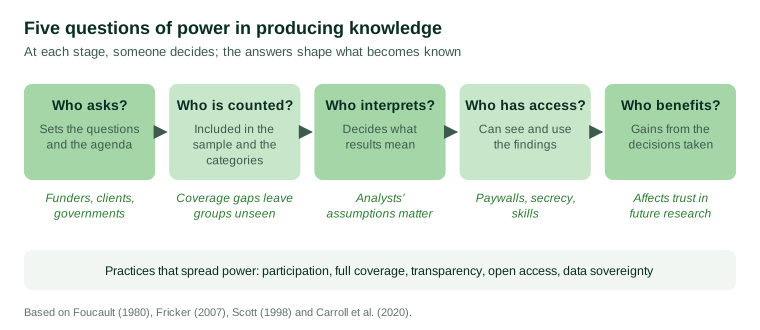
Participation. Arnstein (1969) described a ladder of citizen participation, from manipulation and token consultation at the bottom to partnership and citizen control at the top. Cornwall and Jewkes (1995) described participatory research, in which the people being studied take part in setting questions, collecting data and interpreting results, and argued that the key difference from conventional research lies in who controls the process.
Full coverage. Designing samples and methods to include groups that are hard to reach, and reporting results separately for them where numbers allow, makes their circumstances visible.
Transparency. Disclosing who funded research, how questions were chosen and how data were analysed allows others to judge whose perspective the findings reflect.
Open access. Publishing findings and, where possible, data openly allows more people to use and check them.
Data sovereignty. Respecting the rights of communities to govern data about themselves, as set out in principles such as OCAP and CARE.
Implications for research organisations
Survey and research organisations exercise power in each of the ways described here. They help clients decide which questions to ask. They design samples that determine who is counted. They choose how to analyse and present results. And they agree with clients who may see the findings.
Recognising this power is the first step to using it responsibly. Practical measures include advising clients when a research design would leave important groups out, using methods and languages that allow more people to take part, reporting results for subgroups where the data support it, being open about methods and funding, protecting the confidentiality of respondents and honouring commitments about how their information will be used. Respondents give their time and their information; respect for their interests is part of what makes the knowledge produced from them trustworthy.
Conclusion
Knowledge and power are closely linked. The power to set questions, define categories, interpret results and control access shapes what becomes known and what remains invisible. Official statistics have long been tools of government; data collected by powerful organisations can leave some groups unseen; and some people's knowledge is discounted because of who they are. Yet knowledge can also distribute power, when people take part in producing it, when everyone is counted, when methods are open and when communities have a say in how knowledge about them is used. For organisations that produce knowledge, asking who gets to know is part of producing knowledge that is both accurate and fair. Research that includes everyone it concerns, explains its choices openly and returns its findings to those who made it possible is more likely to be trusted, used and supported in future.
References
Akerlof, G. A. (1970). The market for "lemons": Quality uncertainty and the market mechanism. Quarterly Journal of Economics, 84(3), 488–500. https://doi.org/10.2307/1879431
Arnstein, S. R. (1969). A ladder of citizen participation. Journal of the American Institute of Planners, 35(4), 216–224. https://doi.org/10.1080/01944366908977225
Benjamin, R. (2019). Race after technology: Abolitionist tools for the new Jim Code. Polity.
Buolamwini, J., & Gebru, T. (2018). Gender shades: Intersectional accuracy disparities in commercial gender classification. Proceedings of Machine Learning Research, 81, 77–91.
Carroll, S. R., Garba, I., Figueroa-Rodríguez, O. L., Holbrook, J., Lovett, R., Materechera, S., Parsons, M., Raseroka, K., Rodriguez-Lonebear, D., Rowe, R., Sara, R., Walker, J. D., Anderson, J., & Hudson, M. (2020). The CARE principles for Indigenous data governance. Data Science Journal, 19(1), Article 43. https://doi.org/10.5334/dsj-2020-043
Cornwall, A., & Jewkes, R. (1995). What is participatory research? Social Science & Medicine, 41(12), 1667–1676. https://doi.org/10.1016/0277-9536(95)00127-S
Criado Perez, C. (2019). Invisible women: Exposing data bias in a world designed for men. Chatto & Windus.
Desrosières, A. (1998). The politics of large numbers: A history of statistical reasoning (C. Naish, Trans.). Harvard University Press.
D'Ignazio, C., & Klein, L. F. (2020). Data feminism. MIT Press. https://doi.org/10.7551/mitpress/11805.001.0001
First Nations Information Governance Centre. (2014). Ownership, control, access and possession (OCAP™): The path to First Nations information governance. First Nations Information Governance Centre.
Foucault, M. (1977). Discipline and punish: The birth of the prison (A. Sheridan, Trans.). Pantheon Books.
Foucault, M. (1980). Power/knowledge: Selected interviews and other writings, 1972–1977 (C. Gordon, Ed.). Pantheon Books.
Fricker, M. (2007). Epistemic injustice: Power and the ethics of knowing. Oxford University Press. https://doi.org/10.1093/acprof:oso/9780198237907.001.0001
Hacking, I. (1990). The taming of chance. Cambridge University Press. https://doi.org/10.1017/CBO9780511819766
Haraway, D. (1988). Situated knowledges: The science question in feminism and the privilege of partial perspective. Feminist Studies, 14(3), 575–599. https://doi.org/10.2307/3178066
Harding, S. (1991). Whose science? Whose knowledge? Thinking from women's lives. Cornell University Press.
Lukes, S. (2005). Power: A radical view (2nd ed.). Palgrave Macmillan.
Merton, R. K. (1968). The Matthew effect in science. Science, 159(3810), 56–63. https://doi.org/10.1126/science.159.3810.56
Pfeffer, J. (1981). Power in organizations. Pitman.
Porter, T. M. (1995). Trust in numbers: The pursuit of objectivity in science and public life. Princeton University Press.
Scott, J. C. (1998). Seeing like a state: How certain schemes to improve the human condition have failed. Yale University Press.
Tichenor, P. J., Donohue, G. A., & Olien, C. N. (1970). Mass media flow and differential growth in knowledge. Public Opinion Quarterly, 34(2), 159–170. https://doi.org/10.1086/267786
Tuhiwai Smith, L. (1999). Decolonizing methodologies: Research and indigenous peoples. Zed Books.
Wynne, B. (1992). Misunderstood misunderstanding: Social identities and public uptake of science. Public Understanding of Science, 1(3), 281–304. https://doi.org/10.1088/0963-6625/1/3/004
Zuboff, S. (2019). The age of surveillance capitalism: The fight for a human future at the new frontier of power. PublicAffairs.