
The Generation of Knowledge · Knowledge production
Interdisciplinary Research and the Creation of New Fields
What multidisciplinary, interdisciplinary and transdisciplinary research mean, how new fields such as psychology, molecular biology and survey methodology were formed at the boundaries of older ones, what the evidence says about the costs and benefits of crossing disciplines, and how to make interdisciplinary teams work.
Much of the most important new knowledge of the past two centuries was created where academic disciplines meet. Biochemistry joined biology and chemistry; molecular biology drew physicists into the study of heredity; cognitive science combined psychology, linguistics, computer science and philosophy; behavioural economics brought psychological evidence into economics. Survey methodology itself grew from the meeting of statistics, psychology and sociology. At the same time, crossing disciplinary boundaries is difficult. Researchers must learn new languages and methods, and they may find that the institutions that fund, publish and promote them are organised along disciplinary lines. This article explains the main forms of research across disciplines, describes how new fields are created, reviews the evidence on whether interdisciplinary research succeeds, and draws lessons for organisations that combine different kinds of expertise.
Disciplines and their boundaries
A discipline is more than a subject. It is a community with its own departments, degree programmes, journals, professional associations, methods and standards of evidence. Becher and Trowler (2001) described disciplines as "academic tribes" with distinct cultures: ways of writing, arguing, judging quality and rewarding achievement that members learn during their training and that outsiders often find strange.
Disciplines are powerful because they concentrate effort. A shared set of problems and methods allows researchers to build on each other's work and to judge it competently. But the same features can make disciplines inward-looking. Problems that do not fit neatly within one field may be neglected, and methods developed in one field may be ignored by others that could use them.
Abbott (2001) argued that the system of disciplines is less stable than it looks. Disciplines repeatedly split into subfields, which develop rival approaches and sometimes recombine with each other or with parts of other fields. On his account, interdisciplinary work is not an exception to the disciplinary system but a normal part of how it changes.
Multi, inter and trans
Writers on the subject distinguish several ways of combining disciplines. The terms became widely used after a seminar organised by the OECD in 1970, whose report set out early definitions (OECD, 1972). Klein (1990) provided a comprehensive account of their history and meaning.
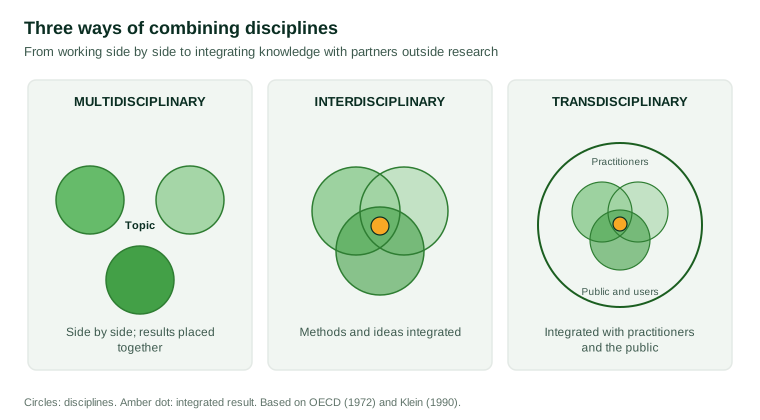
Multidisciplinary research brings together several disciplines to work on a common topic, but each contributes from its own perspective, and the results are placed side by side rather than integrated. A report on an ageing population might contain separate chapters by an economist, a doctor and a sociologist.
Interdisciplinary research integrates knowledge from different disciplines. The United States National Academies defined it as research that integrates information, data, techniques, tools, perspectives, concepts or theories from two or more disciplines to advance understanding or to solve problems beyond the scope of a single discipline (National Academy of Sciences et al., 2005). Integration is the key word: the result is something that none of the disciplines could have produced alone.
Transdisciplinary research goes further, transcending disciplinary boundaries and often involving people outside academia, such as practitioners, policymakers and citizens, in defining problems and producing knowledge. Gibbons et al. (1994) made transdisciplinarity a defining feature of what they called Mode 2 knowledge production, and Lang et al. (2012) described principles for transdisciplinary research on sustainability problems.
Why boundaries are productive
Why should the meeting of disciplines be such a fertile source of new knowledge? Several reasons stand out.
Methods travel. A technique developed for one purpose often turns out to be powerful elsewhere. The design of experiments and the analysis of variance were developed for agricultural field trials in the early twentieth century and later became standard in medicine, psychology and industry. Sampling theory, developed by statisticians, made modern opinion polling and market research possible. When methods cross a boundary, they can solve problems that the receiving field had struggled with for years.
Problems ignore boundaries. Many of the most pressing questions, such as how to reduce disease, manage natural resources or understand consumer behaviour, involve biological, psychological, economic and social factors at once. A single discipline can study only part of such a problem, and its partial answer may be misleading if the other parts are ignored.
Fresh eyes see differently. Researchers from outside a field bring different assumptions and may question what insiders take for granted. Many of the founders of molecular biology, discussed below, came from physics and approached biological questions with expectations formed in a different science.
Recombination creates novelty. New ideas often arise from combining existing ideas in new ways. Because disciplines develop separately, the space of possible combinations across them is large and relatively unexplored. Uzzi et al. (2013), discussed below, found evidence that unusual combinations of prior work are associated with high-impact research, provided they are anchored in familiar foundations.
How new fields are created
Interdisciplinary work often begins as a temporary collaboration but sometimes produces a lasting new field, with its own journals, departments and identity. Historians and sociologists of science have studied how this happens.
Role hybridisation: the birth of psychology
Ben-David and Collins (1966) studied the origins of experimental psychology in nineteenth-century Germany. They noted that the ideas needed for a scientific psychology existed in several countries, but a new discipline emerged only in Germany. Their explanation was social. German physiology was a crowded field with few professorships available. Some physiologists moved into philosophy, where positions were more available, and brought their experimental methods with them. This role hybridisation, combining the methods of one field with the problems and institutional position of another, created a new kind of researcher, and a new discipline formed around the laboratories and students these researchers built up.
From network to specialty: molecular biology
Mullins (1972) traced the development of the "phage group", a network of researchers who studied viruses that infect bacteria and who played a central part in the origins of molecular biology. Several of its founders had trained as physicists. Mullins described a sequence of stages: a small group sharing a new approach, a communication network of people in contact with one another, a tighter cluster of collaborators, and finally an established specialty with its own training programmes, journals and recognised problems. The movement of people trained in one field into the problems of another was central to the process. Mullins's stages also show how much institutional work is needed before a new field is secure. Informal networks must turn into courses that train students, journals that publish the new work, and positions that allow researchers to make careers in it. Without these, promising boundary work often fades when its founders retire or move on.
The psychology of survey response
Survey research offers its own example. For much of the twentieth century, survey methodology was dominated by statistical theory about sampling, while the wording of questions was treated largely as an art. From the 1980s, researchers began applying ideas from cognitive psychology to the question-and-answer process, studying how respondents understand questions, retrieve memories, form judgements and select answers. Tourangeau et al. (2000) brought this work together in a model of the survey response process that is now central to questionnaire design. The result was a new interdisciplinary field that improved surveys by combining the methods of statistics and psychology.
The field continues to grow across boundaries. Modern surveys draw on computer science for online data collection and the analysis of paradata, the records of how respondents moved through a questionnaire; on linguistics and translation studies for surveys conducted in several languages; on visual design for the layout of web and mobile questionnaires; and on data science for combining survey responses with other sources. Each of these exchanges has produced new methods, journals and specialists, illustrating how one interdisciplinary field can itself become the meeting point for others.
Is science becoming more interdisciplinary?
Many people believe that research is becoming more interdisciplinary, and funders often encourage it. The evidence suggests that the trend is real but gradual. Porter and Rafols (2009) measured interdisciplinarity in six research fields over three decades, using the range of disciplines cited in published papers. They found that papers cited a wider range of fields and had more authors over time, but that most of the increase involved neighbouring fields rather than distant ones.
A related change is the rise of teams. Wuchty et al. (2007) analysed nearly 20 million papers and more than 2 million patents over five decades and found that teams increasingly dominate the production of knowledge in almost all fields. Team-authored papers were also more likely to be highly cited. Teams make it easier to combine expertise from several fields, since no single person needs to master them all.
Measuring interdisciplinarity is not simple. Stirling (2007) proposed a general framework in which diversity has three components: variety, the number of different categories involved; balance, how evenly they are represented; and disparity, how different they are from one another. A paper that cites many closely related fields differs from one that combines two very distant ones, and these differences matter for understanding what interdisciplinarity achieves.
Does it work?
Effects on impact and novelty
The evidence on whether interdisciplinary research is more valuable is mixed. Uzzi et al. (2013) studied about 18 million papers and found that the highest-impact work was usually grounded in highly conventional combinations of prior work while also including an unusual combination: novelty worked best when it was anchored in the familiar. Wang et al. (2015) found that the different components of interdisciplinarity identified by Stirling had different effects on the later citations a paper received, so that whether interdisciplinarity helps depends on what kind of combination is involved.
Leahey et al. (2017) studied the careers of scientists and found that interdisciplinary research had both costs and benefits. Scientists whose work was more interdisciplinary published fewer papers, perhaps because integration takes more time and such work is harder to publish, but their papers were more visible and received more citations. They summarised the result as "prominent but less productive".
Costs and barriers
Interdisciplinary research also faces institutional obstacles. Bromham et al. (2016) analysed more than 18,000 research proposals submitted to the Australian Research Council and found that the more interdisciplinary a proposal was, the lower its chance of being funded, even though funders officially encouraged such work. Reviewers from a single discipline may find it hard to judge proposals that draw on fields they do not know.
Early-career researchers face particular risks. Rhoten and Parker (2004) surveyed graduate students and postdoctoral researchers and found that while many valued interdisciplinary work, they worried that it would harm their prospects in a job market organised by discipline. Jacobs and Frickel (2009) reviewed the research literature and concluded that claims for the benefits of interdisciplinarity often ran ahead of the evidence, and that disciplines themselves are more open to outside ideas than critics often assume.
Evaluation is a recurring difficulty. Peer review works well when reviewers share standards with the authors, but interdisciplinary work may be judged by reviewers from only one of the fields involved, each of whom sees the weaknesses in their own area and undervalues the contributions from the others. Journals organised by discipline may regard interdisciplinary papers as falling outside their scope. Promotion committees may be unsure how to weigh publications in unfamiliar venues. The National Academy of Sciences et al. (2005) recommended that universities and funders adapt their review and reward systems, for example by using mixed review panels and by recognising joint appointments, so that interdisciplinary researchers are not penalised for the very breadth that makes their work valuable.
What makes teams work
Research on collaborative science, sometimes called the science of team science, has examined what helps interdisciplinary teams succeed (Stokols et al., 2008). Cummings and Kiesler (2005) studied a large set of collaborative research projects funded by the United States National Science Foundation. They found that projects involving many different disciplines were not, in themselves, less successful. What harmed outcomes was spreading a project across many separate institutions, because coordination became harder. Projects that used deliberate coordination mechanisms, such as regular meetings, shared workspaces and exchanges of students, overcame much of this difficulty.
Working across boundaries
Scholars of science have described several mechanisms that allow people from different disciplines to work together without fully sharing each other's expertise.
Trading zones
Galison (1997) studied how theorists, experimenters and engineers in twentieth-century physics collaborated despite having different concepts and priorities. He described the places where they met as trading zones, borrowing the idea from anthropology. In a trading zone, groups develop simplified shared languages, like the pidgins that arise between trading peoples, that allow them to coordinate without agreeing on everything. Over time, these languages can grow into fuller "creoles" and, eventually, into new fields.
Interactional expertise
Collins et al. (2007) added that successful trading zones often depend on people with interactional expertise: people who have learned to speak the language of another field fluently enough to understand its practitioners and translate between them, even though they could not do that field's work themselves. Such people play a crucial bridging role in interdisciplinary teams.
Boundary objects
Star and Griesemer (1989) studied how amateurs, professional scientists, administrators and collectors cooperated in building a natural history museum. They introduced the concept of boundary objects: things, such as specimens, maps, forms and standardised records, that are flexible enough to serve the different needs of each group yet stable enough to maintain a common identity across them. In interdisciplinary research, shared data sets, models, diagrams and questionnaires often serve as boundary objects. A survey questionnaire is a good example. The statistician sees it as a measurement instrument, the client sees it as a list of business questions, the programmer sees it as a specification for software, and the respondent sees it as a conversation. Each group uses it differently, but because they all work from the same document, their efforts can be coordinated.
A process for interdisciplinary research
Several writers have proposed practical guides for doing interdisciplinary research. Repko and Szostak (2020) set out a process that begins by defining the problem and justifying an interdisciplinary approach, then identifies the relevant disciplines and gathers their insights, and finally works to identify conflicts between those insights, create common ground and construct a more comprehensive understanding. They emphasise that integration does not happen automatically: it requires deliberate work to identify where disciplines disagree and why.
The Oxford handbook edited by Frodeman (2017) brings together many perspectives on the theory and practice of interdisciplinarity, from research and teaching to policy and evaluation, and shows how far the subject has developed into a field of study in its own right.
Lessons for organisations that combine expertise
Applied research organisations are interdisciplinary by nature. A single survey project may require statisticians, questionnaire designers, subject experts, programmers, data analysts, visual designers and client specialists. The research reviewed above suggests several practical lessons.
Integrate, do not just assemble. Placing experts side by side produces multidisciplinary work. Interdisciplinary value comes from integration: designing the questionnaire, sample and analysis together so that each informs the others.
Build shared language deliberately. Specialists use the same words differently. Terms such as "significant", "segment", "weight" or "bias" can mean different things to a statistician, a marketer and a psychologist. Glossaries, shared definitions and early discussion of key terms reduce misunderstanding.
Value bridging people. People with interactional expertise, who understand both the technical and the business side of a project, are often the most valuable members of a team. Organisations should recognise and develop this skill.
Use boundary objects. Shared documents, such as a question-by-question specification, a data dictionary or an analysis plan, allow different specialists to coordinate their work around a common reference.
Coordinate actively. As Cummings and Kiesler (2005) found, the main barrier is often coordination, not difference of discipline. Regular meetings and clear responsibilities matter more as teams grow and spread across organisations.
Anchor novelty in sound methods. Uzzi et al. (2013) found that the most influential work combined novel connections with a conventional foundation. In applied research, innovative approaches are most trusted when built on well-established methods.
Evaluate fairly. Work that crosses boundaries should be judged by people who understand all the fields involved, or by mixed panels, rather than by the standards of a single specialism.
Conclusion
New knowledge is often created at the boundaries between disciplines, where methods developed for one set of problems are applied to another, and where people trained in different traditions learn to work together. The history of fields such as psychology, molecular biology and survey methodology shows that such boundary work can create entirely new disciplines. Yet interdisciplinary research is also costly, slower to produce results and harder to evaluate, and the evidence on its benefits is more mixed than enthusiasts sometimes claim. Its success depends on deliberate integration, shared language, bridging people and careful coordination. For organisations whose work combines several kinds of expertise, these are not abstract lessons. They describe the everyday conditions for producing knowledge that no single specialism could produce alone.
References
Abbott, A. (2001). Chaos of disciplines. University of Chicago Press.
Becher, T., & Trowler, P. R. (2001). Academic tribes and territories: Intellectual enquiry and the culture of disciplines (2nd ed.). Society for Research into Higher Education & Open University Press.
Ben-David, J., & Collins, R. (1966). Social factors in the origins of a new science: The case of psychology. American Sociological Review, 31(4), 451–465. https://doi.org/10.2307/2090769
Bromham, L., Dinnage, R., & Hua, X. (2016). Interdisciplinary research has consistently lower funding success. Nature, 534(7609), 684–687. https://doi.org/10.1038/nature18315
Collins, H., Evans, R., & Gorman, M. (2007). Trading zones and interactional expertise. Studies in History and Philosophy of Science Part A, 38(4), 657–666. https://doi.org/10.1016/j.shpsa.2007.09.003
Cummings, J. N., & Kiesler, S. (2005). Collaborative research across disciplinary and organizational boundaries. Social Studies of Science, 35(5), 703–722. https://doi.org/10.1177/0306312705055535
Frodeman, R. (Ed.). (2017). The Oxford handbook of interdisciplinarity (2nd ed.). Oxford University Press. https://doi.org/10.1093/oxfordhb/9780198733522.001.0001
Galison, P. (1997). Image and logic: A material culture of microphysics. University of Chicago Press.
Gibbons, M., Limoges, C., Nowotny, H., Schwartzman, S., Scott, P., & Trow, M. (1994). The new production of knowledge: The dynamics of science and research in contemporary societies. SAGE.
Jacobs, J. A., & Frickel, S. (2009). Interdisciplinarity: A critical assessment. Annual Review of Sociology, 35, 43–65. https://doi.org/10.1146/annurev-soc-070308-115954
Klein, J. T. (1990). Interdisciplinarity: History, theory, and practice. Wayne State University Press.
Lang, D. J., Wiek, A., Bergmann, M., Stauffacher, M., Martens, P., Moll, P., Swilling, M., & Thomas, C. J. (2012). Transdisciplinary research in sustainability science: Practice, principles, and challenges. Sustainability Science, 7(Suppl. 1), 25–43. https://doi.org/10.1007/s11625-011-0149-x
Leahey, E., Beckman, C. M., & Stanko, T. L. (2017). Prominent but less productive: The impact of interdisciplinarity on scientists' research. Administrative Science Quarterly, 62(1), 105–139. https://doi.org/10.1177/0001839216665364
Mullins, N. C. (1972). The development of a scientific specialty: The phage group and the origins of molecular biology. Minerva, 10(1), 51–82. https://doi.org/10.1007/BF01881390
National Academy of Sciences, National Academy of Engineering, & Institute of Medicine. (2005). Facilitating interdisciplinary research. National Academies Press. https://doi.org/10.17226/11153
OECD. (1972). Interdisciplinarity: Problems of teaching and research in universities. Organisation for Economic Co-operation and Development, Centre for Educational Research and Innovation.
Porter, A. L., & Rafols, I. (2009). Is science becoming more interdisciplinary? Measuring and mapping six research fields over time. Scientometrics, 81(3), 719–745. https://doi.org/10.1007/s11192-008-2197-2
Repko, A. F., & Szostak, R. (2020). Interdisciplinary research: Process and theory (4th ed.). SAGE.
Rhoten, D., & Parker, A. (2004). Risks and rewards of an interdisciplinary research path. Science, 306(5704), 2046. https://doi.org/10.1126/science.1103628
Star, S. L., & Griesemer, J. R. (1989). Institutional ecology, "translations" and boundary objects: Amateurs and professionals in Berkeley's Museum of Vertebrate Zoology, 1907–39. Social Studies of Science, 19(3), 387–420. https://doi.org/10.1177/030631289019003001
Stirling, A. (2007). A general framework for analysing diversity in science, technology and society. Journal of the Royal Society Interface, 4(15), 707–719. https://doi.org/10.1098/rsif.2007.0213
Stokols, D., Hall, K. L., Taylor, B. K., & Moser, R. P. (2008). The science of team science: Overview of the field and introduction to the supplement. American Journal of Preventive Medicine, 35(2, Suppl.), S77–S89. https://doi.org/10.1016/j.amepre.2008.05.002
Tourangeau, R., Rips, L. J., & Rasinski, K. (2000). The psychology of survey response. Cambridge University Press. https://doi.org/10.1017/CBO9780511819322
Uzzi, B., Mukherjee, S., Stringer, M., & Jones, B. (2013). Atypical combinations and scientific impact. Science, 342(6157), 468–472. https://doi.org/10.1126/science.1240474
Wang, J., Thijs, B., & Glänzel, W. (2015). Interdisciplinarity and impact: Distinct effects of variety, balance, and disparity. PLOS ONE, 10(5), Article e0127298. https://doi.org/10.1371/journal.pone.0127298
Wuchty, S., Jones, B. F., & Uzzi, B. (2007). The increasing dominance of teams in production of knowledge. Science, 316(5827), 1036–1039. https://doi.org/10.1126/science.1136099