
The Generation of Knowledge · Knowledge production
Cumulative Knowledge: Standing on the Shoulders of Giants
How knowledge builds on earlier knowledge, from the medieval image of dwarfs on the shoulders of giants to citation networks and meta-analysis, why accumulation is getting harder, how it breaks down, and how research organisations can build on what is already known.
"If I have seen further it is by standing on the shoulders of Giants." Isaac Newton wrote these words in a letter to Robert Hooke in 1676, and they have become the best-known expression of the idea that knowledge is cumulative: each generation builds on the work of those who came before. The idea seems obvious, but it raises real questions. How does knowledge accumulate? What makes accumulation possible, and what breaks it? Is it getting harder as the body of knowledge grows? This article examines these questions and what they mean for organisations that produce research.
An old image
Newton did not invent the image. The sociologist Robert Merton traced its long history in a playful but scholarly book (Merton, 1965), showing that it was already old when Newton used it. The earliest recorded version comes from the twelfth-century scholar John of Salisbury, who attributed it to his teacher, Bernard of Chartres. According to John, Bernard said that we are like dwarfs perched on the shoulders of giants, able to see more and farther than they did, not because our sight is sharper or our height greater, but because we are carried high by their giant size (John of Salisbury, 1955).
The image expresses two ideas at once. It is humble, because it credits predecessors with most of the achievement. And it is optimistic, because it implies that even ordinary people, building on what has been done, can extend the reach of knowledge.
How knowledge accumulates
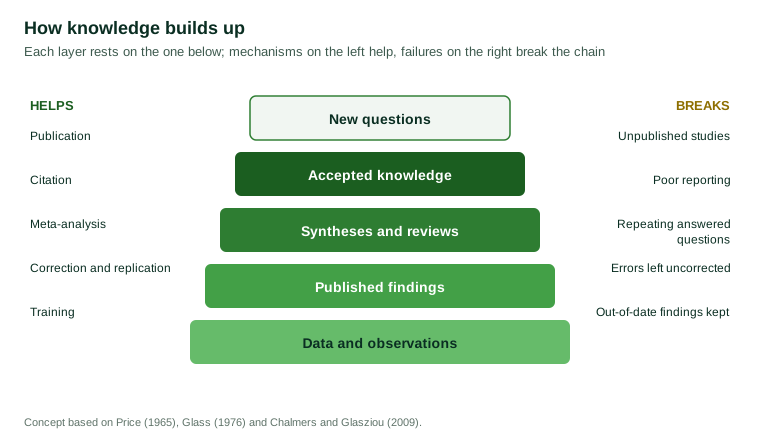
Knowledge accumulates through several mechanisms that work together.
Publication records findings in a permanent, public form that others can read and build upon. Without it, each generation would have to rediscover what its predecessors knew.
Citation links new work to the work it depends on. Garfield (1955) proposed a citation index for science that would allow researchers to trace how ideas were taken up by later work. Price (1965) used citation data to show that scientific papers form a network in which recent papers cite a "research front" of other recent work, while also drawing on a smaller body of classic papers. The network of citations is a map of how knowledge builds on knowledge.
Synthesis combines many studies to establish what is known. Glass (1976) introduced the term meta-analysis for the statistical analysis of results from many studies, which allows researchers to estimate an effect more precisely than any single study can and to examine why results differ.
Correction removes errors from the accumulated stock. Replication, criticism and new evidence allow mistaken findings to be identified and revised. Accumulation without correction would simply pile errors on errors.
Training passes on skills and tacit knowledge, so that each generation of researchers can use the methods and instruments developed by the last.
The growth of the stock
The result of accumulation has been rapid growth in the amount of published knowledge. Price (1963) argued that by most measures, such as the number of scientists, journals and papers, science had grown exponentially since the seventeenth century, doubling roughly every ten to fifteen years. Bornmann and Mutz (2015) analysed publication and citation data and estimated that, since the mid-twentieth century, the global output of science has grown by about 8 to 9% a year, which implies a doubling of output roughly every nine years.
Is it getting harder?
A growing stock of knowledge creates its own difficulty. Before researchers can add to a field, they must learn what is already known. Jones (2009) called this the burden of knowledge. He found that inventors were older when they made their first inventions, more specialised and more likely to work in teams than in earlier decades, which suggests that reaching the frontier takes longer as the frontier moves outward.
Bloom et al. (2020) asked whether ideas are getting harder to find. Across a range of fields, they found that the number of researchers needed to sustain a constant rate of progress has risen sharply. For example, the research effort needed to keep doubling the density of computer chips was more than eighteen times greater than in the early 1970s. Accumulation continues, but each new step requires more effort.
When knowledge does not accumulate
Not all knowledge accumulates smoothly. Kuhn (1962) argued that scientific revolutions replace one framework with another, and that some problems and concepts of the old framework are abandoned rather than built upon. Laudan (1977) suggested that progress is best measured by a field's growing ability to solve problems, accepting that some earlier solutions may be lost along the way.
Accumulation also fails for more ordinary reasons. Chalmers and Glasziou (2009) estimated that as much as 85% of investment in biomedical research is wasted, because studies ask questions that have already been answered, use weak designs, are never published or are reported too poorly to be used. Lau et al. (1992) showed how much this can matter. By combining clinical trials of a drug used to treat heart attacks in the order in which they were published, they showed that its benefit could have been established years before the last trials were conducted and before textbooks recommended it. Patients in later trials received placebos when the evidence already favoured treatment. Knowledge existed, but because it had not been synthesised, it was not used.
Some knowledge also goes out of date. Arbesman (2012) described how facts in many fields have a "half-life", as findings are revised or overturned over time. Cumulative knowledge requires not only adding new findings but also retiring old ones.
Finally, fields differ in how well they accumulate. It is often assumed that the physical sciences are more cumulative than the social sciences. Hedges (1987) tested this by comparing the consistency of results across studies in particle physics and in psychology and found, surprisingly, that the two were similar. The cumulativeness of a field may depend more on its research practices than on its subject matter.
Ownership and cumulative innovation
When knowledge can be owned, accumulation raises economic questions. Scotchmer (1991) analysed how patent law should treat cumulative innovation, in which later inventions build on earlier ones. Strong protection for the first inventor rewards pioneering work but may block or tax later improvements; weak protection does the reverse. The balance determines how quickly a field can build on its own results.
Accumulation inside organisations
The same mechanisms, and the same failures, operate inside organisations. A research firm, a marketing department or a government statistical office builds up knowledge over years of projects: which questions work, how particular groups respond, what earlier studies found and why some results turned out to be wrong. Much of this knowledge is never published. It sits in project files, in the memories of experienced staff and in data sets that only their creators fully understand. When those people leave, or when files are stored in ways that no one else can search, the organisation loses the ability to build on its own past. It may then repeat studies it has already done, or repeat mistakes it has already corrected. The giants on whose shoulders an organisation stands are often its own former projects, and keeping them within reach takes deliberate effort.
Building on what is known in applied research
For organisations that generate knowledge, the history of cumulative knowledge suggests several practical rules.
Start with what is already known. Before designing a new study, review existing research, previous surveys and internal data. A new survey that repeats questions already answered elsewhere wastes resources and respondents' time.
Make results reusable. Record methods, questionnaires, definitions and data in forms that others, including future colleagues, can understand and use.
Synthesise. Combining results from several studies, waves or markets often reveals more than any one study. Tracking studies that ask the same questions over time are a form of cumulative knowledge in themselves.
Correct and retire. Mark findings that have been superseded, and update conclusions when new evidence arrives.
Credit predecessors. Citing sources accurately allows readers to trace the foundations of a claim and judge its strength.
Conclusion
The image of dwarfs on the shoulders of giants captures something true about knowledge: its growth depends on preserving, connecting and building upon earlier work. But accumulation is not automatic. It requires publication, citation, synthesis, correction and training, and it can fail when research is unpublished, poorly reported, ignored or never brought together. As the stock of knowledge grows, building on it takes more effort. Organisations that take the work of accumulation seriously, by starting from what is known and leaving reusable records for those who follow, give their own research the best chance of seeing further.
References
Arbesman, S. (2012). The half-life of facts: Why everything we know has an expiration date. Current.
Bloom, N., Jones, C. I., Van Reenen, J., & Webb, M. (2020). Are ideas getting harder to find? American Economic Review, 110(4), 1104–1144. https://doi.org/10.1257/aer.20180338
Bornmann, L., & Mutz, R. (2015). Growth rates of modern science: A bibliometric analysis based on the number of publications and cited references. Journal of the Association for Information Science and Technology, 66(11), 2215–2222. https://doi.org/10.1002/asi.23329
Chalmers, I., & Glasziou, P. (2009). Avoidable waste in the production and reporting of research evidence. The Lancet, 374(9683), 86–89. https://doi.org/10.1016/S0140-6736(09)60329-9
Garfield, E. (1955). Citation indexes for science: A new dimension in documentation through association of ideas. Science, 122(3159), 108–111. https://doi.org/10.1126/science.122.3159.108
Glass, G. V. (1976). Primary, secondary, and meta-analysis of research. Educational Researcher, 5(10), 3–8. https://doi.org/10.3102/0013189X005010003
Hedges, L. V. (1987). How hard is hard science, how soft is soft science? The empirical cumulativeness of research. American Psychologist, 42(5), 443–455. https://doi.org/10.1037/0003-066X.42.5.443
John of Salisbury. (1955). The Metalogicon of John of Salisbury: A twelfth-century defense of the verbal and logical arts of the trivium (D. D. McGarry, Trans.). University of California Press. (Original work written 1159)
Jones, B. F. (2009). The burden of knowledge and the "death of the Renaissance man": Is innovation getting harder? The Review of Economic Studies, 76(1), 283–317. https://doi.org/10.1111/j.1467-937X.2008.00531.x
Kuhn, T. S. (1962). The structure of scientific revolutions. University of Chicago Press.
Lau, J., Antman, E. M., Jimenez-Silva, J., Kupelnick, B., Mosteller, F., & Chalmers, T. C. (1992). Cumulative meta-analysis of therapeutic trials for myocardial infarction. The New England Journal of Medicine, 327(4), 248–254. https://doi.org/10.1056/NEJM199207233270406
Laudan, L. (1977). Progress and its problems: Towards a theory of scientific growth. University of California Press.
Merton, R. K. (1965). On the shoulders of giants: A Shandean postscript. Free Press.
Price, D. J. de S. (1963). Little science, big science. Columbia University Press.
Price, D. J. de S. (1965). Networks of scientific papers. Science, 149(3683), 510–515. https://doi.org/10.1126/science.149.3683.510
Scotchmer, S. (1991). Standing on the shoulders of giants: Cumulative research and the patent law. Journal of Economic Perspectives, 5(1), 29–41. https://doi.org/10.1257/jep.5.1.29