
The Generation of Knowledge · Knowledge production
Citizen-Generated Knowledge
How members of the public contribute to research, from counting birds and classifying galaxies to challenging experts with local knowledge, the levels at which they can take part, the evidence on data quality, the ethical questions involved, and what citizen science means for organisations that gather information from the public.
Knowledge is not produced only by professional researchers. For centuries, amateur naturalists, astronomers, weather observers and local historians have collected observations that professionals later used. Since the 1990s, this tradition has grown into a recognised field known as citizen science, in which members of the public take part in research, often in very large numbers and with the help of the internet and mobile phones. Alongside it, social scientists have documented how ordinary people, drawing on their own experience, have sometimes corrected or challenged the knowledge of experts. This article examines the forms that citizen-generated knowledge takes, the evidence on its quality and value, the ethical questions it raises and the lessons it offers for organisations that collect information from the public.
Two meanings of citizen science
The term has two origins, both from the mid-1990s. The sociologist Alan Irwin used "citizen science" to describe science that responds to the concerns and needs of citizens and that draws on the knowledge citizens themselves possess (Irwin, 1995). His emphasis was democratic: science should be accountable to the public, and people's local and practical knowledge should be taken seriously. At about the same time, researchers at the Cornell Lab of Ornithology in the United States used the term for projects in which members of the public collect data for scientific research. Bonney et al. (2009) described the model developed at Cornell, in which volunteers follow standard protocols to gather observations that scientists then analyse, and argued that such projects both expand scientific knowledge and improve participants' understanding of science.
The two meanings overlap but differ in emphasis. One sees citizens mainly as contributors of data; the other sees them as holders of knowledge and as partners in deciding what questions research should ask. Heigl et al. (2019) noted that the wide range of activities now described as citizen science has made it difficult to agree on a single definition, and called for shared criteria to clarify what counts.
Levels of participation
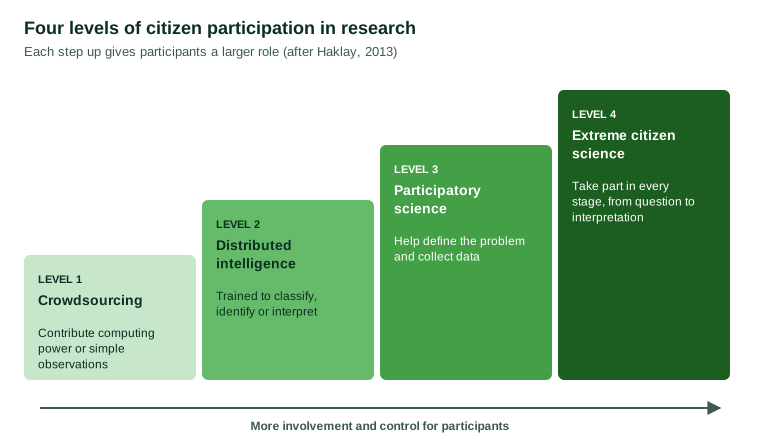
Citizen participation in research ranges from simple data collection to full partnership. Haklay (2013) proposed a four-level typology.
At the first level, crowdsourcing, participants contribute resources such as computing power or simple observations, with little cognitive involvement. At the second level, distributed intelligence, participants are trained to perform tasks that require judgement, such as identifying species or classifying images. At the third level, participatory science, participants help define the problem and take part in data collection, often on issues that affect their own communities. At the fourth level, extreme citizen science, participants are involved in every stage, from choosing the problem to analysing data and interpreting results, working as collaborators with professional scientists.
Wiggins and Crowston (2011) classified citizen science projects instead by their purpose, distinguishing projects focused on action, conservation, investigation, virtual (online) activities and education. Both classifications show that "citizen science" covers a wide variety of arrangements, from huge online projects with minimal individual involvement to small community studies in which local people lead.
Examples of citizen-generated knowledge
Observing nature
Bird watchers are among the oldest and largest groups of citizen scientists. Annual bird counts organised by volunteers in North America date back to the beginning of the twentieth century. eBird, launched by the Cornell Lab of Ornithology and the National Audubon Society, allows bird watchers around the world to submit their observations online. Sullivan et al. (2009) described how the project combined millions of observations into a database used to study bird distribution, migration and population change at a scale that professional researchers alone could not achieve.
Classifying galaxies
Some projects ask volunteers to perform tasks that computers once could not do well. In Galaxy Zoo, members of the public classified images of galaxies from a large astronomical survey by their shape. Lintott et al. (2008) reported that more than 100,000 participants classified nearly 900,000 galaxies, and that their combined classifications agreed well with those of professional astronomers. The scale of participation allowed each galaxy to be classified many times, so that errors by individual volunteers could be identified and averaged out.
Solving puzzles
Foldit turned the problem of predicting the structures of proteins into an online game. Cooper et al. (2010) found that players, working in teams and using strategies that they developed themselves, could match or outperform a leading computer algorithm on some structure prediction problems. The project showed that human spatial reasoning and problem-solving skills could make real contributions to scientific problems.
Mapping the world
Goodchild (2007) described the rise of volunteered geographic information, in which members of the public create and share maps and location data, as in the OpenStreetMap project. He called such contributors "citizens as sensors", noting that billions of people could act as observers of their local environments.
Lay knowledge and expert knowledge
Citizen-generated knowledge is not limited to collecting data under scientists' direction. Some of the most influential studies of public knowledge show citizens challenging experts.
Wynne (1996) studied sheep farmers in the English Lake District after the Chernobyl nuclear accident of 1986 spread radioactive contamination across their land. Government scientists predicted that restrictions on the sale of sheep would be short. The farmers, drawing on detailed knowledge of their land and flocks, doubted the scientists' assumptions, and the restrictions in fact lasted far longer than predicted. Wynne argued that the scientists had failed to recognise the value of the farmers' practical knowledge, and that this failure damaged public trust in expert advice.
Brown (1992) described popular epidemiology, in which residents of communities affected by pollution gather evidence about illness and its possible causes. In the case of Woburn, Massachusetts, residents who noticed an unusual number of childhood leukaemia cases collected information, sought help from scientists and pressed for investigation of contaminated water supplies. Epstein (1995) showed how AIDS activists in the United States acquired enough scientific knowledge to engage with researchers on equal terms, and influenced the design of clinical trials of new treatments.
Collins and Evans (2002) offered a framework for understanding such cases. They argued that expertise does not always require formal qualifications. People can acquire genuine experience-based expertise about their own circumstances, and in some cases that expertise can contribute directly to technical decisions. Cornwall and Jewkes (1995) argued that the defining feature of participatory research is where control lies: who defines the questions, who collects and interprets the data, and who owns the results.
Can citizen data be trusted?
A common concern is data quality. Volunteers may be untrained, inconsistent or careless, and some may have interests in particular results. Kosmala et al. (2016) reviewed the evidence and concluded that citizen science data can be as reliable as data collected by professionals, provided that projects are designed with quality in mind. Effective strategies include clear protocols, training and testing of volunteers, simple tasks, repeated observations of the same items by different people, expert checking of a sample of records, and statistical methods that account for differences between observers.
The Galaxy Zoo approach of classifying each item many times illustrates one principle: aggregating many independent judgements can produce accurate results even when individual judgements vary. Another principle is transparency: recording who made each observation, how and under what conditions allows analysts to model and correct for errors.
Why citizen science has grown
Silvertown (2009) identified several reasons for the rapid growth of citizen science. New technologies, such as the internet, smartphones with cameras and location sensors, and online platforms for sharing data, made it easier to recruit volunteers and collect their observations. Professional scientists recognised that volunteers could provide a free and skilled labour force for projects that needed observations across large areas or long periods. Funders increasingly expected research to engage the public. And many people wanted to contribute to science and learn about the natural world.
Ethical questions
Citizen-generated knowledge raises ethical questions. Resnik et al. (2015) identified issues including data quality and integrity, ownership of data, credit for contributions, the risk of exploiting unpaid labour, conflicts of interest and the protection of participants' privacy. Volunteers who contribute significantly to a discovery may expect to be acknowledged. Communities that provide data about themselves may expect to share in the benefits and to have a say in how the data are used. Data collected by volunteers may include information about their locations and habits, which needs to be protected.
Lessons for organisations that gather public input
Organisations that conduct surveys and consult the public already depend on people's willingness to share knowledge about their own lives, opinions and experiences. Citizen science and research on lay expertise offer several lessons.
Respect participants' knowledge. People are experts in their own experience. Questions should be designed to draw on that expertise, and open responses can reveal knowledge that researchers did not anticipate.
Design for quality. Clear instructions, simple tasks, built-in checks and appropriate statistical methods improve the reliability of information provided by the public.
Consider deeper participation. For some projects, involving people from the communities being studied in defining questions and interpreting results can produce more relevant and trusted findings.
Be transparent and fair. Explain how contributions will be used, protect personal information and share findings with participants where possible.
Value disagreement. When people's experience conflicts with expert assumptions, as in the case of the Cumbrian sheep farmers, the conflict may reveal an error in the assumptions rather than in the people.
Conclusion
Citizen-generated knowledge takes many forms, from the mass classification of galaxies to communities investigating threats to their health. The evidence shows that members of the public can produce reliable data when projects are well designed, and that their practical knowledge can correct the assumptions of experts. Citizen science also raises questions of quality, credit, ownership and privacy that must be addressed deliberately. For organisations that gather information from the public, the central lesson is that people are not only sources of data but holders of knowledge, and that treating them as partners can improve both the quality and the legitimacy of what is learned.
References
Bonney, R., Cooper, C. B., Dickinson, J., Kelling, S., Phillips, T., Rosenberg, K. V., & Shirk, J. (2009). Citizen science: A developing tool for expanding science knowledge and scientific literacy. BioScience, 59(11), 977–984. https://doi.org/10.1525/bio.2009.59.11.9
Brown, P. (1992). Popular epidemiology and toxic waste contamination: Lay and professional ways of knowing. Journal of Health and Social Behavior, 33(3), 267–281. https://doi.org/10.2307/2137356
Collins, H. M., & Evans, R. (2002). The third wave of science studies: Studies of expertise and experience. Social Studies of Science, 32(2), 235–296. https://doi.org/10.1177/0306312702032002003
Cooper, S., Khatib, F., Treuille, A., Barbero, J., Lee, J., Beenen, M., Leaver-Fay, A., Baker, D., Popović, Z., & Foldit players. (2010). Predicting protein structures with a multiplayer online game. Nature, 466(7307), 756–760. https://doi.org/10.1038/nature09304
Cornwall, A., & Jewkes, R. (1995). What is participatory research? Social Science & Medicine, 41(12), 1667–1676. https://doi.org/10.1016/0277-9536(95)00127-S
Epstein, S. (1995). The construction of lay expertise: AIDS activism and the forging of credibility in the reform of clinical trials. Science, Technology, & Human Values, 20(4), 408–437. https://doi.org/10.1177/016224399502000402
Goodchild, M. F. (2007). Citizens as sensors: The world of volunteered geography. GeoJournal, 69(4), 211–221. https://doi.org/10.1007/s10708-007-9111-y
Haklay, M. (2013). Citizen science and volunteered geographic information: Overview and typology of participation. In D. Sui, S. Elwood, & M. Goodchild (Eds.), Crowdsourcing geographic knowledge: Volunteered geographic information (VGI) in theory and practice (pp. 105–122). Springer. https://doi.org/10.1007/978-94-007-4587-2_7
Heigl, F., Kieslinger, B., Paul, K. T., Uhlik, J., & Dörler, D. (2019). Toward an international definition of citizen science. Proceedings of the National Academy of Sciences, 116(17), 8089–8092. https://doi.org/10.1073/pnas.1903393116
Irwin, A. (1995). Citizen science: A study of people, expertise and sustainable development. Routledge.
Kosmala, M., Wiggins, A., Swanson, A., & Simmons, B. (2016). Assessing data quality in citizen science. Frontiers in Ecology and the Environment, 14(10), 551–560. https://doi.org/10.1002/fee.1436
Lintott, C. J., Schawinski, K., Slosar, A., Land, K., Bamford, S., Thomas, D., Raddick, M. J., Nichol, R. C., Szalay, A., Andreescu, D., Murray, P., & Vandenberg, J. (2008). Galaxy Zoo: Morphologies derived from visual inspection of galaxies from the Sloan Digital Sky Survey. Monthly Notices of the Royal Astronomical Society, 389(3), 1179–1189. https://doi.org/10.1111/j.1365-2966.2008.13689.x
Resnik, D. B., Elliott, K. C., & Miller, A. K. (2015). A framework for addressing ethical issues in citizen science. Environmental Science & Policy, 54, 475–481. https://doi.org/10.1016/j.envsci.2015.05.008
Silvertown, J. (2009). A new dawn for citizen science. Trends in Ecology & Evolution, 24(9), 467–471. https://doi.org/10.1016/j.tree.2009.03.017
Sullivan, B. L., Wood, C. L., Iliff, M. J., Bonney, R. E., Fink, D., & Kelling, S. (2009). eBird: A citizen-based bird observation network in the biological sciences. Biological Conservation, 142(10), 2282–2292. https://doi.org/10.1016/j.biocon.2009.05.006
Wiggins, A., & Crowston, K. (2011). From conservation to crowdsourcing: A typology of citizen science. In Proceedings of the 44th Hawaii International Conference on System Sciences (pp. 1–10). IEEE. https://doi.org/10.1109/HICSS.2011.207
Wynne, B. (1996). May the sheep safely graze? A reflexive view of the expert–lay knowledge divide. In S. Lash, B. Szerszynski, & B. Wynne (Eds.), Risk, environment and modernity: Towards a new ecology (pp. 44–83). SAGE.