
The Generation of Knowledge · Trust, quality and the future
Filter Bubbles and Fragmented Knowledge
What filter bubbles and echo chambers are, what large studies of online news exposure have found, why the evidence is more mixed than popular accounts suggest, and what the fragmentation of audiences means for shared knowledge and for research.
When people get their news and information through personalised online services, each person may see a different version of the world. In 1995, the technologist Nicholas Negroponte imagined a "Daily Me", a newspaper assembled entirely to suit one reader's interests (Negroponte, 1995). What seemed a convenience soon prompted concern. If everyone sees only what suits their existing views, how can a society keep a shared body of knowledge on which to argue and decide? This article examines the ideas of filter bubbles and echo chambers, what the research has found and what fragmentation means for knowledge.
Two related ideas
Pariser (2011) coined the term filter bubble to describe the personal world of information created when algorithms select content based on what a person has clicked, liked and searched for in the past. He argued that such filtering is invisible, because people do not know what has been left out, and that it is not chosen, because people do not decide to enter the bubble. The result, he warned, could be a narrowing of exposure to unfamiliar ideas and a loss of the common experiences that a democracy needs.
Sunstein (2017) focused on echo chambers: communities in which people hear mainly views that repeat and reinforce their own. Drawing on research into group polarisation, he argued that like-minded groups tend to move towards more extreme versions of the views their members started with. When people can choose to interact only with those who agree with them, discussion may make them more confident and more extreme rather than better informed.
Both ideas build on a long-established finding about social life. McPherson et al. (2001) reviewed research on homophily, the tendency of people to form ties with others who are similar to them in characteristics such as age, education, religion and political views. Homophily existed long before the internet. It shapes who people talk to and therefore what information reaches them.
What the evidence shows
The fear of filter bubbles prompted a large body of research, and its findings are more mixed than popular accounts suggest.
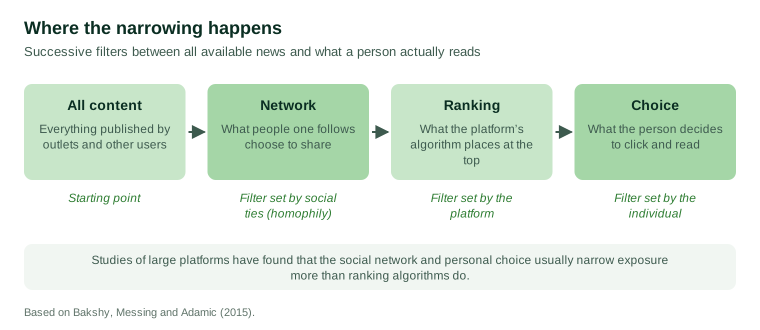
Bakshy et al. (2015) studied the exposure of about 10 million Facebook users in the United States to news that cut across their political views. They separated three filters: the friends people chose, the ranking algorithm of the news feed, and the content people chose to click. Each filter reduced exposure to opposing views, but the algorithm had a smaller effect than people's own choices of friends and of what to read. This finding has been criticised because it was produced by researchers working for the platform, but it suggests that much of the narrowing comes from people themselves.
Gentzkow and Shapiro (2011) measured ideological segregation in news consumption in the United States. They found that segregation online was low in absolute terms. It was higher than for most offline media such as national television, but much lower than segregation in face-to-face networks of friends, neighbours and colleagues. Flaxman et al. (2016) analysed the web browsing histories of 50,000 Americans. They found that news reached through social media and search engines was associated with greater ideological distance between individuals, but also with greater exposure to opposing views. Most online news consumption came from people visiting the websites of mainstream outlets directly.
Other studies have found that many people encounter more varied information online than offline. Fletcher and Nielsen (2018) compared surveys in Italy, Australia, the United Kingdom and the United States and found that people who used social media for other purposes were exposed to news from more sources than those who did not use social media at all. Dubois and Blank (2018) surveyed adults in the United Kingdom and found that those who were interested in politics and used a varied range of media generally avoided echo chambers. The people most at risk were those with little interest in politics and few sources of news. Bruns (2019) concluded that the filter bubble, as usually described, is largely a myth, and that the more important divides are between groups who reject mainstream information sources altogether and everyone else.
Recent experiments have tested the effect of algorithms directly. Guess et al. (2023) worked with researchers at Meta to change the news feeds of consenting users during the 2020 United States election, for example by showing posts in chronological order rather than ranked by the algorithm. Users spent less time on the platform, but there were no detectable changes in their levels of polarisation or political attitudes over the three months of the study. Nyhan et al. (2023) reduced the share of content from like-minded sources in users' feeds by about a third and likewise found no measurable effect on polarisation.
Exposure to opposing views does not always help either. Bail et al. (2018) paid Twitter users in the United States to follow an account that shared messages from political leaders and commentators of the opposing side. After a month, Republicans who followed a liberal account expressed substantially more conservative views. Democrats who followed a conservative account became slightly more liberal, although this change was not statistically significant. Simply breaking a bubble, in other words, may not produce understanding.
Fragmentation beyond bubbles
If personalised algorithms are not the main cause of division, the concern about fragmented knowledge has not gone away. Cinelli et al. (2021) analysed more than 100 million pieces of content on several platforms and found that some platforms showed strong clustering of users with similar views, while others showed much less. Platform design appears to matter. Zuiderveen Borgesius et al. (2016) concluded that the empirical evidence did not justify serious worry about filter bubbles at that time, but that the issue should be monitored as personalisation became more powerful.
The deeper fragmentation may be of trust rather than exposure. People can see the same news and interpret it in opposite ways, depending on whom they trust. Shared knowledge requires not only common information but common standards for judging it. A news report that one group sees as confirming a problem may be dismissed by another as biased, so that exposure to the same facts deepens disagreement rather than resolving it. Fragmentation of trust is harder to measure than fragmentation of exposure, and harder to repair.
Implications for research and knowledge
For organisations that produce knowledge, fragmentation creates two challenges. The first concerns reach. Findings that are published in one place may never reach audiences who rely on other sources, so producers of knowledge need to communicate through several channels and in forms that different audiences can use.
The second concerns measurement. Surveys and research can show how far people actually share a common picture of the facts, as distinct from how much they disagree on values. Well-designed surveys that ask the same factual questions of different groups can reveal whether disagreements reflect different information, different trust or different values. Each calls for a different response. Research of this kind helps societies understand the extent of fragmentation rather than assuming it.
Conclusion
The ideas of filter bubbles and echo chambers capture a real concern: that personalised information may leave people with different pictures of the world. The evidence suggests that algorithms play a smaller role than feared, that people's own choices and social ties narrow exposure more, and that many people encounter a wider range of sources online than offline. Yet fragmentation of trust remains a serious challenge to shared knowledge. Producers of knowledge can respond by reaching audiences through several channels, measuring how far people share a common picture of the facts, and helping to sustain common standards for judging evidence.
References
Bail, C. A., Argyle, L. P., Brown, T. W., Bumpus, J. P., Chen, H., Hunzaker, M. B. F., Lee, J., Mann, M., Merhout, F., & Volfovsky, A. (2018). Exposure to opposing views on social media can increase political polarization. Proceedings of the National Academy of Sciences, 115(37), 9216–9221. https://doi.org/10.1073/pnas.1804840115
Bakshy, E., Messing, S., & Adamic, L. A. (2015). Exposure to ideologically diverse news and opinion on Facebook. Science, 348(6239), 1130–1132. https://doi.org/10.1126/science.aaa1160
Bruns, A. (2019). Are filter bubbles real? Polity Press.
Cinelli, M., De Francisci Morales, G., Galeazzi, A., Quattrociocchi, W., & Starnini, M. (2021). The echo chamber effect on social media. Proceedings of the National Academy of Sciences, 118(9), e2023301118. https://doi.org/10.1073/pnas.2023301118
Dubois, E., & Blank, G. (2018). The echo chamber is overstated: The moderating effect of political interest and diverse media. Information, Communication & Society, 21(5), 729–745. https://doi.org/10.1080/1369118X.2018.1428656
Flaxman, S., Goel, S., & Rao, J. M. (2016). Filter bubbles, echo chambers, and online news consumption. Public Opinion Quarterly, 80(S1), 298–320. https://doi.org/10.1093/poq/nfw006
Fletcher, R., & Nielsen, R. K. (2018). Are people incidentally exposed to news on social media? A comparative analysis. New Media & Society, 20(7), 2450–2468. https://doi.org/10.1177/1461444817724170
Gentzkow, M., & Shapiro, J. M. (2011). Ideological segregation online and offline. The Quarterly Journal of Economics, 126(4), 1799–1839. https://doi.org/10.1093/qje/qjr044
Guess, A. M., Malhotra, N., Pan, J., Barberá, P., Allcott, H., Brown, T., Crespo-Tenorio, A., Dimmery, D., Freelon, D., Gentzkow, M., González-Bailón, S., Kennedy, E., Kim, Y. M., Lazer, D., Moehler, D., Nyhan, B., Velasco Rivera, C., Settle, J., Thomas, D. R., … Tucker, J. A. (2023). How do social media feed algorithms affect attitudes and behavior in an election campaign? Science, 381(6656), 398–404. https://doi.org/10.1126/science.abp9364
McPherson, M., Smith-Lovin, L., & Cook, J. M. (2001). Birds of a feather: Homophily in social networks. Annual Review of Sociology, 27, 415–444. https://doi.org/10.1146/annurev.soc.27.1.415
Negroponte, N. (1995). Being digital. Knopf.
Nyhan, B., Settle, J., Thorson, E., Wojcieszak, M., Barberá, P., Chen, A. Y., Allcott, H., Brown, T., Crespo-Tenorio, A., Dimmery, D., Freelon, D., Gentzkow, M., González-Bailón, S., Guess, A. M., Kennedy, E., Kim, Y. M., Lazer, D., Malhotra, N., Moehler, D., … Tucker, J. A. (2023). Like-minded sources on Facebook are prevalent but not polarizing. Nature, 620(7972), 137–144. https://doi.org/10.1038/s41586-023-06297-w
Pariser, E. (2011). The filter bubble: What the Internet is hiding from you. Penguin Press.
Sunstein, C. R. (2017). #Republic: Divided democracy in the age of social media. Princeton University Press.
Zuiderveen Borgesius, F. J., Trilling, D., Möller, J., Bodó, B., de Vreese, C. H., & Helberger, N. (2016). Should we worry about filter bubbles? Internet Policy Review, 5(1). https://doi.org/10.14763/2016.1.401