
The Generation of Knowledge · Knowledge production
Discovery Versus Invention in the Growth of Knowledge
The difference between discovering what already exists and inventing what did not, why historians and philosophers find the line hard to draw, how both grow knowledge, and why the distinction matters for applied research.
We usually speak of discovering a planet and inventing a machine. The planet was there before anyone saw it; the machine did not exist until someone made it. The distinction between discovery and invention seems obvious, and it is built into language, law and the way we tell the history of knowledge. Yet historians, philosophers and sociologists who have studied it closely find that the line is often hard to draw. This article examines the distinction, the ways in which each kind of novelty is produced, and what the distinction means for organisations that create knowledge.
Two kinds of novelty
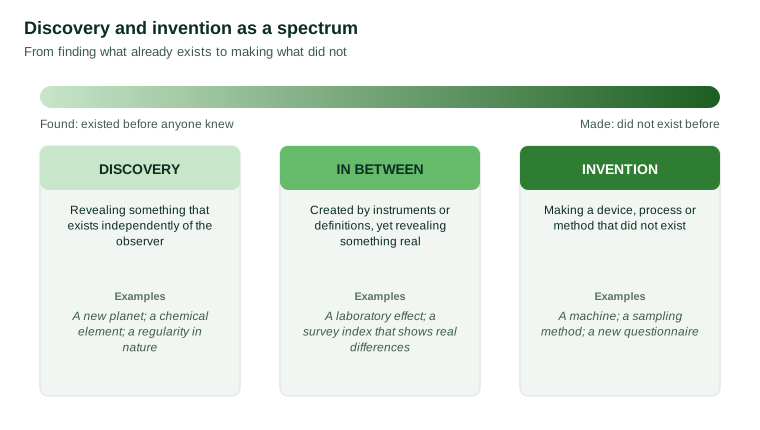
In the simplest account, a discovery reveals something that was already true of the world: a law of nature, a chemical element, a pattern in human behaviour. An invention creates something new: a tool, a process, a method or a design. Discovery adds to our knowledge of what is; invention adds to our capacity to do. Mokyr (2002) made a related distinction between propositional knowledge, knowledge about natural phenomena and regularities, and prescriptive knowledge, knowledge of techniques for making things and getting things done. He argued that the sustained economic growth of the modern world came from the growing interaction between the two, as discoveries about nature supported new techniques and new techniques made further discoveries possible.
The distinction has practical consequences. Patent law in many countries rewards inventions but excludes discoveries, scientific theories and mathematical methods as such. A newly found natural substance cannot usually be patented, although a new process for extracting or using it can. Credit in science, by contrast, goes mainly to discoveries, recorded in publications and named after the people who made them.
Discovery as a process, not a moment
Popular history treats discoveries as events: a moment of insight, a date and a name. Kuhn (1962) argued that this picture is misleading. Taking the discovery of oxygen as his example, he showed that several people, including Scheele, Priestley and Lavoisier, isolated or studied the gas in the 1770s, but each understood it differently. Priestley thought he had found "dephlogisticated air"; Lavoisier came to see it as a distinct element, but only gradually and with mistakes along the way. Asking exactly who discovered oxygen, and when, has no simple answer, because discovery involves both observing something and understanding what it is. Kuhn concluded that discoveries are extended processes, often spread over years and several people, and that the historical structure of discovery resembles the larger scientific revolutions he later described.
Sociologists have gone further. Brannigan (1981) argued that whether something counts as a discovery depends on social processes of attribution: a finding becomes a discovery when a community recognises it as new, valid and significant. Many earlier observations were later reinterpreted as anticipations, while others were never recognised at all. Schaffer (1986) showed that the very idea of discovery as the defining achievement of science, and of the discoverer as a hero, became established only in the late eighteenth and early nineteenth centuries, as natural philosophy gave way to the modern sciences.
Is there a logic of discovery?
Philosophers long held that discovery and justification are separate matters. Reichenbach (1938) distinguished the context of discovery, the psychological and social circumstances in which an idea arises, from the context of justification, the logical relation between a theory and the evidence for it. Popper (1959) argued that there is no logical method for having new ideas; the logic of science applies only to testing them. On this view, how a hypothesis was thought of, whether by careful reasoning or in a dream, is irrelevant to whether it is true.
Others challenged this view. Simon et al. (1981) argued that scientific discovery is a form of problem solving that can be studied and even reproduced. Langley et al. (1987) described a series of computer programs that, given suitable data, rediscovered laws such as Kepler's third law of planetary motion, using general strategies for finding patterns. Their work suggested that at least some kinds of discovery follow rules that can be described and taught. Weisberg (2006) reviewed psychological research on creativity and argued that creative thinking in science and invention usually builds on ordinary cognitive processes and deep knowledge of a field, rather than on mysterious flashes of insight.
How invention works
Invention has its own patterns. Arthur (2009) argued that technologies are built by combining existing technologies: each new invention is assembled from components and principles that already exist, and becomes in turn a component for later inventions. Technology therefore evolves through combinatorial evolution, and the stock of possible inventions grows as the stock of existing technologies grows. Invention also depends on harnessing natural phenomena, which links it directly to discovery: a new phenomenon, once understood, becomes available for use.
Economists distinguish invention from innovation. Schumpeter (1934) defined innovation as the commercial introduction of new products, methods, markets or forms of organisation, and argued that it, rather than invention as such, drives economic development. An invention that is never used changes nothing. Rosenberg (1982) showed that the relationship between science and technology runs in both directions: technology often comes first, posing problems and supplying instruments that science later explains. Kline and Rosenberg (1986) proposed a chain-linked model of innovation in which design, testing, production and marketing interact through many feedback loops, and in which research is drawn on when problems arise rather than standing at the start of a linear sequence.
Multiple discovery and inevitability
One striking feature of both discovery and invention is that they often happen more than once, independently. Ogburn and Thomas (1922) compiled a list of 148 cases in which inventions or discoveries were made independently by two or more people, including calculus, the theory of evolution by natural selection and the telephone. They argued that inventions become nearly inevitable once the necessary cultural elements are in place. Merton (1961) went further, proposing that independent multiple discoveries are the normal pattern in science, and that apparently single discoveries are often multiples that were forestalled because one researcher published first.
The pattern applies to both discovery and invention, which suggests that they have something in common. Each depends on the existing state of knowledge, instruments and problems. When the ground has been prepared, several people are likely to see the same opportunity.
Where the line blurs
Several cases show how difficult it is to keep discovery and invention apart.
Phenomena made in the laboratory. Hacking (1983) argued that experimental science often creates phenomena rather than simply finding them. Many effects studied in physics do not occur in pure form in nature; they exist only when apparatus is built to produce them. Are such effects discovered or invented? Hacking's answer was that they are created, but that once created they are as real as anything else.
Mathematics. Whether mathematical truths are discovered or invented is an old debate. Some mathematicians hold that they discover objects and relations that exist independently of human minds. Others argue that mathematics is a human creation. Hersh (1997) defended the view that mathematics is a social and cultural activity whose results are nonetheless objective in the sense that competent practitioners agree on them.
Concepts and measures. In the social sciences, many of the things we measure, such as unemployment, inflation or customer satisfaction, are defined by the measures we invent. A survey index is designed, tested and refined, which makes it an invention. Yet once it exists, it can reveal patterns, such as differences between groups or changes over time, that are genuine discoveries.
Use-inspired research. Stokes (1997) showed that much important research aims both at understanding and at use. Louis Pasteur's work on microbes produced fundamental discoveries about disease while also inventing practical methods for preserving food and preventing infection.
Why the distinction still matters
If the line is blurred, is the distinction still useful? It is, for at least three reasons.
First, it reminds us that knowledge grows in two ways that support each other. Discoveries about how things are make new techniques possible; new techniques, including new instruments and methods, make new discoveries possible. A healthy knowledge system needs both.
Second, the two call for different kinds of evaluation. A claimed discovery must be judged by whether it is true and well supported. An invention must be judged by whether it works, whether it is better than the alternatives and whether it is worth its cost.
Third, the distinction clarifies questions of credit and ownership. Inventions can often be owned and licensed; discoveries generally belong to everyone once published. Organisations that commission research need to know which parts of the work they can own, such as a proprietary method or dataset, and which parts, such as a general finding about a market once it is published, they cannot.
Lessons for research organisations
Applied research organisations both discover and invent. They discover facts about markets, populations and behaviour; they invent the instruments, samples, indices and analytical methods that make those discoveries possible. Recognising both roles leads to several practical points.
Treat methods as inventions that need testing. A new questionnaire, scale or model is a designed object. It should be piloted, validated and refined before its outputs are treated as findings.
Treat findings as discoveries that need confirmation. A striking result is a claimed discovery. It should be checked against other data and, where possible, replicated before decisions rest on it.
Do not confuse the measure with the thing. Because social measures are invented, their results depend partly on design choices. Reporting how a measure was built helps users understand what it does and does not show.
Expect to be anticipated. As the history of multiple discovery shows, good ideas tend to occur to several people at once. Speed, care and clear records of what was found and when all matter.
Conclusion
The difference between discovery and invention captures a real contrast between finding out how the world is and making something new within it. But the two are closely linked. Discoveries depend on invented instruments and concepts; inventions depend on discovered phenomena; and many of the most important advances, from laboratory effects to social statistics, are both at once. Understanding the relationship helps researchers judge their own work appropriately, testing their methods as inventions and their findings as discoveries.
References
Arthur, W. B. (2009). The nature of technology: What it is and how it evolves. Free Press.
Brannigan, A. (1981). The social basis of scientific discoveries. Cambridge University Press.
Hacking, I. (1983). Representing and intervening: Introductory topics in the philosophy of natural science. Cambridge University Press. https://doi.org/10.1017/CBO9780511814563
Hersh, R. (1997). What is mathematics, really? Oxford University Press.
Kline, S. J., & Rosenberg, N. (1986). An overview of innovation. In R. Landau & N. Rosenberg (Eds.), The positive sum strategy: Harnessing technology for economic growth (pp. 275–305). National Academy Press.
Kuhn, T. S. (1962). Historical structure of scientific discovery. Science, 136(3518), 760–764. https://doi.org/10.1126/science.136.3518.760
Langley, P., Simon, H. A., Bradshaw, G. L., & Zytkow, J. M. (1987). Scientific discovery: Computational explorations of the creative processes. MIT Press.
Merton, R. K. (1961). Singletons and multiples in scientific discovery: A chapter in the sociology of science. Proceedings of the American Philosophical Society, 105(5), 470–486.
Mokyr, J. (2002). The gifts of Athena: Historical origins of the knowledge economy. Princeton University Press.
Ogburn, W. F., & Thomas, D. (1922). Are inventions inevitable? A note on social evolution. Political Science Quarterly, 37(1), 83–98. https://doi.org/10.2307/2142320
Popper, K. R. (1959). The logic of scientific discovery. Hutchinson.
Reichenbach, H. (1938). Experience and prediction: An analysis of the foundations and the structure of knowledge. University of Chicago Press.
Rosenberg, N. (1982). Inside the black box: Technology and economics. Cambridge University Press.
Schaffer, S. (1986). Scientific discoveries and the end of natural philosophy. Social Studies of Science, 16(3), 387–420. https://doi.org/10.1177/030631286016003001
Schumpeter, J. A. (1934). The theory of economic development: An inquiry into profits, capital, credit, interest, and the business cycle (R. Opie, Trans.). Harvard University Press.
Simon, H. A., Langley, P. W., & Bradshaw, G. L. (1981). Scientific discovery as problem solving. Synthese, 47(1), 1–27. https://doi.org/10.1007/BF01064262
Stokes, D. E. (1997). Pasteur's quadrant: Basic science and technological innovation. Brookings Institution Press.
Weisberg, R. W. (2006). Creativity: Understanding innovation in problem solving, science, invention, and the arts. Wiley.