
The Generation of Knowledge · Knowledge and decisions
Democratisation of Knowledge in the Digital Era
Whether digital technology has made knowledge more widely available, produced and shared, examining open access, open data, wikis, citizen science and online courses, the persistence of digital divides, the spread of misinformation and what it all means for trustworthy evidence.
The internet promised to put the world's knowledge within everyone's reach. Research papers, government data, encyclopaedias, courses and expert commentary that were once available only to a few can now be found by anyone with a connection. People can also create and share knowledge themselves, through blogs, wikis, social media and citizen science. This article asks how far this promise has been fulfilled. It examines the main ways in which digital technology has opened up knowledge, the evidence on who has benefited and the new problems that wider access has brought.
A new mode of production
Benkler (2006) argued that digital networks had made possible a new way of producing knowledge and culture, which he called commons-based peer production. Large numbers of people, working voluntarily and coordinated through the internet rather than through firms or markets, could create valuable goods such as free software and online encyclopaedias. Because the cost of communication and computing had fallen so far, individuals could contribute small amounts of effort that, combined, produced something substantial. Shirky (2008) described how online tools lowered the costs of organising groups, allowing collective action and knowledge-sharing without formal organisations.
Wikipedia became the best-known example. Giles (2005) compared a sample of scientific entries in Wikipedia and the Encyclopaedia Britannica, with experts reviewing the entries without knowing their source, and found that the difference in accuracy between the two was smaller than many expected.
Opening access to research
For most of the twentieth century, research findings were published in journals available mainly through university and institutional subscriptions. Open access publishing makes research free to read online. Suber (2012) described the main routes: publishing in open-access journals, and depositing copies of articles in open repositories.
Open access has grown substantially. Piwowar et al. (2018) analysed a large sample of scholarly articles and estimated that a substantial share of the literature was freely available to read, and that the share was higher for recently published articles. Funders and governments have increasingly required research they pay for to be openly available. UNESCO (2021) adopted a recommendation on open science, encouraging member states to make scientific knowledge, data and methods openly available and to involve society more widely in science.
Opening data
Governments have also opened their data. Open data portals publish statistics, maps, budgets and records for anyone to use. Janssen et al. (2012) reviewed the benefits claimed for open government data, including transparency, accountability, innovation and better public services. They also identified barriers and myths: publishing data does not automatically produce benefits, because data must be usable, relevant and accompanied by the skills and institutions needed to interpret them.
Citizens producing knowledge
Digital tools have allowed members of the public to take part in research. Bonney et al. (2009) described citizen science projects in which volunteers collect observations, for example of birds, weather or water quality, contributing data on a scale that professional researchers could not achieve alone, while also learning about science.
Learning for all
Massive open online courses, offering university-level teaching free or at low cost, were expected to transform education. The evidence has been more sobering. Hansen and Reich (2015) analysed participation in courses offered by two leading universities and found that people from more affluent neighbourhoods were more likely to enrol and to complete courses. Reich and Ruipérez-Valiente (2019) found that completion rates remained low and that most learners came from wealthier countries. The courses widened access in principle but, in practice, were used mostly by people who already had advantages.
Who benefits?
The pattern seen in online courses appears more widely, as Figure 1 summarises.
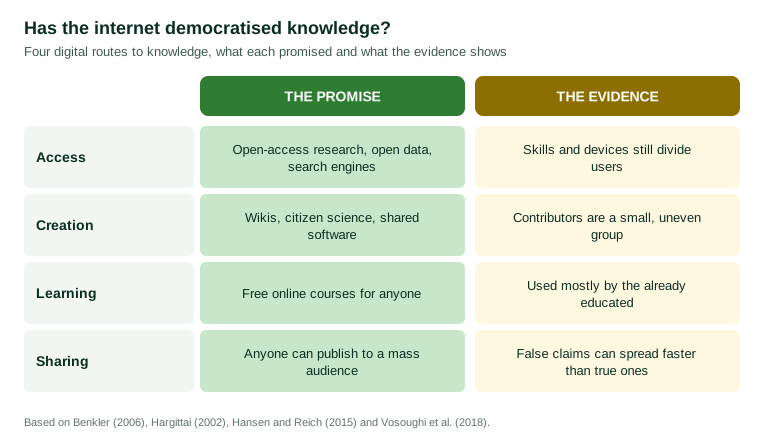
The digital divide. Not everyone has reliable internet access or suitable devices. Van Dijk (2020) argued that the divide has several layers: motivation to use the technology, physical access, skills and the benefits people actually gain.
The skills divide. Hargittai (2002) found large differences in people's ability to find information online, even among those with access, and called this the second-level digital divide. Knowing how to search, evaluate sources and use what is found matters as much as access itself.
The knowledge gap. Tichenor et al. (1970) proposed that when information becomes more widely available, people with more education tend to gain from it faster, so that gaps between groups can widen. The digital era has provided many examples consistent with this hypothesis.
Uneven participation. The people who create content online, whether by editing encyclopaedias or contributing to open projects, are a small fraction of users and are not representative of the population. Their perspectives shape what is available to everyone.
The problem of trust
Wider access to publishing has a cost: anyone can publish false or misleading claims, and they can spread quickly. Vosoughi et al. (2018) studied the spread of true and false news stories on Twitter between 2006 and 2017 and found that false stories spread farther, faster and more widely than true ones, largely because people shared them, not because of automated accounts. Lazer et al. (2018) called for research and action to address the spread of false news, including better ways for people to judge the reliability of sources.
Concerns have also been raised that online platforms show people mainly information that confirms their existing views. Pariser (2011) warned of a filter bubble created by personalisation. The evidence is mixed. Bakshy et al. (2015) studied the news seen by users of Facebook in the United States and found that individuals' own choices of what to click on limited their exposure to opposing views more than the platform's ranking did.
Some writers have argued that the digital era has weakened respect for expertise. Keen (2007) criticised the replacement of professional judgement by amateur content, and Nichols (2017) argued that easy access to information had led many people to overrate their own knowledge and dismiss experts. Others reply that challenging experts can be healthy, and that what matters is the ability to tell reliable from unreliable sources.
Artificial intelligence and access to knowledge
Large language models and other forms of artificial intelligence have added a new chapter. These systems, trained on vast collections of text, can answer questions, summarise documents and explain ideas in plain language, offering a new kind of access to knowledge. Bommasani et al. (2021) described such foundation models and their potential to make expertise more widely available, while warning of their risks: they can produce fluent but false statements, reflect biases in the data they were trained on and concentrate power in the few organisations able to build them. Whether they widen or narrow access to reliable knowledge will depend on how accurately they represent sources, how openly their limitations are explained and who can use them.
Hearing more voices
Digital tools have also changed how the views of the public are gathered. Online surveys, polls and feedback forms make it cheap to ask large numbers of people what they think, and give more people a chance to be heard. Groves (2011) described how survey research had entered an era in which designed surveys are combined with data generated by digital activity. Yet more voices do not always mean more representative ones. Polls that anyone can join attract people with strong views or time to spare, and the opinions expressed most loudly online may not reflect those of the wider population. Hearing everyone fairly still requires careful sampling and design, which is why well-conducted surveys remain essential even as other sources multiply.
What this means for trustworthy evidence
The democratisation of knowledge has made reliable evidence more accessible than ever, but has also made it harder to distinguish from unreliable claims. For organisations that produce research, this raises the value of transparency. When methods, sources and limitations are clearly stated, readers can judge the evidence for themselves. Openly published findings and data allow others to check and build on them. And clear communication, written for non-specialists without sacrificing accuracy, extends the reach of reliable knowledge to people who might otherwise rely on weaker sources.
Survey research itself has been opened up by digital tools, which allow almost anyone to run a survey. This brings new voices into research, but also many poorly designed studies whose results are presented with unjustified confidence. The ability to judge a survey's sample, questions and analysis has therefore become a skill that every user of evidence needs. Simple questions help: who was asked, how they were chosen, what exactly they were asked and how many responded.
Conclusion
Digital technology has opened knowledge to far more people than before. Research, data, encyclopaedias and courses are widely available, and many people take part in creating knowledge. Yet the benefits have been uneven: differences in access, skills and education mean that those already advantaged often gain most, and the freedom to publish has helped false claims spread alongside true ones. The democratisation of knowledge is therefore unfinished. Its success depends not only on making information available but on helping people find, judge and use it well, and on producers of knowledge making their methods and evidence open to scrutiny.
References
Bakshy, E., Messing, S., & Adamic, L. A. (2015). Exposure to ideologically diverse news and opinion on Facebook. Science, 348(6239), 1130–1132. https://doi.org/10.1126/science.aaa1160
Benkler, Y. (2006). The wealth of networks: How social production transforms markets and freedom. Yale University Press.
Bommasani, R., Hudson, D. A., Adeli, E., Altman, R., Arora, S., von Arx, S., Bernstein, M. S., Bohg, J., Bosselut, A., Brunskill, E., Brynjolfsson, E., Buch, S., Card, D., Castellon, R., Chatterji, N., Chen, A., Creel, K., Davis, J. Q., Demszky, D., … Liang, P. (2021). On the opportunities and risks of foundation models (arXiv:2108.07258). arXiv. https://doi.org/10.48550/arXiv.2108.07258
Bonney, R., Cooper, C. B., Dickinson, J., Kelling, S., Phillips, T., Rosenberg, K. V., & Shirk, J. (2009). Citizen science: A developing tool for expanding science knowledge and scientific literacy. BioScience, 59(11), 977–984. https://doi.org/10.1525/bio.2009.59.11.9
Giles, J. (2005). Internet encyclopaedias go head to head. Nature, 438(7070), 900–901. https://doi.org/10.1038/438900a
Groves, R. M. (2011). Three eras of survey research. Public Opinion Quarterly, 75(5), 861–871. https://doi.org/10.1093/poq/nfr057
Hansen, J. D., & Reich, J. (2015). Democratizing education? Examining access and usage patterns in massive open online courses. Science, 350(6265), 1245–1248. https://doi.org/10.1126/science.aab3782
Hargittai, E. (2002). Second-level digital divide: Differences in people's online skills. First Monday, 7(4). https://doi.org/10.5210/fm.v7i4.942
Janssen, M., Charalabidis, Y., & Zuiderwijk, A. (2012). Benefits, adoption barriers and myths of open data and open government. Information Systems Management, 29(4), 258–268. https://doi.org/10.1080/10580530.2012.716740
Keen, A. (2007). The cult of the amateur: How today's internet is killing our culture. Doubleday/Currency.
Lazer, D. M. J., Baum, M. A., Benkler, Y., Berinsky, A. J., Greenhill, K. M., Menczer, F., Metzger, M. J., Nyhan, B., Pennycook, G., Rothschild, D., Schudson, M., Sloman, S. A., Sunstein, C. R., Thorson, E. A., Watts, D. J., & Zittrain, J. L. (2018). The science of fake news. Science, 359(6380), 1094–1096. https://doi.org/10.1126/science.aao2998
Nichols, T. (2017). The death of expertise: The campaign against established knowledge and why it matters. Oxford University Press.
Pariser, E. (2011). The filter bubble: What the Internet is hiding from you. Penguin Press.
Piwowar, H., Priem, J., Larivière, V., Alperin, J. P., Matthias, L., Norlander, B., Farley, A., West, J., & Haustein, S. (2018). The state of OA: A large-scale analysis of the prevalence and impact of Open Access articles. PeerJ, 6, Article e4375. https://doi.org/10.7717/peerj.4375
Reich, J., & Ruipérez-Valiente, J. A. (2019). The MOOC pivot. Science, 363(6423), 130–131. https://doi.org/10.1126/science.aav7958
Shirky, C. (2008). Here comes everybody: The power of organizing without organizations. Penguin Press.
Suber, P. (2012). Open access. MIT Press.
Tichenor, P. J., Donohue, G. A., & Olien, C. N. (1970). Mass media flow and differential growth in knowledge. Public Opinion Quarterly, 34(2), 159–170. https://doi.org/10.1086/267786
UNESCO. (2021). UNESCO recommendation on open science. UNESCO.
van Dijk, J. (2020). The digital divide. Polity.
Vosoughi, S., Roy, D., & Aral, S. (2018). The spread of true and false news online. Science, 359(6380), 1146–1151. https://doi.org/10.1126/science.aap9559