
Share your volunteering experience
Tell us whether you volunteered in the last year, how much time you gave and what stops you from doing more. Your answers are combined with other people's and reported only as totals.
Start the volunteering surveyAbout 5 minutes. No account needed. You can stop at any time.
What volunteering covers
Volunteering means giving time and effort, without pay, to help others or a cause. Researchers usually separate it into two kinds:
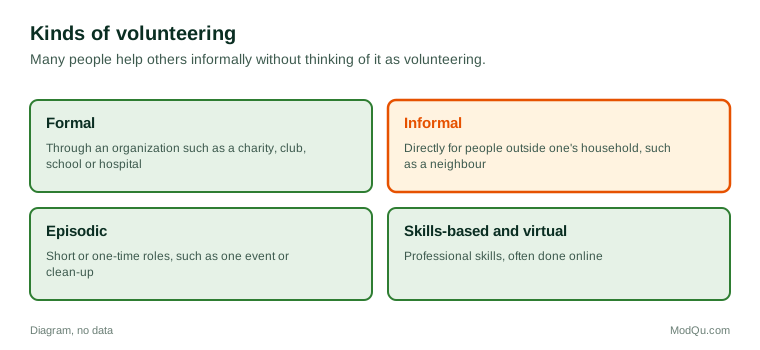
- Formal volunteering, done through an organization such as a charity, non-profit, school, place of worship, sports club, hospital or community group.
- Informal volunteering, done directly for people outside one's own household, such as shovelling a neighbour's driveway, shopping for an older person or helping a friend move.
Statistics Canada measures both kinds in its surveys on giving, volunteering and participating. Many people help others informally without thinking of it as volunteering.
Where people volunteer
Common places and roles include:
- Sports and recreation: coaching, refereeing, running clubs and tournaments.
- Social services: food banks, shelters, meal programs, and services for children, seniors and newcomers.
- Education: helping in classrooms, school councils, tutoring and literacy programs.
- Health: hospital volunteers, patient support, and fundraising for health charities.
- Religious organizations: services, events, outreach and maintenance.
- Arts and culture: festivals, museums, theatres and community events.
- Environment: tree planting, clean-ups and conservation projects.
- Emergency services: volunteer firefighters, search and rescue, and disaster response.
- Governance: sitting on boards and committees of non-profits and community organizations.
Why people volunteer
Reasons people give for volunteering include:
- Helping a cause they care about or giving back to their community.
- Using skills and experience, or learning new ones.
- Meeting people and feeling part of a group.
- Personal connection, such as a child on a team or a family member helped by a charity.
- Career and education, such as gaining experience, references or required hours. Some provinces require secondary school students to complete community involvement hours.
- Faith and values.
- Keeping active after retirement.
Many people start volunteering because someone asked them, often a friend, family member or coworker.
Volunteers often say that giving time helps them as well as others. Research has linked volunteering with a stronger sense of belonging, wider social networks and, for some groups such as older adults, better reported wellbeing, although it is hard to separate cause and effect: people who are healthier and more connected may also be more likely to volunteer.
Volunteering can also be a route into a community. Newcomers often volunteer to practise a language, meet people and gain local experience. People who have retired, moved or lost a partner may volunteer to rebuild a routine and friendships. Burnout is a risk too, especially for the small group who take on several roles at once.
Example
A parent signs their child up for soccer and is asked whether they could help coach because the team has no coach. They agree reluctantly. Three seasons later, they coach two teams, have taken a coaching course and sit on the club's board. They say they would never have offered if no one had asked.
What stops people from volunteering more
The reasons people give for not volunteering, or not volunteering more, tend to be consistent:
- Lack of time, because of work, caregiving and family responsibilities.
- Not being able to make a long-term commitment.
- Not being asked, or not knowing where to start.
- Cost, such as transport, parking, background checks or equipment.
- Health or mobility limits.
- Previous bad experiences, such as feeling unappreciated or poorly organized.
- Formal requirements, such as police record checks, training and long application forms.
Organizations that make it easy to start, offer short or flexible roles and thank volunteers tend to keep them longer.
Example
A busy nurse working rotating shifts wants to volunteer but cannot commit to a weekly slot. A local food bank lets volunteers sign up for single shifts through an online calendar. The nurse books two Saturday morning shifts a month when their schedule allows and has kept it up for a year.
How much time people give
The amount of time volunteers give varies widely. A small share of volunteers often give a large share of the total hours, while many give a few hours a year. This makes many organizations dependent on a core group of long-serving volunteers, which becomes a risk when those people retire or burn out.
Example (hypothetical figures)
A community organization has 120 volunteers. Over a year, 20 of them give 150 hours each, or 3,000 hours. The other 100 give an average of 12 hours each, or 1,200 hours. In total, volunteers give 4,200 hours, and the 20 most active volunteers, one-sixth of the group, give about 71% of the hours.
Skills-based, episodic and virtual volunteering
Volunteering is changing in several ways:
- Skills-based volunteering: professionals offer specific skills, such as accounting, legal, design or IT help, to charities.
- Episodic volunteering: short, one-time roles, such as helping at a single event or a one-day clean-up.
- Virtual volunteering: tasks done online, such as tutoring, translating, mentoring or managing social media.
- Employer-supported volunteering: paid time off or team volunteering days organized by employers.
- Family volunteering: parents and children volunteering together.
Example
A retired accountant volunteers two hours a month to review the books of a small arts charity, doing most of the work online. They also help a volunteer income tax clinic each spring. They say this kind of short, skilled role suits them better than a weekly shift.
What organizations need from volunteers
Charities and non-profits often depend on volunteers to deliver programs, run events and govern the organization. Common challenges for them include:
- finding volunteers for regular, long-term roles such as board positions and coaching;
- training and screening volunteers, especially for roles with children or vulnerable people;
- keeping volunteers engaged and thanking them;
- managing volunteers with limited paid staff;
- replacing volunteers who retire.
Good practice in volunteer management usually includes clear role descriptions, orientation, safety training, regular communication and recognition, such as thank-you events or certificates.
What people disagree about
People disagree about whether required volunteer hours for students are true volunteering, whether some roles should be paid jobs rather than volunteer positions, how much screening is reasonable for volunteer roles, and whether employers should give paid time to volunteer. Questions that charities and foundations want answered include whether people volunteered in the last year, how many hours a month they gave and what stops them from volunteering more.
Key terms
- Formal volunteeringUnpaid work done through an organization.
- Informal volunteeringUnpaid help given directly to people outside one's household.
- Episodic volunteeringShort-term or one-time volunteer roles.
- Skills-based volunteeringVolunteering that uses a person's professional skills.
- Virtual volunteeringVolunteer tasks done online.
- Volunteer screeningChecks such as interviews, references and police record checks before a volunteer starts.
- Board of directorsThe group of people, often volunteers, who govern a non-profit organization.
- Volunteer recognitionWays an organization thanks and acknowledges its volunteers.
Full glossary: volunteer management terms on EditingTests.com.
Volunteering vocabulary test
How well do you know the language of this topic? Try 8 quick questions. Your score is shown straight away and is not saved.
What the volunteering survey asks
This survey is part of ModQu's Charities and Giving survey. The volunteering part takes about five minutes and covers:
- Whether you volunteered in the last year, formally or informally.
- Where you volunteered and what you did.
- How many hours a month you usually give.
- Why you volunteer, and how you first got involved.
- What stops you from volunteering more.
- What would make volunteering easier or more rewarding for you.
After that you can choose to continue with other short parts of the Charities and Giving survey, such as donating to charity or trust in charities, or stop.
Ready to take part?
Your answers help show what people really think and do. Results are only ever reported as totals; no one can see your individual answers.
Start the surveyQuestions about this survey
Who can take part?
Adults.
Do I have to give my name?
No. You may be asked for your age group, region and similar details so results can be broken down, but not your name. ModQu never asks for passwords, card numbers or account numbers.
How are the results used?
Answers are combined into totals and percentages and published in ModQu reports. Individual answers are never shown.
Is the vocabulary test part of the survey?
No. It is optional and separate, and your score is not stored.
Do I need a police record check to volunteer?
It depends on the role. Organizations usually ask for a police record check, sometimes a vulnerable sector check, for roles with children, older adults or other vulnerable people.
Can volunteering count as work experience?
Many employers value volunteer experience, especially when it shows relevant skills. Listing specific tasks and results on a résumé makes it easier to judge.