
Share the causes you care about
Tell us which social causes matter most to you and whether you have signed a petition, joined a protest or taken other action. Your answers are combined with other people's and reported only as totals.
Start the social causes and activism surveyAbout 5 minutes. No account needed. You can stop at any time.
What this topic covers
A social cause is an issue that people want to change or protect for the good of society, such as poverty, the environment, human rights, health, education or animal welfare. Activism is action taken to bring about that change, usually by influencing governments, businesses or public opinion.
This page describes how people take part. It does not take sides on any cause. People take action on all sides of public debates, and the same methods are used by groups with opposite goals.
Causes people care about
Causes that commonly come up in surveys include:
- Cost of living and housing: affordability, homelessness and tenant rights.
- Health care, including access, wait times and mental health.
- The environment and climate change.
- Human rights and equality, including racial justice, gender equality, 2SLGBTQI+ rights and disability rights.
- Indigenous rights and reconciliation.
- Poverty, food security and income support.
- Education and children's issues.
- Animal welfare.
- Public safety, crime and justice.
- International issues, such as conflicts, refugees and humanitarian crises.
- Local issues, such as a school closure, a new development or a park.
Which cause people rank first often depends on their age, their personal experience and what is in the news at the time.
The ways people take action
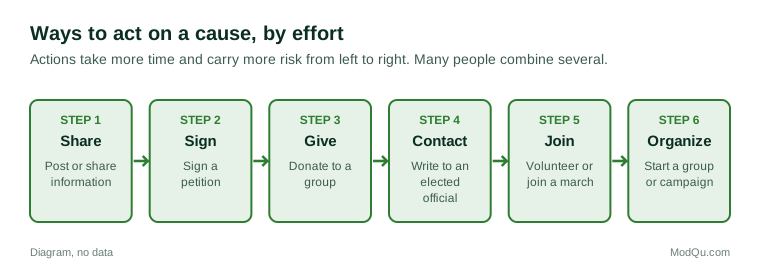
People take part in causes in many ways. Some take little time; others take a great deal:
- Signing petitions, online or on paper, including official petitions to Parliament and provincial legislatures.
- Contacting elected officials by email, letter, phone or a visit.
- Donating to advocacy groups and charities.
- Volunteering for an organization working on the cause.
- Boycotting or buycotting: avoiding products from companies one disagrees with, or choosing products from companies one supports.
- Sharing information and posting on social media.
- Attending meetings, consultations and public hearings.
- Joining protests, marches, rallies and vigils.
- Running for office, or working on election campaigns.
- Organizing: starting a group, a campaign or a union drive.
Example
A parent learns that their neighbourhood school may close. They sign an online petition, then join a parents' group that meets weekly. The group presents at a school board meeting, collects letters from local businesses and holds a rally outside the board office. The board delays the decision for a year to study other options.
Online and offline activism
Social media has made it easier to learn about causes, organize and share information quickly. It has also led to debate about what online activity achieves:
- Supporters say it allows people with little time or money to take part, helps small groups reach large audiences and can turn online attention into offline action.
- Critics use the term slacktivism for low-effort actions, such as liking or sharing a post, that may make people feel involved without changing much.
Research suggests the picture is mixed: online activity can lead some people to take further action, and many campaigns combine online and offline methods.
Example
A university student shares posts about a local food bank's shortage. A friend who sees the post organizes a food drive in their residence building, and dozens of students donate. The student says the online post was only the first step, but without it the food drive would not have happened.
Petitions and protests
Petitions are one of the most common forms of action. In Canada, the House of Commons accepts electronic petitions: an e-petition that meets the requirements and gathers enough signatures can be presented in the House, and the government must table a response. Provincial legislatures have their own rules. Petitions on private websites can show public interest but have no formal standing.
Example (hypothetical figures)
A community group launches an e-petition asking for safer crossings near a school. It needs 500 signatures to be presented. In the first week it gets 180 signatures, in the second 240 and in the third 150. The total of 570 is 70 more than needed. The group's member of Parliament presents it, and a written government response is tabled later.
Peaceful assembly and freedom of expression are protected by the Canadian Charter of Rights and Freedoms, subject to reasonable limits set by law. Protests range from small vigils to large marches and long-running occupations. Public views on protests often depend on the cause, the methods used and how much disruption they cause, such as blocking roads, rail lines or bridges.
What affects whether people take action
Research on participation has found several factors:
- Being asked to take part, often by friends, family or an organization.
- Feeling that action can work, sometimes called political efficacy.
- Personal connection to an issue.
- Time, money and skills, which make some forms of action easier for some people.
- Social networks, such as unions, faith groups, student groups and community associations.
- Risk, including fear of being identified, harassed or affecting one's job.
Reasons people give for staying out include lack of time, feeling it would make no difference, disliking conflict, distrust of organizers and worry about how others will react.
Example
A worker cares strongly about a cause but does not join protests because their employer has a strict policy on public statements. Instead, they give a monthly donation to an advocacy group and write to their member of the provincial legislature twice a year. They say these quieter actions feel safer and still let them do something.
Businesses and causes
People increasingly expect businesses to take a position on some social issues, while others prefer businesses to stay out of politics. Consumers may reward or punish companies through what they buy, and employees may push their employers to act. Businesses that speak out can face criticism from both directions, which makes this an area many companies research carefully.
What people disagree about
People disagree about which causes deserve the most attention, which forms of protest are acceptable, whether online activism makes a difference, whether businesses should take public positions on social issues, and how much disruption is justified. Questions that charities and foundations want answered include which social cause matters most to people, whether they have signed a petition this year and whether they have joined a protest or march.
Key terms
- Social causeAn issue people want to change or protect for the good of society.
- ActivismAction taken to bring about social or political change.
- AdvocacyEfforts to influence public policy or decisions on behalf of a cause.
- E-petitionAn online petition submitted through an official legislative system.
- BoycottRefusing to buy from or deal with a company or country as a protest.
- BuycottChoosing to buy from companies whose actions one supports.
- SlacktivismLow-effort online support for a cause that may have little practical effect.
- Political efficacyA person's belief that they can influence political decisions.
Full glossary: nonprofit terms on EditingTests.com.
Social causes and activism vocabulary test
How well do you know the language of this topic? Try 8 quick questions. Your score is shown straight away and is not saved.
What the social causes and activism survey asks
This survey is part of ModQu's Charities and Giving survey. The social causes and activism part takes about five minutes and covers:
- Which social causes matter most to you, and why.
- Whether you have signed a petition this year, online or on paper.
- Whether you have joined a protest, march or rally, and how often.
- Other actions you have taken, such as contacting officials, donating or boycotting.
- What stops you from taking more action on causes you care about.
- Whether you think businesses should take public positions on social issues.
After that you can choose to continue with other short parts of the Charities and Giving survey, such as donating to charity or volunteering, or stop.
Ready to take part?
Your answers help show what people really think and do. Results are only ever reported as totals; no one can see your individual answers.
Start the surveyQuestions about this survey
Who can take part?
Adults.
Do I have to give my name?
No. You may be asked for your age group, region and similar details so results can be broken down, but not your name. ModQu never asks for passwords, card numbers or account numbers.
How are the results used?
Answers are combined into totals and percentages and published in ModQu reports. Individual answers are never shown.
Is the vocabulary test part of the survey?
No. It is optional and separate, and your score is not stored.