
Share your experience of religious community
Tell us whether you belong to a religious community, how often you attend and whether you give to it. Your answers are combined with other people's and reported only as totals.
Start the faith and religious organizations surveyAbout 5 minutes. No account needed. You can stop at any time.
What this topic covers
Faith and religious organizations include churches, mosques, synagogues, temples, gurdwaras and other places of worship, along with the wider organizations connected to them: religious charities, schools, camps, community centres, chaplaincies and relief agencies.
This page is about how people take part in and support these organizations. It does not compare or judge beliefs. People of every faith, and people with no religion, may answer the survey.
Canada is religiously diverse. The census asks people about their religion every ten years, most recently in 2021. Christianity is the largest religious group in Canada, a growing share of people report no religion, and communities such as Muslims, Hindus, Sikhs, Buddhists and Jews make up a growing part of the population. Indigenous spiritual traditions are also practised in many communities.
Belonging, believing and attending
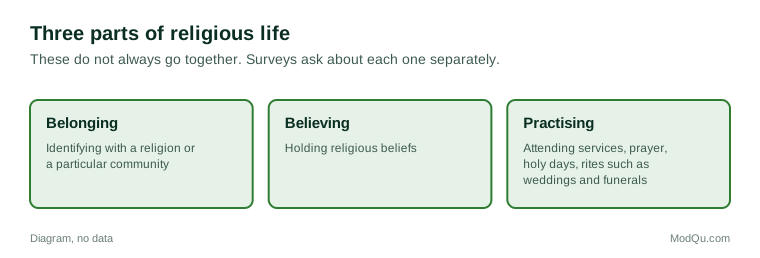
Researchers often separate three parts of religious life:
- Belonging: identifying with a religion or a particular community.
- Believing: holding religious beliefs.
- Practising: attending services, praying, reading sacred texts, fasting, observing holy days and taking part in rites such as weddings and funerals.
These do not always go together. Some people identify with a religion for cultural or family reasons but rarely attend services. Others pray or meditate privately without belonging to a community. Some attend regularly for the sense of community as much as for belief.
Example
A man raised in a religious family stopped attending services as a young adult but still describes himself as belonging to the faith. After his first child is born, he and his partner start attending a few times a year for holidays and family events. They say they want their children to know the traditions, even though they are unsure about some of the beliefs.
How often people attend
Attendance varies widely, from daily to weekly to only on major holidays or for weddings and funerals. Surveys in Canada and many other countries have found that the share of people attending religious services regularly has fallen over recent decades, while attendance remains high in some communities, especially among some immigrant communities and some faith traditions.
Since the COVID-19 pandemic, many places of worship offer services online or by livestream as well as in person. Some members now attend mostly online, which has changed how communities count and connect with their members.
Example
An older woman with limited mobility used to attend weekly services. When her congregation began livestreaming during the pandemic, she started watching at home every week. She now attends in person once a month when her daughter can drive her, and watches online the rest of the time. She says she feels more connected than she did before the livestreams started.
Giving to religious organizations
Religious organizations rely mostly on their members for money. Common forms of giving include:
- Regular offerings or contributions, during services or by automatic payment.
- Tithing, a tradition in some Christian communities of giving a tenth of income.
- Zakat, an obligation in Islam to give a portion of eligible wealth each year to those in need, and other forms of charitable giving such as sadaqah.
- Tzedakah, giving as an obligation of justice in Judaism.
- Seva, selfless service, and langar, free community meals, in Sikh tradition.
- Building and special funds for repairs, new buildings or projects.
- Volunteer time, which is often as important as money.
Many places of worship are registered charities in Canada and can issue receipts for tax credits. Religious organizations receive a large share of total charitable donations in Canada, and religious participation has been linked in research to higher giving to secular charities as well.
Example (hypothetical figures)
A family with a household income of $90,000 a year decides to give 5% of income to their congregation, or $4,500 a year. They set up an automatic gift of $375 a month. They also give $600 a year to secular charities, so their total giving is $5,100, or about 5.7% of their income.
Community roles of faith groups
Religious organizations often provide services to the wider community, not only to members. Common examples include:
- Food programs, such as food banks, meal programs and community kitchens.
- Shelter and housing, including winter shelters and affordable housing projects.
- Refugee sponsorship: many groups in Canada's private refugee sponsorship program are faith-based.
- Space for community use, such as halls used by community groups, clubs, day cares and recovery meetings.
- Pastoral care and chaplaincy in hospitals, prisons, the military and universities.
- Support for newcomers, including language help and community connections.
- Rites of passage, such as weddings, funerals and coming-of-age ceremonies.
Example
A small congregation with a large building and a shrinking membership agrees to share its hall with a local day care, a seniors' exercise class and a community choir during the week. The rental income helps pay for repairs, and several day care families later attend the congregation's holiday events.
Challenges and change
Religious organizations in Canada face several common challenges:
- Ageing and shrinking congregations in some traditions.
- Costly old buildings that need repair, and debates about selling or converting them.
- Fewer clergy in some traditions.
- Younger people who are less likely to attend regularly.
- Growth in other communities, which may need new or larger spaces.
- Public debates about the role of religion in public life, including religious symbols, schools and the legacy of residential schools run by churches for the federal government.
Some communities are responding by merging congregations, sharing buildings, expanding online services and focusing on community programs.
Measuring religion in surveys
Religion is a sensitive topic, and surveys need to ask about it carefully. Good questions separate identity, belief and practice, offer a "no religion" option, avoid assuming one tradition, and allow people to skip questions. People may over-report attendance because they see it as expected, a form of social desirability bias, so questions about a specific recent week often give more accurate answers than "how often do you usually attend".
What people disagree about
People disagree about the role of religion in public life, whether places of worship should keep their tax advantages, how faith-based organizations should be involved in public services, and how religious communities should respond to changing social views. Questions that charities and foundations want answered include whether people belong to a religious community, how often they attend services and whether they give money to it.
Key terms
- CongregationThe members of a particular place of worship.
- Place of worshipA building used for religious services, such as a church, mosque, synagogue, temple or gurdwara.
- TithingGiving a tenth of one's income, a tradition in some Christian communities.
- ZakatAn obligation in Islam to give a portion of eligible wealth each year to those in need.
- ChaplainA religious leader who provides spiritual care in a hospital, prison, the military or another institution.
- Pastoral careEmotional and spiritual support offered by religious leaders and communities.
- InterfaithInvolving people of different religions working or meeting together.
- Private sponsorshipA program in which groups in Canada sponsor refugees and support them after arrival.
Full glossary: faith based organizations terms on EditingTests.com.
Faith and religious organizations vocabulary test
How well do you know the language of this topic? Try 8 quick questions. Your score is shown straight away and is not saved.
What the faith and religious organizations survey asks
This survey is part of ModQu's Charities and Giving survey. The faith and religious organizations part takes about five minutes and covers:
- Whether you belong to a religious community, and which tradition, if you wish to say.
- How often you attend services in person or online.
- Whether you give money or time to your religious community, and how.
- What role your religious community plays in your life and your neighbourhood.
- Whether you use services run by faith groups, such as food programs or community halls.
- How your involvement has changed over the years.
After that you can choose to continue with other short parts of the Charities and Giving survey, such as donating to charity or volunteering, or stop.
Ready to take part?
Your answers help show what people really think and do. Results are only ever reported as totals; no one can see your individual answers.
Start the surveyQuestions about this survey
Who can take part?
Adults.
Do I have to give my name?
No. You may be asked for your age group, region and similar details so results can be broken down, but not your name. ModQu never asks for passwords, card numbers or account numbers.
How are the results used?
Answers are combined into totals and percentages and published in ModQu reports. Individual answers are never shown.
Is the vocabulary test part of the survey?
No. It is optional and separate, and your score is not stored.