
Surveys · Questionnaire design
Skip Logic and Branching: Designing Adaptive Questionnaires
Skip logic sends each respondent only the questions that apply to them. This article explains how branching works on paper and on screen, the errors it can cause, how filter questions can change answers and how to design and test routing well.
Most surveys ask different questions of different people. Someone who has never used a product cannot rate it; someone without children should not be asked about their children's schooling. Skip logic, also called branching or routing, is the set of rules that decides which questions each respondent sees, based on their earlier answers. Done well, it makes a long questionnaire feel short and relevant. Done badly, it produces missing data, wrong data and frustrated respondents.
This article explains how skip logic works in different modes, the errors it can cause and how to design and test it.
How branching works
The basic building block is a filter question, which determines whether a follow-up applies. For example:
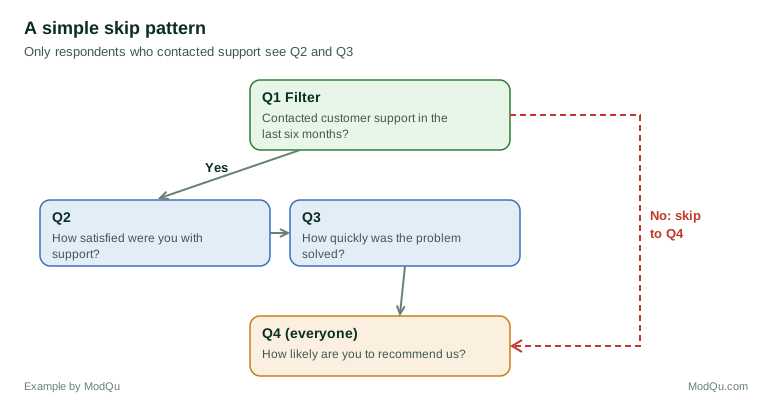
More complex designs combine several conditions ("if the respondent is employed and works more than 30 hours a week"), carry earlier answers forward into later questions ("You said you bought a laptop. Where did you buy it?") or vary question wording by group. A questionnaire that adapts in these ways is sometimes called a tailored or adaptive questionnaire.
Branching on paper
In paper questionnaires, respondents must follow the routing themselves, guided by instructions such as "If No, go to Question 7". Many do not. Studies of self-completed paper forms have found substantial rates of errors of two kinds: commission errors, where respondents answer questions they should have skipped, and omission errors, where they skip questions they should have answered (Redline & Dillman, 2002). Omission errors are the more serious, because the information is lost.
Visual design has a strong effect on these errors. Instructions placed next to the answer box, arrows pointing to the next question, bold or larger text and a short reminder at the start of the follow-up question all reduce errors. In an experiment in the United States Census 2000, alternative designs of the branching instructions reduced errors substantially compared with the standard form (Redline et al., 2003). Theories of how respondents read self-completed questionnaires explain why: respondents attend to the answer spaces and questions and often do not notice instructions placed elsewhere (Jenkins & Dillman, 1997).
Branching on screen
Computer-assisted questionnaires, whether completed by an interviewer or online, apply routing automatically. Respondents never see the questions that do not apply to them, so routing errors by respondents disappear. This is one of the main advantages of computer-assisted data collection, and it allows far more complex routing than paper can support (Couper, 2008).
Automation moves the risk from the respondent to the designer. If a routing rule is programmed wrongly, every respondent who meets the condition is affected, and the problem may not be visible until the data are analysed. A missing condition can send some respondents past questions they should have answered; a wrong condition can show questions that make no sense to them.
Web survey design choices interact with routing. In paging designs, where each screen holds one or a few questions, routing can be applied between screens. In scrolling designs, where the whole questionnaire appears on one page, routing is harder to apply and respondents may see irrelevant questions (Peytchev et al., 2006). Most modern web surveys use paging for this reason (Tourangeau et al., 2013).
When filters change answers
Filter questions can affect how respondents answer, not just which questions they see. Respondents quickly learn that saying "yes" to a filter leads to more questions. In a series of experiments, respondents answered filter questions differently depending on whether the filters were asked one at a time, each followed immediately by its follow-ups (the interleafed format), or all together before any follow-ups (the grouped format). In the interleafed format, respondents said "yes" less often to later filters, apparently to avoid extra questions (Kreuter et al., 2011). Later work found that this kind of misreporting was driven mainly by respondents' wish to shorten the survey (Eckman et al., 2014).
This motivated underreporting is a real risk in long surveys with many filters. Designers can reduce it by asking filter questions together before their follow-ups, by keeping the follow-ups short and by placing the most important filters early, when motivation is highest.
Branching can also be used deliberately to improve measurement. Questions about attitudes can be asked in two steps, first asking the direction ("Do you agree, disagree or neither?") and then the strength. Experiments have found that this branching approach can improve the reliability and validity of measures of bipolar attitudes compared with a single question (Malhotra et al., 2009).
Designing good routing
Plan before programming
Routing should be designed on paper, or in a flowchart, before it is programmed. A routing map shows every path through the questionnaire and makes it easy to spot dead ends, loops and paths that skip essential questions (Bethlehem & Biffignandi, 2012).
Keep it as simple as possible
Every additional condition adds a chance of error. Complex conditions should be broken into simpler steps, and derived variables, such as "employed full-time," can be calculated once and used in later routing.
Write clear filter questions
A filter question must be unambiguous, because everything that follows depends on it. If respondents misunderstand the filter, they are routed wrongly, and the error cannot be corrected later.
Allow for "don't know" and refusals
Routing must specify what happens when a respondent does not answer the filter. If a non-answer leads nowhere, the respondent may be stuck or may skip a whole section.
Use text fills carefully
Carrying earlier answers into later questions makes a survey feel personal and reduces ambiguity, but it fails awkwardly when the earlier answer is missing or unusual.
Testing routing
Routing errors are among the most common faults in computer-assisted questionnaires, and they must be tested systematically (Groves et al., 2009). Good practice includes:
- Path testing, in which testers work through every route in the routing map using test cases designed to trigger each condition.
- Dummy data, in which the survey is completed many times with random answers and the resulting data are checked to confirm that every question was asked of the right people.
- Usability testing, in which real users are observed completing the survey, which can reveal navigation problems that path testing misses (Couper, 2000).
- Pilot data checks, in which pilot responses are examined to confirm that the number of respondents answering each question matches what the routing predicts.
In business surveys
Customer and employee surveys often route respondents by product, region, role or experience. A survey that asks every customer about every product wastes time and produces meaningless answers; well-designed routing shows each customer only the products they use. The same discipline also allows a single questionnaire to serve several audiences, with each group following its own path through common core questions. A common pattern in business surveys is the loop, in which the same block of questions is repeated for each item the respondent selected earlier, such as each brand used or each store visited. Loops are efficient, but they can multiply burden quickly: a respondent who selects eight brands may face eight repetitions of the same block. Designers often cap loops, for example by asking the detailed block for no more than two or three randomly chosen items, which keeps the burden manageable while still producing unbiased results across items. Routing should also be checked against the sample: if a filter is expected to route only a small share of respondents into a section, the number of completed interviews must be large enough to give useful results for that section. Checking pilot data for the expected number of answers at each question is the quickest way to catch routing errors before launch (Dillman et al., 2014).
Conclusion
Skip logic makes questionnaires shorter, more relevant and more precise, and computer-assisted surveys allow routing far more complex than paper ever could. But routing is also a source of error: respondents miss instructions on paper, designers make programming mistakes on screen and filter questions can change the answers they are meant to sort. Clear filters, simple conditions, a routing map and thorough testing keep the benefits while controlling the risks (Callegaro et al., 2015).
References
Bethlehem, J., & Biffignandi, S. (2012). Handbook of web surveys. Wiley.
Callegaro, M., Lozar Manfreda, K., & Vehovar, V. (2015). Web survey methodology. SAGE.
Couper, M. P. (2000). Usability evaluation of computer-assisted survey instruments. Social Science Computer Review, 18(4), 384–396. https://doi.org/10.1177/089443930001800402
Couper, M. P. (2008). Designing effective web surveys. Cambridge University Press. https://doi.org/10.1017/CBO9780511499371
Dillman, D. A., Smyth, J. D., & Christian, L. M. (2014). Internet, phone, mail, and mixed-mode surveys: The tailored design method (4th ed.). Wiley.
Eckman, S., Kreuter, F., Kirchner, A., Jäckle, A., Tourangeau, R., & Presser, S. (2014). Assessing the mechanisms of misreporting to filter questions in surveys. Public Opinion Quarterly, 78(3), 721–733. https://doi.org/10.1093/poq/nfu030
Groves, R. M., Fowler, F. J., Jr., Couper, M. P., Lepkowski, J. M., Singer, E., & Tourangeau, R. (2009). Survey methodology (2nd ed.). Wiley.
Jenkins, C. R., & Dillman, D. A. (1997). Towards a theory of self-administered questionnaire design. In L. Lyberg, P. Biemer, M. Collins, E. de Leeuw, C. Dippo, N. Schwarz, & D. Trewin (Eds.), Survey measurement and process quality (pp. 165–196). Wiley.
Kreuter, F., McCulloch, S., Presser, S., & Tourangeau, R. (2011). The effects of asking filter questions in interleafed versus grouped format. Sociological Methods & Research, 40(1), 88–104. https://doi.org/10.1177/0049124110392342
Malhotra, N., Krosnick, J. A., & Thomas, R. K. (2009). Optimal design of branching questions to measure bipolar constructs. Public Opinion Quarterly, 73(2), 304–324. https://doi.org/10.1093/poq/nfp023
Peytchev, A., Couper, M. P., McCabe, S. E., & Crawford, S. D. (2006). Web survey design: Paging versus scrolling. Public Opinion Quarterly, 70(4), 596–607. https://doi.org/10.1093/poq/nfl028
Redline, C. D., & Dillman, D. A. (2002). The influence of alternative visual designs on respondents' performance with branching instructions in self-administered questionnaires. In R. M. Groves, D. A. Dillman, J. L. Eltinge, & R. J. A. Little (Eds.), Survey nonresponse (pp. 179–193). Wiley.
Redline, C., Dillman, D. A., Dajani, A. N., & Scaggs, M. A. (2003). Improving navigational performance in U.S. Census 2000 by altering the visually administered languages of branching instructions. Journal of Official Statistics, 19(4), 403–419.
Tourangeau, R., Conrad, F. G., & Couper, M. P. (2013). The science of web surveys. Oxford University Press. https://doi.org/10.1093/acprof:oso/9780199747047.001.0001