
Surveys · Nonresponse, weighting and data quality
Acquiescence Bias: The Tendency to Agree and How to Counter It
Many survey respondents tend to agree with statements regardless of their content. This article explains acquiescence bias, why it happens, who is most affected, how it distorts survey results and the question designs and analysis methods that reduce it.
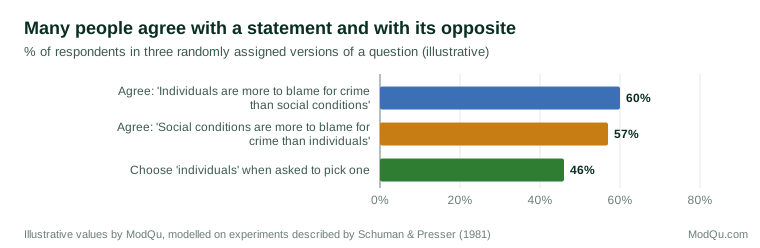
Ask a group of people whether they agree that "individuals are more to blame than social conditions for crime", and many will agree. Ask a similar group whether they agree that "social conditions are more to blame than individuals for crime", and many will agree with that too. Some respondents, it seems, tend to say "agree", "yes" or "true" whatever the statement says. This tendency is called acquiescence, or acquiescent response style, and the distortion it causes is acquiescence bias (Schuman & Presser, 1981; Krosnick, 1991).
Acquiescence is one of several response styles, systematic tendencies to use response scales in particular ways regardless of content (Van Vaerenbergh & Thomas, 2013). It matters because agree–disagree questions are among the most common formats in surveys, from employee engagement and customer satisfaction studies to political attitudes and personality measures. This article explains why acquiescence occurs, who is most affected, how it distorts results and what researchers can do about it.
Evidence of acquiescence
The strongest evidence comes from experiments in which respondents are randomly assigned to receive a statement or its opposite. If answers reflected only content, agreement with one version should roughly equal disagreement with the other. In practice, agreement with both versions is often higher than this would imply. Schuman and Presser (1981) reported a series of such experiments and found that, for many items, a substantial share of respondents agreed whichever way the statement was worded. When the same issue was posed as a forced choice between two alternatives, the results differed from both agree–disagree versions. Figure 1 illustrates the pattern.
Studies of personality and attitude scales also show acquiescence. Couch and Keniston (1960) described "yeasayers" and "naysayers" who consistently agreed or disagreed with statements across many unrelated items. Billiet and McClendon (2000) modelled acquiescence in balanced sets of items, in which half are worded positively and half negatively, and found a consistent acquiescence factor affecting answers to both. Later research found that individual response styles are fairly stable over time and across questionnaires, suggesting that they reflect enduring characteristics of respondents as well as features of particular questions (Billiet & Davidov, 2008; Weijters et al., 2010).
Why people acquiesce
Several explanations have been offered, and they are not mutually exclusive (Krosnick, 1991; Van Vaerenbergh & Thomas, 2013).
Satisficing. Agreeing requires less effort than disagreeing. To answer an agree–disagree question carefully, a respondent must form a judgement about the topic and then translate it into agreement or disagreement with the specific statement, which may be worded in a way that does not match their view. Agreeing allows them to skip this work. Krosnick (1991) argued that acquiescence is a form of satisficing and should therefore be more common among respondents with lower ability or motivation and for more difficult questions.
Confirmatory thinking. When people evaluate a statement, they tend to search for reasons it might be true rather than reasons it might be false. This bias towards confirmation makes agreement more likely.
Deference and politeness. Respondents may defer to the interviewer or the researcher, treating the statement as the view of someone of higher status. Lenski and Leggett (1960) found more acquiescence among respondents of lower social status and suggested that deference to interviewers played a role. In cultures where disagreement is considered impolite, acquiescence can be higher (Javeline, 1999; Smith, 2004).
Who acquiesces
Acquiescence is not spread evenly across respondents. It is consistently more common among people with less formal education. Narayan and Krosnick (1996) analysed many survey experiments and found that acquiescence, along with several other response effects, was stronger among less educated respondents. It also varies across countries and cultures. Johnson et al. (2005) compared 19 countries and found that acquiescence was related to cultural dimensions, and Baumgartner and Steenkamp (2001) found substantial differences in response styles between European countries in marketing research data. Smith (2004) linked national differences in acquiescence to cultural norms of communication.
Because acquiescence varies between groups, it can create false differences. If less educated respondents acquiesce more, they will appear to agree more with any statement, whether it expresses a liberal or conservative view, a positive or negative evaluation. Comparisons across countries using agree–disagree items can likewise reflect differences in response style rather than in attitudes (Baumgartner & Steenkamp, 2001).
How acquiescence distorts results
Acquiescence affects survey results in several ways.
Inflated agreement. Levels of agreement with any statement are overstated. Employee and customer surveys built on positive statements, such as "I am proud to work here", will report higher satisfaction than direct questions would.
Distorted relationships. When several items are all worded in the same direction, acquiescence adds a shared component to all of them. This inflates correlations between items and can make scales appear more reliable than they are, or make unrelated concepts appear related. This is one source of common method variance, the shared error that arises when variables are measured with the same method (Podsakoff et al., 2003).
Misleading group differences. As noted above, groups that acquiesce more appear to agree more, which can be mistaken for real differences.
Problems with reversed items. A common remedy, mixing positively and negatively worded items, introduces its own problems. Respondents may misread negated statements, and reversed items often behave differently from positive ones for reasons unrelated to acquiescence (Weijters et al., 2013).
Beyond agree–disagree: yes/no and true/false questions
Acquiescence is not limited to agree–disagree scales. Questions with yes/no or true/false answers show the same tendency: respondents are more likely to say "yes" to "Do you favour…?" than to say "no" to "Do you oppose…?" Early debates in personality research turned on how far answers to true/false inventories reflected content and how far they reflected a general tendency to answer "true". Jackson and Messick (1958) argued that such response styles could account for a large part of the variation in some personality scales, a claim that prompted decades of research into separating style from content. For survey designers, the lesson is that any format asking respondents to accept or reject a proposition offered by the researcher invites acquiescence.
Mode and acquiescence
The mode of data collection influences acquiescence. Interviewer-administered surveys may increase it, because deference to the interviewer and the pace of conversation encourage quick agreement. Holbrook et al. (2003) compared telephone and face-to-face interviews and found more acquiescence by telephone, which they attributed to lower engagement and greater satisficing in telephone interviews. Self-administered web questionnaires remove the interviewer but can encourage fast clicking through grids of agree–disagree statements, which also produces acquiescence. Mode differences in acquiescence are one reason why results from different modes should not be combined without checking for measurement differences.
Acquiescence in customer and employee research
Customer satisfaction and employee engagement surveys rely heavily on positively worded agree–disagree statements, such as "I would recommend this company to a friend" or "I have the tools I need to do my job". Acquiescence inflates scores on all of these and, because every item is worded the same way, inflates the correlations between them. This can make a set of items look like a single, highly reliable measure of engagement or satisfaction when part of the shared variance is response style (Podsakoff et al., 2003). It can also make results appear more favourable in countries or business units where acquiescence is more common, which may lead to unfair comparisons between managers or regions (Baumgartner & Steenkamp, 2001). Item-specific questions and a few behavioural measures, such as actual referrals or staff turnover, provide useful checks.
Countering acquiescence through question design
Use item-specific questions
The most effective design remedy is to avoid agree–disagree questions altogether and ask about the dimension of interest directly. Instead of asking respondents to agree or disagree that "my manager gives me useful feedback", ask "How useful is the feedback your manager gives you?" with a scale from "not at all useful" to "extremely useful". These are called item-specific or construct-specific questions. Figure 2 compares the two formats.
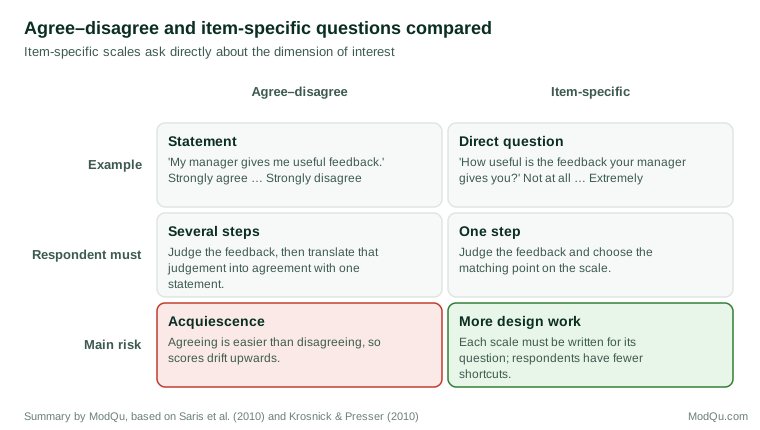
Saris et al. (2010) compared agree–disagree and item-specific versions of the same questions in several countries using multitrait-multimethod experiments and found that item-specific questions had consistently higher measurement quality. Krosnick and Presser (2010) recommended item-specific formats as a general principle of questionnaire design. Item-specific questions also require less cognitive translation: the respondent's judgement maps directly onto the response scale. Höhne and Lenzner (2018) used eye tracking to show that agree–disagree questions required more processing effort than item-specific ones.
Use forced choices
When an issue has two sides, asking respondents to choose between them avoids the tendency to agree with whichever side is presented. "Which comes closer to your view: individuals are more to blame for crime, or social conditions are more to blame?" Rotating the order of the alternatives across respondents prevents order effects from replacing acquiescence (Schuman & Presser, 1981).
Balance item wording if agree–disagree items are kept
When agree–disagree items must be used, for example to maintain comparability with an existing scale, a balanced set with equal numbers of positively and negatively keyed items allows acquiescence to be detected and partly cancelled. Negatively keyed items should express the opposite view without using negations such as "not", which respondents often misread (Weijters & Baumgartner, 2012).
Reduce satisficing
Because acquiescence is partly a form of satisficing, the general remedies for satisficing also help: shorter questionnaires, simpler wording, fewer long grids and explanations that encourage careful answering (Krosnick, 1991).
Countering acquiescence in analysis
When data have already been collected with agree–disagree items, several analysis methods can estimate and adjust for acquiescence (Billiet & McClendon, 2000; Van Vaerenbergh & Thomas, 2013):
- Acquiescence indices. With balanced scales, the average agreement across positively and negatively keyed items measures each respondent's tendency to agree regardless of content. This index can be used as a control variable or to adjust scores.
- Latent variable models. Structural equation models can include an acquiescence factor that affects all items equally, separating style from content.
- Within-person centring. Subtracting each respondent's average answer across many unrelated items removes a general tendency to agree, although it also removes real differences in overall level.
A further option, when the same respondents answer surveys repeatedly, is to estimate each person's response style from earlier waves and use it to interpret later answers, since individual styles are fairly stable over time (Weijters et al., 2010). Whichever method is used, it is good practice to report results both with and without the adjustment, so that readers can see how much the conclusions depend on it. These methods require suitable items and assumptions about how acquiescence operates. They are a second-best solution compared with designing questions that avoid acquiescence in the first place.
An example
A company's annual employee survey has 30 agree–disagree statements, all worded positively. Scores have been high and stable for years, and differences between departments are small. The research team suspects acquiescence and runs a split-sample test: half of employees receive the usual statements and half receive item-specific versions of the same questions. In the item-specific version, average scores are about 8 points lower on a 100-point scale, differences between departments are larger, and the gap between employees with and without university degrees, which had appeared in the old version, largely disappears. The team adopts the item-specific version and reports the change, with a bridging estimate so that the long-term trend can still be followed (illustrative example).
Conclusion
Acquiescence is the tendency to agree with statements regardless of their content. It arises from the effort required to disagree, from confirmatory thinking and from deference, and it is more common among respondents with less education and in some cultures. It inflates agreement, distorts relationships between items and creates false differences between groups. The most effective remedy is to replace agree–disagree statements with item-specific questions or forced choices. When agree–disagree items must be used, balanced wording and appropriate analysis can reduce the bias. Designing questions that ask directly about what researchers want to know produces more accurate survey knowledge.
References
Baumgartner, H., & Steenkamp, J.-B. E. M. (2001). Response styles in marketing research: A cross-national investigation. Journal of Marketing Research, 38(2), 143–156. https://doi.org/10.1509/jmkr.38.2.143.18840
Billiet, J. B., & Davidov, E. (2008). Testing the stability of an acquiescence style factor behind two interrelated substantive variables in a panel design. Sociological Methods & Research, 36(4), 542–562. https://doi.org/10.1177/0049124107313901
Billiet, J. B., & McClendon, M. J. (2000). Modeling acquiescence in measurement models for two balanced sets of items. Structural Equation Modeling, 7(4), 608–628. https://doi.org/10.1207/S15328007SEM0704_5
Couch, A., & Keniston, K. (1960). Yeasayers and naysayers: Agreeing response set as a personality variable. Journal of Abnormal and Social Psychology, 60(2), 151–174. https://doi.org/10.1037/h0040372
Höhne, J. K., & Lenzner, T. (2018). New insights on the cognitive processing of agree/disagree and item-specific questions. Journal of Survey Statistics and Methodology, 6(3), 401–417. https://doi.org/10.1093/jssam/smx028
Holbrook, A. L., Green, M. C., & Krosnick, J. A. (2003). Telephone versus face-to-face interviewing of national probability samples with long questionnaires: Comparisons of respondent satisficing and social desirability response bias. Public Opinion Quarterly, 67(1), 79–125. https://doi.org/10.1086/346010
Jackson, D. N., & Messick, S. (1958). Content and style in personality assessment. Psychological Bulletin, 55(4), 243–252. https://doi.org/10.1037/h0045996
Javeline, D. (1999). Response effects in polite cultures: A test of acquiescence in Kazakhstan. Public Opinion Quarterly, 63(1), 1–28. https://doi.org/10.1086/297701
Johnson, T., Kulesa, P., Cho, Y. I., & Shavitt, S. (2005). The relation between culture and response styles: Evidence from 19 countries. Journal of Cross-Cultural Psychology, 36(2), 264–277. https://doi.org/10.1177/0022022104272905
Krosnick, J. A., & Presser, S. (2010). Question and questionnaire design. In P. V. Marsden & J. D. Wright (Eds.), Handbook of survey research (2nd ed., pp. 263–313). Emerald.
Krosnick, J. A. (1991). Response strategies for coping with the cognitive demands of attitude measures in surveys. Applied Cognitive Psychology, 5(3), 213–236. https://doi.org/10.1002/acp.2350050305
Lenski, G. E., & Leggett, J. C. (1960). Caste, class, and deference in the research interview. American Journal of Sociology, 65(5), 463–467.
Narayan, S., & Krosnick, J. A. (1996). Education moderates some response effects in attitude measurement. Public Opinion Quarterly, 60(1), 58–88. https://doi.org/10.1086/297739
Podsakoff, P. M., MacKenzie, S. B., Lee, J.-Y., & Podsakoff, N. P. (2003). Common method biases in behavioral research: A critical review of the literature and recommended remedies. Journal of Applied Psychology, 88(5), 879–903. https://doi.org/10.1037/0021-9010.88.5.879
Saris, W. E., Revilla, M., Krosnick, J. A., & Shaeffer, E. M. (2010). Comparing questions with agree/disagree response options to questions with item-specific response options. Survey Research Methods, 4(1), 61–79. https://doi.org/10.18148/srm/2010.v4i1.2682
Schuman, H., & Presser, S. (1981). Questions and answers in attitude surveys: Experiments on question form, wording, and context. Academic Press.
Smith, P. B. (2004). Acquiescent response bias as an aspect of cultural communication style. Journal of Cross-Cultural Psychology, 35(1), 50–61. https://doi.org/10.1177/0022022103260380
Van Vaerenbergh, Y., & Thomas, T. D. (2013). Response styles in survey research: A literature review of antecedents, consequences, and remedies. International Journal of Public Opinion Research, 25(2), 195–217. https://doi.org/10.1093/ijpor/eds021
Weijters, B., & Baumgartner, H. (2012). Misresponse to reversed and negated items in surveys: A review. Journal of Marketing Research, 49(5), 737–747. https://doi.org/10.1509/jmr.11.0368
Weijters, B., Baumgartner, H., & Schillewaert, N. (2013). Reversed item bias: An integrative model. Psychological Methods, 18(3), 320–334. https://doi.org/10.1037/a0032121
Weijters, B., Geuens, M., & Schillewaert, N. (2010). The stability of individual response styles. Psychological Methods, 15(1), 96–110. https://doi.org/10.1037/a0018721