
Research · Market and business research
The Research Industry: Size, Structure and Trends
How large the market research and insights industry is, how it is divided between research agencies, software platforms and reporting firms, who the largest companies are, and where it is heading.
Market research is a global industry made up of agencies, data collectors, software firms and analysts that produce information about markets and customers for businesses, governments and other organisations. The most widely used figures on its size come from ESOMAR, the international association for market, social and opinion research, which publishes an annual Global Market Research report based on national association data and company reports. This article summarises what those reports show about the industry's size, structure and direction.
Size
ESOMAR's definition has widened over time. Its 2019 report valued the "research and data" industry at about US$80 billion in 2018, of which traditionally defined market research accounted for about US$47 billion (ESOMAR, 2019). Since then ESOMAR has measured a broader insights industry that includes research software and reporting firms as well as research agencies. On this definition, the industry was estimated at about US$142 billion in 2023 (ESOMAR, 2024; Palacio, 2024) and about US$153 billion in 2024 (ESOMAR, 2025a; Ajaluni, 2025). Changes in definition mean that these figures should not be read as a single growth series.
Structure
ESOMAR divides the insights industry into three sectors (ESOMAR, 2025b):
- Market research: project-based research agencies, full-service firms and sample and fieldwork providers.
- Research software: data-as-a-service and software-as-a-service products, analytics tools, do-it-yourself survey platforms and customer feedback management systems.
- Reporting: consultancies and publishers of industry and market reports.
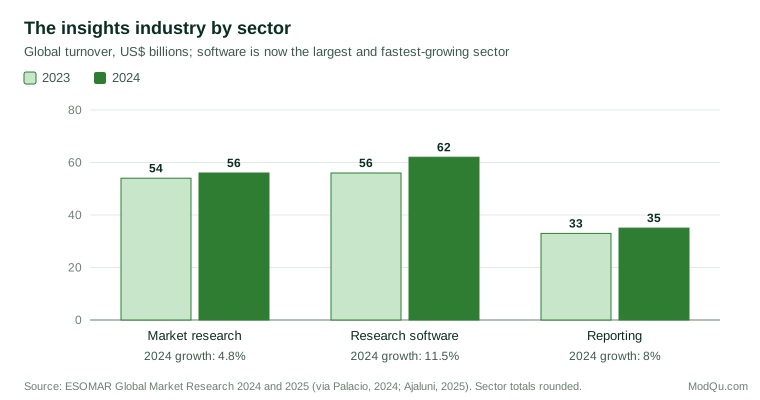
In 2024, market research accounted for about US$56 billion, research software for about US$62 billion and reporting for about US$35 billion (Ajaluni, 2025). Within the market research sector, about 62% of turnover came from full-service and fieldwork services, 31% from subscription-based and software services, and 7% from consultancy.
Methods and clients
Most research revenue comes from quantitative work. In ESOMAR's 2019 report, quantitative research accounted for 78% of global market research turnover in 2018, down from 81% the year before, while qualitative research held steady at 14% (ESOMAR, 2019). The largest client sectors were consumer non-durables, at 19% of the total, followed by media and entertainment and by pharmaceuticals, each at 16%. Clients increasingly combine commissioned studies with data they already hold, such as transaction records, web analytics and customer feedback, which helps explain the growth of software and data products.
Concentration and geography
The industry is concentrated at the top. ESOMAR (2025b) estimated that the 50 largest insights companies held just over half of global turnover in 2024, 52.4%. The list now includes software and data companies alongside research specialists. Gartner, IQVIA, Adobe, Salesforce, NIQ, Nielsen, Kantar, CoStar Group, Ipsos and HubSpot were the ten largest by insights turnover; for some, such as Adobe and Salesforce, only the insights part of their business was counted. In 2018, the ten largest research companies alone accounted for more than half of world market research turnover (ESOMAR, 2019).
Geographically, the industry is dominated by a few countries. In 2018 the United States accounted for 44% of global market research turnover, followed by the United Kingdom, Germany, France and China (ESOMAR, 2019). Below the largest firms are thousands of small agencies, specialist consultancies and independent researchers.
Trends
Software is growing fastest. In 2024 research software grew by 11.5%, reporting by 8% and market research by 4.8% (Ajaluni, 2025). ESOMAR (2025b) reports that growth has favoured platforms, software companies and subscription-based services.
Traditional research is mature. The market research sector is growing slowly and shows the signs of a mature industry (Palacio, 2024). Its share of global insights turnover fell by about 3 percentage points between 2023 and 2024 as software grew (Ajaluni, 2025).
Artificial intelligence is changing data collection. ESOMAR (2025b) identifies advances in artificial intelligence as one of the pressures on sample and panel providers.
Mergers have slowed but are expected to return. Only six of the top 50 companies were involved in significant mergers or acquisitions in 2024, about half the level of 2023, and ESOMAR expected consolidation to resume in 2025 (ESOMAR, 2025b).
For buyers of research, these trends mean more choice of self-service tools and data products, alongside a smaller number of large full-service agencies. ESOMAR's (2025c) forecast report projects the industry's development to 2027.
References
Ajaluni, L. (2025, November 4). Inside the $153bn insights industry. Research World. https://researchworld.com/articles/inside-the-153bn-insights-industry
ESOMAR. (2019). Global market research 2019. ESOMAR.
ESOMAR. (2024). Global market research 2024. ESOMAR.
ESOMAR. (2025a). Global market research 2025. ESOMAR.
ESOMAR. (2025b). Global top insights companies 2025. ESOMAR.
ESOMAR. (2025c). Forecasting the data and insights industry: A 2027 outlook. ESOMAR.
Palacio, X. (2024, November 20). Drivers of our $142bn insights industry. Research World. https://researchworld.com/articles/drivers-of-our-142bn-insights-industry