
Research · Qualitative research
The Contribution of Negative Case Analysis to Theory Refinement
What negative case analysis is, how searching for cases that contradict an emerging explanation refines qualitative theory, its roots in analytic induction, how to carry it out, and how to report it.
A theory that explains every case it was built on may simply not have been tested. Negative case analysis is the deliberate search for cases that do not fit an emerging explanation, followed by revision of the explanation until it accounts for them or until the reasons they differ are understood. It is one of the main ways qualitative researchers test and refine theory, and it applies a principle familiar from the philosophy of science: knowledge grows by confronting ideas with evidence that could prove them wrong. This article explains the origins of the technique, how it is carried out and what it contributes to theory refinement.
Why disconfirming cases matter
Popper (1959) argued that no number of confirming observations can prove a universal claim, while a single counter-example can refute it. Researchers who look only for supporting evidence will always find some. Searching for disconfirming evidence is therefore a stronger test.
In qualitative research the same logic applies, though usually in a softer form. Lincoln and Guba (1985) listed negative case analysis among the techniques that establish the credibility of qualitative findings. They described it as a process of revising hypotheses with hindsight, continuing until the explanation accounts for all known cases without exception. Creswell and Miller (2000) included disconfirming evidence among the main validity procedures in qualitative research, noting that a credible account reports evidence that runs against its main themes, not only evidence that supports them.
Roots in analytic induction
Negative case analysis grew out of analytic induction, a method developed in early twentieth-century sociology. Znaniecki (1934) argued that sociology should seek universal explanations by studying a small number of cases intensively, rather than by measuring averages across many cases. One case that contradicted the explanation was enough to require revision.
Lindesmith (1947) applied the method to opiate addiction. He proposed that people become addicted when they use the drug to relieve withdrawal distress and recognise that the distress comes from stopping the drug. Each time he found a case that did not fit an earlier version of his explanation, he revised the explanation. Cressey (1953) used the same approach to study embezzlement. His initial hypotheses were refuted by cases he interviewed in prison, and he revised his explanation several times before reaching a final account: trusted people embezzle when they have a financial problem they cannot share, recognise that they can solve it by violating their position of trust, and can justify the act to themselves.
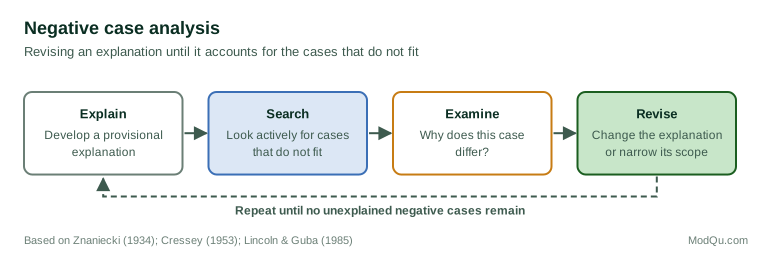
The diagram below summarises the cycle.
Robinson (1951) criticised analytic induction, arguing that it established the conditions that were necessary for a phenomenon but not those that were sufficient, because it examined only cases where the phenomenon occurred. This criticism led researchers to examine cases where the phenomenon was absent as well, which strengthened the method.
Carrying out negative case analysis
In practice, negative case analysis is less rigid than the original analytic induction. The usual steps are:
- Develop a provisional explanation from the data analysed so far.
- Search actively for cases that do not fit. These may be participants, events, sites or episodes. The search should be deliberate, not left to chance.
- Examine each negative case closely. Ask why it differs. Is it a measurement or recording error? Does it reveal a condition the explanation missed? Does it belong to a different phenomenon?
- Revise. Either modify the explanation to include the case, narrow the scope of the explanation to exclude cases of a different kind, or record the case as an unexplained exception.
- Repeat until no new negative cases emerge or the remaining exceptions are understood.
Miles et al. (2014) recommended related tactics, such as checking the meaning of outliers, looking for negative evidence and testing rival explanations. They noted that outliers can protect researchers from self-selecting biases and can suggest conditions under which the main pattern does not hold.
Choosing negative cases in comparative research
In comparative studies, the choice of negative cases needs care. Mahoney and Goertz (2004) proposed the possibility principle: negative cases should be those where the outcome was possible but did not occur. Comparing a country that had a revolution with one where revolution was never plausible teaches little. Comparing it with one where the conditions for revolution were present but none happened is far more informative. Emigh (1997) argued that negative cases are particularly valuable for building theory, because explaining why an expected outcome did not happen forces researchers to identify the conditions their theories had taken for granted.
An example
A hypothetical example: a study of small firms finds that those adopting a new accounting system report saving time. One firm reports the opposite. Close examination shows that it adopted the system without training staff, who continued to keep parallel paper records. The explanation is revised: the system saves time when staff are trained to replace, not duplicate, existing procedures. The negative case did not refute the finding; it identified the condition on which it depends.
Pitfalls
Negative case analysis can be done badly. A researcher may search for negative cases only half-heartedly, or may dismiss them too quickly as errors or exceptions. The opposite risk is to keep stretching an explanation to cover every case, until it becomes so broad that it explains nothing. Popper (1959) warned against protecting a theory with adjustments that make it harder to test, and the same warning applies here: each revision should make the explanation more precise, not more vague. Narrowing the scope of a claim is often more honest than enlarging the explanation.
Reporting
A report should state that negative cases were sought, how they were found, how many there were, and how each was handled. Showing how the explanation changed in response to contradicting cases makes the analysis more credible than an account in which every case fits.
Conclusion
Negative case analysis tests qualitative explanations by searching for the cases that contradict them. Rooted in analytic induction, it refines theory by revealing hidden conditions, narrowing claims to their proper scope and recording genuine exceptions. It turns the cases that do not fit from an embarrassment into one of the most informative parts of the analysis.
References
Cressey, D. R. (1953). Other people's money: A study in the social psychology of embezzlement. Free Press.
Creswell, J. W., & Miller, D. L. (2000). Determining validity in qualitative inquiry. Theory Into Practice, 39(3), 124–130. https://doi.org/10.1207/s15430421tip3903_2
Emigh, R. J. (1997). The power of negative thinking: The use of negative case methodology in the development of sociological theory. Theory and Society, 26(5), 649–684. https://doi.org/10.1023/A:1006896217647
Lincoln, Y. S., & Guba, E. G. (1985). Naturalistic inquiry. SAGE.
Lindesmith, A. R. (1947). Opiate addiction. Principia Press.
Mahoney, J., & Goertz, G. (2004). The possibility principle: Choosing negative cases in comparative research. American Political Science Review, 98(4), 653–669. https://doi.org/10.1017/S0003055404041401
Miles, M. B., Huberman, A. M., & Saldaña, J. (2014). Qualitative data analysis: A methods sourcebook (3rd ed.). SAGE.
Popper, K. R. (1959). The logic of scientific discovery. Hutchinson.
Robinson, W. S. (1951). The logical structure of analytic induction. American Sociological Review, 16(6), 812–818. https://doi.org/10.2307/2087508
Znaniecki, F. (1934). The method of sociology. Farrar & Rinehart.