
Research · Market and business research
Syndicated Research Versus Custom Research: Business Models Compared
How syndicated and custom market research differ as business models, in cost, speed, ownership and the questions they answer, and how organisations combine them.
Research firms sell their work in two basic ways. Syndicated research collects data once and sells the same results to many clients. Custom research, also called ad hoc or bespoke research, is designed and carried out for a single client to answer that client's question (Malhotra, 2019). The two models differ in cost, speed, ownership and the kind of questions they can answer, and most large organisations use both.
Kotler and Keller (2016) classify research suppliers into three groups: syndicated-service firms that gather consumer and trade information and sell it for a fee, custom research firms hired to carry out specific projects, and specialty-line firms that provide specialised services, such as fieldwork, to other research firms. The first two represent different business models, with different economics.
Syndicated research
A syndicated supplier decides what to measure, builds the data collection system and then sells access to subscribers. Common examples are retail scanner data that track sales by product and store, consumer panels that record household purchases, media audience measurement, and recurring industry reports. Bucklin and Gupta (1999) found that packaged-goods firms used scanner data most successfully for decisions about promotions and pricing.
The model's economics rest on spreading a large fixed cost over many buyers. Each client pays far less than it would cost to build the same system alone, and gains data that are standardised across the market, so that a brand's share can be compared with competitors' on the same basis. The trade-offs are that every subscriber sees the same data, so it confers little competitive advantage on its own, and the client cannot change what is measured or how.
From the client's side, syndicated data are a form of secondary data: they were collected by someone else, to a design the client did not choose. Stewart and Kamins (1993) advise users of such sources to check who collected the data, how and when, and how key terms were defined, before relying on them for a decision. For syndicated services this means understanding, for example, which retailers a scanner service covers and how a household panel is recruited and weighted.
For the supplier, the business has high entry costs and strong economies of scale. Once a panel or tracking system is running, each additional subscriber adds revenue at little extra cost, and a long data history becomes difficult for new competitors to match. Revenue is recurring, usually through annual subscriptions, which makes it more predictable than project income.
Custom research
In custom research the client and supplier define the problem together, and the supplier designs the sample, questions and analysis to fit (Malhotra, 2019). Typical projects include concept tests, pricing studies, segmentation studies, advertising pre-tests and customer satisfaction programmes. The results belong to the client and are usually confidential.
The advantages are fit and ownership; the disadvantages are higher cost per project and longer lead times. The quality of the result also depends heavily on the working relationship. Moorman et al. (1992) found that trust between research users and providers affected how much the research was used.
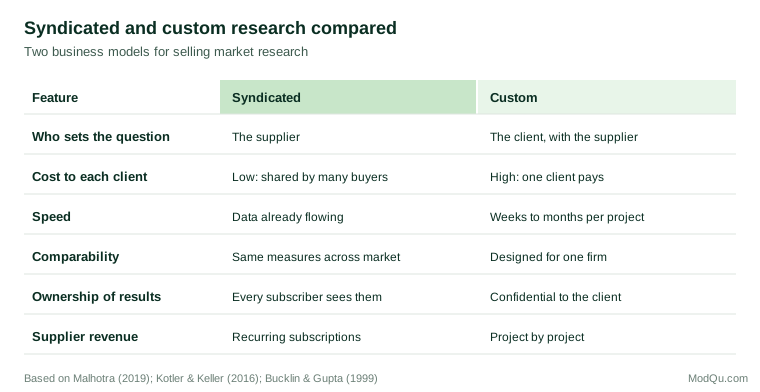
For the supplier, custom research is a project business. Revenue depends on winning a continuing flow of commissions, costs rise roughly in line with the amount of work, and margins depend on how efficiently fieldwork and analysis are run. Entry costs are lower than for syndicated research, so the custom market includes many small and specialist firms alongside large agencies.
The industry picture
ESOMAR's industry estimates do not separate syndicated from custom work directly, but they give a sense of the mix. In its Global Market Research 2025 report, ESOMAR estimated the market research sector at US$56 billion in 2024, of which about 62% came from full-service research and fieldwork, 31% from firms providing subscription-based and research software services, and 7% from consultancy (Ajaluni, 2025). Subscription services are close to the syndicated model, while much full-service work is custom.
Hybrid models
The boundary between the two models is not fixed. Common hybrids include:
- Omnibus surveys, in which several clients each buy a few questions on a shared survey of a common sample, reducing cost while keeping each client's questions private.
- Custom analysis of syndicated data, in which a client pays for special tabulations or models built on a syndicated dataset.
- Access panels and research software, which give clients standardised tools and samples to run their own custom studies.
Choosing between them
Syndicated research suits questions that many firms in a market share, such as category size, market shares, and media audiences, and where comparability over time and across competitors matters. Custom research suits questions specific to the firm, such as how customers react to its own new product or brand. A common pattern is to use syndicated data to monitor the market and spot problems, then commission custom research to investigate causes and test responses.
References
Ajaluni, L. (2025, November 4). Inside the $153bn insights industry. Research World. https://researchworld.com/articles/inside-the-153bn-insights-industry
Bucklin, R. E., & Gupta, S. (1999). Commercial use of UPC scanner data: Industry and academic perspectives. Marketing Science, 18(3), 247–273. https://doi.org/10.1287/mksc.18.3.247
Kotler, P., & Keller, K. L. (2016). Marketing management (15th ed.). Pearson.
Malhotra, N. K. (2019). Marketing research: An applied orientation (7th ed., global ed.). Pearson.
Moorman, C., Zaltman, G., & Deshpandé, R. (1992). Relationships between providers and users of market research: The dynamics of trust within and between organizations. Journal of Marketing Research, 29(3), 314–328.
Stewart, D. W., & Kamins, M. A. (1993). Secondary research: Information sources and methods (2nd ed.). Sage.