
Research · Literature and evidence
Research Synthesis of Qualitative Studies via Meta-Ethnography
What meta-ethnography is, the seven phases set out by Noblit and Hare, how studies are translated into one another, the three kinds of synthesis, and the method's strengths and limits.
Qualitative studies are often small and closely tied to their settings. A single interview study of how customers experience a service can be rich, but it is hard to know how far its insights extend. Meta-ethnography is a method for synthesising qualitative studies so that their combined interpretation says more than any one of them. It was developed by Noblit and Hare (1988) in education research and is now one of the most widely used methods of qualitative synthesis, especially in health research.
Interpretation, not aggregation
Meta-ethnography does not pool findings in the way a meta-analysis pools numbers. Noblit and Hare (1988) described it as interpretive: the aim is to compare the concepts, themes and explanations that different studies offer, and to build a new interpretation that accounts for them all. The key idea is translation. Studies often describe similar ideas in different words, and the reviewer translates the concepts of each study into the terms of the others, checking where they match and where they do not.
This makes meta-ethnography different from simply summarising a set of studies. A summary reports what each study found. A meta-ethnography asks how the findings fit together, and whether a concept that appears under one name in one study and another name in a second study is in fact the same idea.
Seven phases
Noblit and Hare (1988) set out seven phases, shown below.
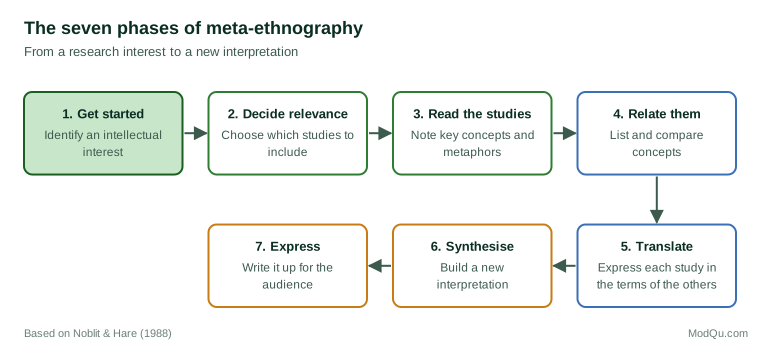
The early phases define the question and select studies. The central work happens in phases four to six. The reviewer lists the key concepts from each study, using the original authors' terms, and decides how the studies relate to one another. Concepts are then translated across studies, usually in a table that sets each concept against each study. Finally the translations are brought together into a synthesis, which is written up for its intended audience.
Three kinds of synthesis
How the studies relate determines the type of synthesis.
Reciprocal translation is used when studies describe similar things. Concepts are translated into one another until a set of overarching concepts emerges.
Refutational synthesis is used when studies contradict one another. The reviewer examines the contradiction and tries to explain it.
Lines-of-argument synthesis builds a whole picture from studies that each describe a part of it, much as a single ethnography would build an account from many observations.
A worked example
Britten et al. (2002) showed how the method works in practice, synthesising four studies of how patients think about taking medicines. They distinguished the views of study participants, which they called first-order constructs, from the interpretations of the original authors, called second-order constructs, and their own new interpretations, called third-order constructs. The synthesis produced new explanations of why patients do not always take medicines as prescribed. Campbell et al. (2003) applied the method to a larger set of studies on people's experiences of diabetes and its care, and concluded that meta-ethnography could produce interpretations that went beyond those of the individual studies.
Practical challenges
Atkins et al. (2008), reporting on a meta-ethnography of studies on adherence to tuberculosis treatment, described several practical difficulties. Searching for qualitative studies is harder than for trials, because indexing is poor. Appraising quality is contested, since there is no agreed checklist for qualitative research. And translating many studies is time-consuming and depends heavily on the reviewers' judgement, which needs to be made transparent.
Dixon-Woods et al. (2005) placed meta-ethnography among a range of methods for synthesising evidence, noting that it is clearly interpretive rather than aggregative. Thomas and Harden (2008) developed thematic synthesis as a related approach that is often easier to apply to large numbers of descriptive studies, while meta-ethnography is best suited to studies with rich, conceptual findings.
Uses in business research
Meta-ethnography can help any field with a body of small qualitative studies on the same issue. In business research it could bring together interview studies of customer trust, employee experience of change or the adoption of new technology, to identify concepts that recur across settings and explanations that no single study could support.
Conclusion
Meta-ethnography offers a structured way to synthesise qualitative research by translating the concepts of different studies into one another. It respects the interpretive nature of qualitative findings and can produce new understanding. It also demands time, judgement and clear reporting of how the synthesis was reached.
References
Atkins, S., Lewin, S., Smith, H., Engel, M., Fretheim, A., & Volmink, J. (2008). Conducting a meta-ethnography of qualitative literature: Lessons learnt. BMC Medical Research Methodology, 8, Article 21. https://doi.org/10.1186/1471-2288-8-21
Britten, N., Campbell, R., Pope, C., Donovan, J., Morgan, M., & Pill, R. (2002). Using meta ethnography to synthesise qualitative research: A worked example. Journal of Health Services Research & Policy, 7(4), 209–215. https://doi.org/10.1258/135581902320432732
Campbell, R., Pound, P., Pope, C., Britten, N., Pill, R., Morgan, M., & Donovan, J. (2003). Evaluating meta-ethnography: A synthesis of qualitative research on lay experiences of diabetes and diabetes care. Social Science & Medicine, 56(4), 671–684. https://doi.org/10.1016/S0277-9536(02)00064-3
Dixon-Woods et al. (2005) reviewed methods for combining qualitative and quantitative evidence and noted that each involves choices about whether the aim is to aggregate findings or to interpret them. Pope et al. (2007) described a range of approaches for synthesising mixed evidence in health research, from narrative and thematic methods to Bayesian approaches, and stressed that the choice should follow from the question. In mixed reviews, an apparent conflict between quantitative and qualitative findings may show that a measured outcome missed something that mattered to participants.
Noblit, G. W., & Hare, R. D. (1988). Meta-ethnography: Synthesizing qualitative studies. SAGE. https://doi.org/10.4135/9781412985000
Thomas, J., & Harden, A. (2008). Methods for the thematic synthesis of qualitative research in systematic reviews. BMC Medical Research Methodology, 8, Article 45. https://doi.org/10.1186/1471-2288-8-45