
Research · Quantitative and mixed methods
Mixed Methods Research: Convergent, Explanatory and Exploratory Designs
What mixed methods research is, the three core designs (convergent, explanatory sequential and exploratory sequential), how integration is achieved, how to choose a design, and how quality is judged.
Some research questions need both numbers and narratives. How many customers are leaving, and why? Does a programme improve outcomes, and how do participants experience it? Mixed methods research combines quantitative and qualitative methods in a single study, so that each can contribute what the other cannot. Johnson et al. (2007) defined it as research in which a researcher or team combines elements of qualitative and quantitative approaches for the broad purposes of breadth and depth of understanding and corroboration. This article explains why researchers mix methods, the three core designs and how to integrate their results.
Why mix methods
Johnson and Onwuegbuzie (2004) described mixed methods as a research paradigm whose time had come, arguing that the long-running dispute between quantitative and qualitative camps had obscured the fact that the two approaches answer different and complementary questions. Many mixed methods researchers adopt pragmatism, the view that methods should be chosen by what works for the question rather than by allegiance to one philosophy (Morgan, 2007).
Greene et al. (1989) reviewed evaluation studies and identified five purposes for mixing methods:
- Triangulation: seeking convergence of results from different methods.
- Complementarity: using one method to elaborate or clarify the results of the other.
- Development: using the results of one method to help design the other.
- Initiation: looking for contradictions that lead to new questions.
- Expansion: extending the breadth of a study by using different methods for different components.
Bryman (2006) analysed published mixed methods articles and found that researchers often gave one rationale in advance but used the combination in other ways once results came in, and that many studies did not fully integrate their quantitative and qualitative findings.
The three core designs
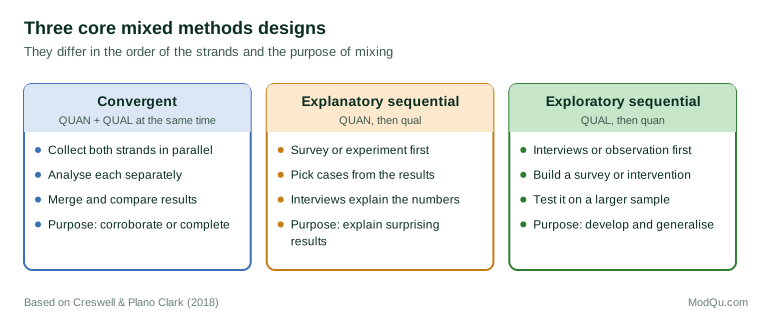
Creswell and Plano Clark (2018) described three core designs, which differ in the order of the two strands and the purpose of combining them. The diagram below compares them.
Convergent design
In a convergent design, quantitative and qualitative data are collected at about the same time, analysed separately, and then compared or merged. The purpose is to obtain different but complementary data on the same topic and see whether they agree. For example, a customer study might run a satisfaction survey and in-depth interviews in parallel, then compare whether the themes from interviews match the survey's patterns.
The main challenge is what to do when the results disagree. Disagreement is not necessarily a failure; it may reveal that the survey and interviews captured different aspects of the topic, or that one method was flawed. Researchers may collect additional data, re-examine the analysis, or report the divergence as a finding.
Explanatory sequential design
In an explanatory sequential design, quantitative data are collected and analysed first, and qualitative data are then collected to explain the quantitative results. Ivankova et al. (2006) described how they used this design to study why doctoral students persisted in or left an online programme: a survey identified which factors predicted persistence, and follow-up case studies explored how those factors operated in students' experience.
The design suits situations where quantitative results are surprising, unclear or need explaining. A key decision is which participants to select for the qualitative phase. Common choices include participants with typical scores, those with extreme scores, or those whose results did not fit the overall pattern.
Exploratory sequential design
In an exploratory sequential design, qualitative data are collected first to explore a topic, and the results are used to build a quantitative phase, such as a survey instrument, an intervention or a set of variables to test. This design is common when little is known about a topic, when existing measures do not fit the population, or when the researcher needs to identify the right questions before measuring them.
For example, a company entering a new market might first interview potential customers to understand how they think about the product category, then use the interview themes to write survey questions, and finally survey a large sample to measure how common each view is.
Sampling across strands
Each strand needs its own sampling logic. The quantitative strand usually needs a sample large enough, and chosen in a way that supports statistical inference. The qualitative strand usually needs a smaller, purposive sample chosen for the richness of information it can provide. Teddlie and Tashakkori (2009) described several ways the two samples can relate: they may be the same people, an overlapping group, a subset of one within the other, or entirely different people. In an explanatory sequential design, the qualitative participants are normally drawn from the quantitative sample, so that each interview can be linked to the participant's survey responses. In a convergent design, using the same participants for both strands makes direct comparison easier, but may place a heavy burden on them.
Notation
Morse (1991) introduced a notation for mixed methods designs that is still widely used. Uppercase letters show the dominant strand (QUAN or QUAL) and lowercase letters show the supporting strand. An arrow shows sequence, and a plus sign shows that strands run at the same time. QUAN → qual describes an explanatory sequential design led by quantitative methods; QUAL + quan describes a convergent design led by qualitative methods. The notation helps readers grasp a design quickly.
Integration
Integration is what distinguishes mixed methods research from running two separate studies. Fetters et al. (2013) described integration at three levels:
- Design level: the overall design, such as convergent or sequential, determines how strands relate.
- Methods level: the strands are linked through connecting (using one sample to select the other), building (using one set of results to design the next phase), merging (bringing data together for analysis) or embedding (linking data collection at several points).
- Interpretation and reporting level: results are combined through narrative, data transformation or joint displays.
A joint display is a table or figure that places quantitative and qualitative results side by side, so that readers can see how they relate. Guetterman et al. (2015) reviewed joint displays in health research and found that they helped researchers draw integrated conclusions, such as showing which themes appeared among participants with high and low scores.
Choosing a design
The choice of design should follow from the research question and the purpose of mixing. Useful questions include:
- Is the main aim to compare results from two methods, to explain quantitative findings, or to develop a measure or intervention?
- Which strand should come first, and why?
- Which strand, if either, should have priority?
- How will the strands be integrated, and at what point?
- Are there the time, skills and resources to carry out both strands well?
Creswell and Creswell (2018) noted that sequential designs take longer than convergent designs, but are easier for a single researcher because the strands are handled one at a time.
Challenges
Mixed methods research is demanding. It requires skills in both quantitative and qualitative methods, which few researchers have in equal measure, so many projects rely on teams whose members must understand each other's approaches. It usually takes more time and money than a single-method study. Integration is often the weakest part: Bryman (2006) found that many studies reported the two strands in separate sections and drew few conclusions from their combination. Planning integration from the start, deciding which joint displays and comparisons will be made, and allowing time in the schedule for this work all help.
An applied example
A hypothetical example: a subscription service notices that cancellations have risen. In an explanatory sequential design, it first analyses account data and a short exit survey, finding that cancellations are concentrated among customers in their third month and among those who never used a particular feature. It then interviews twenty customers from this group. The interviews reveal that many did not know the feature existed and that the third month is when an introductory discount ends. A joint display places each survey finding next to the interview themes that explain it. The combined findings point to two actions, better onboarding for the feature and a review of the discount structure, that neither strand alone would have identified with confidence.
Quality
Judging the quality of mixed methods research involves the quality of each strand and the quality of their combination. Onwuegbuzie and Johnson (2006) proposed the term legitimation for the quality of mixed research, and identified issues such as whether the sample in each strand is appropriate for the inferences drawn and whether the integration produces conclusions that neither strand alone could support. O'Cathain et al. (2008) reviewed mixed methods studies in health services research and found that many did not justify their use of mixed methods or describe how the strands were integrated. Levitt et al. (2018) set out reporting standards for mixed methods research in psychology, which ask authors to describe the design, the rationale for mixing and how integration was carried out.
Teddlie and Tashakkori (2009) described inference quality as the central quality criterion: the degree to which conclusions drawn from the integrated results are credible and well supported.
Conclusion
Mixed methods research combines quantitative and qualitative approaches to answer questions that neither can answer alone. The convergent, explanatory sequential and exploratory sequential designs offer different ways of combining the strands, suited to different purposes. Small (2011) observed that the field has moved from asking whether methods can be mixed to asking how best to do it. The answer lies in a clear rationale, a design that fits the question, and deliberate integration of the results.
References
Bryman, A. (2006). Integrating quantitative and qualitative research: How is it done? Qualitative Research, 6(1), 97–113. https://doi.org/10.1177/1468794106058877
Creswell, J. W., & Creswell, J. D. (2018). Research design: Qualitative, quantitative, and mixed methods approaches (5th ed.). SAGE.
Creswell, J. W., & Plano Clark, V. L. (2018). Designing and conducting mixed methods research (3rd ed.). SAGE.
Fetters, M. D., Curry, L. A., & Creswell, J. W. (2013). Achieving integration in mixed methods designs: Principles and practices. Health Services Research, 48(6, Pt. 2), 2134–2156. https://doi.org/10.1111/1475-6773.12117
Greene, J. C., Caracelli, V. J., & Graham, W. F. (1989). Toward a conceptual framework for mixed-method evaluation designs. Educational Evaluation and Policy Analysis, 11(3), 255–274. https://doi.org/10.3102/01623737011003255
Guetterman, T. C., Fetters, M. D., & Creswell, J. W. (2015). Integrating quantitative and qualitative results in health science mixed methods research through joint displays. Annals of Family Medicine, 13(6), 554–561. https://doi.org/10.1370/afm.1865
Ivankova, N. V., Creswell, J. W., & Stick, S. L. (2006). Using mixed-methods sequential explanatory design: From theory to practice. Field Methods, 18(1), 3–20. https://doi.org/10.1177/1525822X05282260
Johnson, R. B., & Onwuegbuzie, A. J. (2004). Mixed methods research: A research paradigm whose time has come. Educational Researcher, 33(7), 14–26. https://doi.org/10.3102/0013189X033007014
Johnson, R. B., Onwuegbuzie, A. J., & Turner, L. A. (2007). Toward a definition of mixed methods research. Journal of Mixed Methods Research, 1(2), 112–133. https://doi.org/10.1177/1558689806298224
Levitt, H. M., Bamberg, M., Creswell, J. W., Frost, D. M., Josselson, R., & Suárez-Orozco, C. (2018). Journal article reporting standards for qualitative primary, qualitative meta-analytic, and mixed methods research in psychology: The APA Publications and Communications Board task force report. American Psychologist, 73(1), 26–46. https://doi.org/10.1037/amp0000151
Morgan, D. L. (2007). Paradigms lost and pragmatism regained: Methodological implications of combining qualitative and quantitative methods. Journal of Mixed Methods Research, 1(1), 48–76. https://doi.org/10.1177/2345678906292462
Morse, J. M. (1991). Approaches to qualitative-quantitative methodological triangulation. Nursing Research, 40(2), 120–123. https://doi.org/10.1097/00006199-199103000-00014
O'Cathain, A., Murphy, E., & Nicholl, J. (2008). The quality of mixed methods studies in health services research. Journal of Health Services Research & Policy, 13(2), 92–98. https://doi.org/10.1258/jhsrp.2007.007074
Onwuegbuzie, A. J., & Johnson, R. B. (2006). The validity issue in mixed research. Research in the Schools, 13(1), 48–63.
Small, M. L. (2011). How to conduct a mixed methods study: Recent trends in a rapidly growing literature. Annual Review of Sociology, 37, 57–86. https://doi.org/10.1146/annurev.soc.012809.102657
Teddlie, C., & Tashakkori, A. (2009). Foundations of mixed methods research: Integrating quantitative and qualitative approaches in the social and behavioral sciences. SAGE.