
Research · Quantitative and mixed methods
Triangulation: Strengthening Conclusions With Multiple Methods
What triangulation means in research, its four classic types, the different purposes it serves, what to do when sources disagree, and how to use it to strengthen conclusions.
A conclusion supported by one source of evidence is only as strong as that source. If the same conclusion is reached through different methods, data sources or analysts, each with different weaknesses, it is much harder to explain away. Triangulation is the use of several approaches to study the same question, so that the strengths of one offset the weaknesses of another. This article explains where the idea comes from, its main types and how to use it well.
Origins
The term comes from navigation and surveying, where a position is fixed by taking bearings from two or more known points. In research, Campbell and Fiske (1959) argued that a construct is better measured by several methods than by one, because agreement across methods shows that results are not an artefact of a single method. Webb et al. (1966) extended the argument, proposing that researchers combine measures with different sources of error, such as interviews, records and unobtrusive observation. If a proposition survives a series of imperfect measures with different weaknesses, confidence in it should rise.
Four types
Denzin (1978) set out four types of triangulation, shown in the table below.
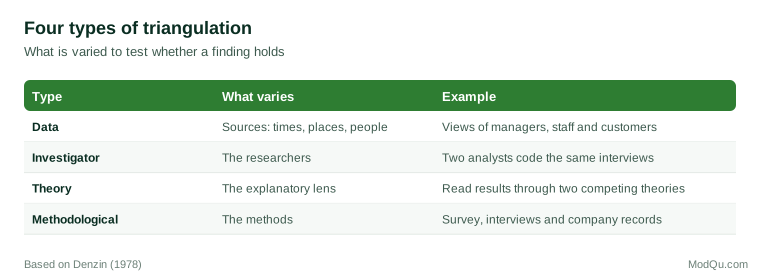
Data triangulation uses different sources of data: different times, places or people. A study of a policy might collect views from managers, front-line staff and service users.
Investigator triangulation uses several researchers to collect or analyse the data, so that findings do not depend on one person's perspective.
Theory triangulation examines the data from several theoretical perspectives, to see which explanations fit best.
Methodological triangulation uses different methods, such as surveys, interviews and documents. Denzin distinguished within-method triangulation, using several variations of one method, from between-method triangulation, combining different methods.
Jick (1979) described an early example in organisational research: a study of employees' anxiety during a merger used surveys, interviews, observation and company records. Where they agreed, confidence in the findings rose; where they disagreed, the differences prompted closer analysis.
Different purposes
Triangulation is often described as a way of confirming results, but it serves other purposes too. Greene et al. (1989) distinguished triangulation in the strict sense, seeking convergence, from complementarity, using different methods to reveal different aspects of a phenomenon. Fielding and Fielding (1986) warned that combining methods does not automatically increase validity: methods based on different assumptions may not be measuring the same thing, so agreement between them cannot simply be added up. Triangulation is better understood as a way of building a fuller and more rounded picture than as a test that proves a result.
Patton (1999) noted that inconsistent findings from different sources should not be seen as weakening the evidence. Differences can reveal how a phenomenon looks from different positions, or show that different methods capture different aspects of it. Carter et al. (2014) described triangulation in qualitative research as a strategy for testing validity through convergence of information from different sources, while also enriching understanding.
Triangulation in quantitative research
The idea applies equally to quantitative research. In epidemiology, Lawlor et al. (2016) argued that causal conclusions are stronger when several approaches, each with different and unrelated sources of bias, point in the same direction. If an observational study, a natural experiment and a genetic study all suggest that a factor causes a disease, it is unlikely that all three are wrong for different reasons. Munafò and Davey Smith (2018) argued that robust research needs many lines of evidence, and that replication with the same method can repeat the same bias, whereas triangulation across methods can expose it.
Planning triangulation
Triangulation works best when it is planned rather than added after the fact. Researchers should first identify the main weaknesses of their primary method and then choose additional sources or methods whose weaknesses are different. A survey may suffer from people giving socially acceptable answers; behavioural records do not, but they say nothing about motives. Interviews reveal motives but are based on small samples. Combining the three covers more ground than any pair that shares the same weakness.
It also helps to decide in advance what counts as agreement. Will two sources be said to agree if they point in the same direction, or must they give similar sizes of effect? How will the researcher weigh a large, well-designed source against a small, weaker one? Writing these rules down before the analysis reduces the temptation to treat any partial agreement as confirmation. Finally, the report should describe each source, how it was analysed and how the results were compared, so that readers can judge for themselves how much the different strands support the conclusion.
When sources disagree
Disagreement is common and should be treated as information. Possible explanations include:
- one method is flawed or poorly executed;
- the methods measure different aspects of the topic;
- different groups genuinely see things differently;
- the phenomenon changed between data collections.
Researchers should investigate the reasons, report the disagreement openly and explain how they resolved it or why it remains. Quietly dropping the source that disagrees, or reporting only the strands that support the main conclusion, defeats the purpose of triangulating at all.
An applied example
A hypothetical example: a retailer wants to know why a new store layout has not raised sales. Sales data show that customers spend less time in one area. Observation shows congestion at a particular aisle. Interviews with staff reveal that restocking happens during peak hours in that aisle. The three sources point to the same problem from different angles, giving more confidence than any one would alone. A change to restocking times, followed by a fresh look at the sales data, then tests the explanation directly.
Conclusion
Triangulation strengthens conclusions by combining data sources, investigators, theories or methods with different weaknesses. Its value lies not in guaranteeing truth but in showing whether a result holds up when approached from several directions, and in revealing aspects that one approach would miss. Agreement increases confidence; disagreement points to where more understanding is needed.
References
Campbell, D. T., & Fiske, D. W. (1959). Convergent and discriminant validation by the multitrait-multimethod matrix. Psychological Bulletin, 56(2), 81–105. https://doi.org/10.1037/h0046016
Carter, N., Bryant-Lukosius, D., DiCenso, A., Blythe, J., & Neville, A. J. (2014). The use of triangulation in qualitative research. Oncology Nursing Forum, 41(5), 545–547. https://doi.org/10.1188/14.ONF.545-547
Denzin, N. K. (1978). The research act: A theoretical introduction to sociological methods (2nd ed.). McGraw-Hill.
Fielding, N. G., & Fielding, J. L. (1986). Linking data. SAGE.
Greene, J. C., Caracelli, V. J., & Graham, W. F. (1989). Toward a conceptual framework for mixed-method evaluation designs. Educational Evaluation and Policy Analysis, 11(3), 255–274. https://doi.org/10.3102/01623737011003255
Jick, T. D. (1979). Mixing qualitative and quantitative methods: Triangulation in action. Administrative Science Quarterly, 24(4), 602–611. https://doi.org/10.2307/2392366
Lawlor, D. A., Tilling, K., & Davey Smith, G. (2016). Triangulation in aetiological epidemiology. International Journal of Epidemiology, 45(6), 1866–1886. https://doi.org/10.1093/ije/dyw314
Munafò, M. R., & Davey Smith, G. (2018). Robust research needs many lines of evidence. Nature, 553(7689), 399–401. https://doi.org/10.1038/d41586-018-01023-3
Patton, M. Q. (1999). Enhancing the quality and credibility of qualitative analysis. Health Services Research, 34(5, Pt. 2), 1189–1208.
Webb, E. J., Campbell, D. T., Schwartz, R. D., & Sechrest, L. (1966). Unobtrusive measures: Nonreactive research in the social sciences. Rand McNally.