
Research · Qualitative research
Longitudinal Qualitative Research for Tracking Knowledge Evolution
How longitudinal qualitative research follows people, groups and organisations through time to understand how experience, knowledge and practice change, covering design choices, data collection, analysis approaches, ethics, archiving and applied uses.
Many important questions are about change. How do people adjust to a diagnosis, a new job or retirement? How does an organisation learn to use a new technology? How do customers' views of a product shift over the years they own it? A single interview captures a moment. Longitudinal qualitative research follows the same people, groups or organisations over time, returning to them repeatedly to understand how their experience, knowledge and practice develop. It combines the depth of qualitative inquiry with attention to time, and is particularly suited to tracking how knowledge evolves. This article explains what the approach involves, how studies are designed and analysed, the challenges it raises and how it can be used in applied research.
What makes research longitudinal and qualitative
Longitudinal research collects data from the same cases at two or more points in time. In quantitative work this usually means panel surveys that measure the same variables repeatedly, so that change can be estimated statistically (Ruspini, 2002). Longitudinal qualitative research shares the commitment to repeated contact but asks different questions. It seeks to understand how and why change happens, how people make sense of it, and what it means to them.
Saldaña (2003) described longitudinal qualitative research as the study of change through time, and argued that the researcher's main analytic task is to identify what changes, what stays the same, and how change happens. Neale (2019) emphasised that the approach is defined less by a particular method than by an orientation: time and change are placed at the centre of the inquiry, rather than treated as background.
Neale and Flowerdew (2003) used the phrase time and texture to describe what the approach adds. Quantitative panels show the broad patterns of change across many cases; qualitative longitudinal studies show the texture of change in individual lives, how people experience transitions and how their accounts of the past and future shift as they move through time.
Why study change over time
Several kinds of question call for a longitudinal qualitative design:
- Transitions. How people move through life events, such as leaving school, becoming parents, migrating or retiring. Henderson et al. (2007) followed young people in Britain over a decade to study how they invented adult identities in different social settings.
- Processes. How things unfold in organisations and communities, such as strategic change, adoption of new practices or growth of a project.
- Responses to interventions. How people experience a programme or policy over time, and how its effects emerge or fade (Lewis, 2007).
- Illness and care. How patients and carers adjust to long-term or terminal illness. Murray et al. (2009) showed that serial interviews revealed changing needs that single interviews missed.
- Knowledge and learning. How individuals and groups acquire, revise and apply knowledge as their circumstances change.
In each case, a cross-sectional study would capture only a snapshot, and retrospective accounts would be filtered through later understanding. Repeated contact allows the researcher to compare what people said at the time with what they say later, and to observe change as it happens.
Prospective and retrospective time
Thomson and Holland (2003) described longitudinal qualitative research as combining hindsight, foresight and insight. At each interview, participants look back on what has happened and forward to what they expect. Returning to them later allows the researcher to compare earlier expectations with what actually happened, and earlier accounts with later reinterpretations.
This is one of the method's most distinctive contributions. People continually retell their own stories. An event described as a disaster at the time may later be described as a turning point, and a decision explained one way in the moment may be justified differently years later. McLeod (2003) argued that these shifts are not errors to be corrected but data about how people make sense of their lives. Elder (1998) placed this within the life course perspective, which emphasises that lives are shaped by historical time, timing of events, linked relationships with others and human agency. Adam (1990) argued more broadly that social research should treat time as a lived and constructed experience, not merely as a sequence of dates.
Organisational and process research
In organisation studies, longitudinal field research has a long tradition. Pettigrew (1990) argued that organisational change can only be understood by studying it over time and in context, linking the content of change to the processes by which it happened and the inner and outer settings in which it took place. He recommended studying change across several levels of analysis and over long periods, combining real-time observation with retrospective accounts.
Van de Ven and Huber (1990) distinguished two questions in research on organisational change: what are the antecedents and consequences of change, and how does a change emerge, develop and end over time? The second question, about process, requires longitudinal data. Langley (1999) described several strategies for building theory from process data, including narrative accounts that reconstruct sequences of events, visual mapping of events over time, and temporal bracketing, which divides a process into phases so that the researcher can see how actions in one phase shape the context for the next.
Designing a study
Designing a longitudinal qualitative study involves several decisions that cross-sectional studies do not face. The table below summarises the main ones.
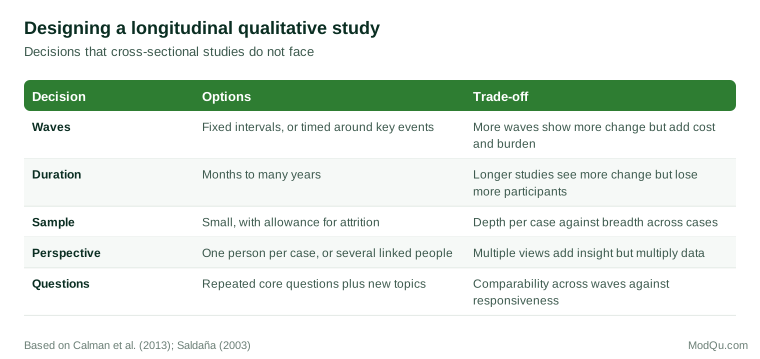
Number and spacing of waves. How many times will participants be contacted, and how far apart? Calman et al. (2013) recommended that the timing of waves should follow the process being studied: closely spaced waves around key events, such as a diagnosis or a product launch, and wider spacing during stable periods. Some studies fix intervals in advance; others follow participants through events, contacting them when something significant happens.
Duration. Studies range from a few months to many years. Longer studies capture more change but face greater attrition and cost. Hermanowicz (2013) described returning to scientists he had interviewed a decade earlier, showing that very long intervals can reveal changes in career and identity that shorter studies would not detect.
Sample. Samples are usually small, because each case requires repeated, in-depth contact. Researchers must plan for attrition, as some participants will move, lose interest or decline to continue. A slightly larger starting sample, and efforts to keep in touch between waves, help.
Perspective. Studies may follow one person per case, or several people connected to the same case, such as couples, families or teams. Vogl et al. (2018) developed an analytical framework for multiple perspective longitudinal interviews, in which several members of a family are interviewed repeatedly, allowing the researcher to compare how each describes the same changes.
Consistency and flexibility. Some questions should be repeated at each wave so that answers can be compared. Other questions should respond to what has changed since the last contact. A common design uses a core set of repeated questions with additional topics added at each wave.
Collecting data across waves
Interviews are the most common method, often supplemented by diaries, observation, documents or visual material. Diaries are useful between waves, recording events and reflections that participants might forget by the next interview.
Each wave builds on the last. Researchers typically review previous transcripts before each interview, so that they can follow up on earlier comments and ask about changes. This creates a cumulative relationship that deepens over time. Plumridge and Thomson (2003) noted that the researcher also changes: they bring their own developing interpretations and relationships into each wave, and their reflexive account becomes part of the data. Researchers may also change: when a study runs for many years, different interviewers may visit the same participant, which can affect what is said.
Returning to participants also raises questions of disclosure. Should the researcher remind participants of what they said before? Doing so can prompt reflection and comparison, but may also lead participants to defend or adjust their earlier statements. Many researchers use earlier material selectively, to prompt recall of events rather than to confront participants with their past words.
Analysing change
Analysing longitudinal qualitative data is demanding, because the researcher must work across both cases and time. Grossoehme and Lipstein (2016) described two broad approaches. A recurrent cross-sectional analysis compares all participants at each wave, identifying themes at each time point and then examining how themes change across waves. A trajectory analysis follows each participant through all waves, identifying how their individual story develops, and then compares trajectories across participants. The two approaches answer different questions and are often combined. The diagram below compares them with the case history approach.
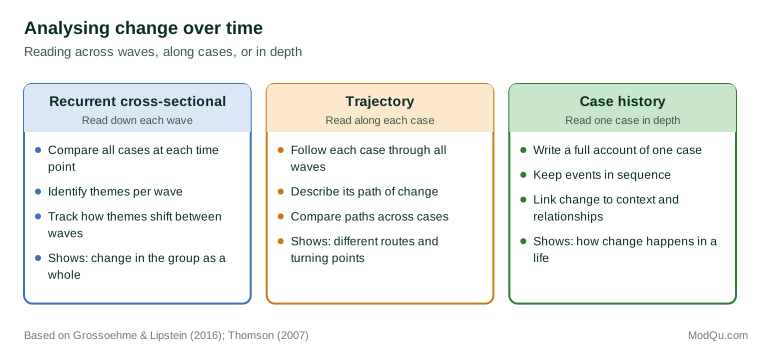
Thomson (2007) described the case history, a detailed account of a single participant's development across all waves, as a key output of longitudinal qualitative analysis. Case histories preserve the individual's story and the sequence of events, which thematic analysis across cases can break apart.
Saldaña (2003) proposed a set of analytic questions to guide the work, including what increases or emerges over time, what decreases or ceases, what remains constant, what is idiosyncratic, and what changes appear as turning points. These questions help the researcher move from description to an account of how change happens.
Lewis (2007) described practical frameworks for managing the data, such as matrices with cases in rows and waves in columns, which allow the researcher to read across a single case over time or down a single wave across cases. Software for qualitative analysis can store such matrices, but the analytic work of interpreting change remains with the researcher.
Contributions to policy and practice
Corden and Millar (2007) reviewed the use of longitudinal qualitative research in social policy and found that it was especially useful for understanding how policies are experienced over time, how people adapt to changes in their circumstances, and why outcomes differ between people who appear similar at the start. Millar (2007) showed how such studies of people moving between welfare and work revealed patterns of adaptation, setback and recovery that cross-sectional data and statistics on employment rates could not show. These findings helped to explain why some interventions worked for some people and not others.
Combining qualitative and quantitative panels
Longitudinal qualitative studies are often run alongside quantitative panel surveys. The survey measures how many people change and in which direction; the qualitative study explains how and why. Ruspini (2002) noted that panel data are good at showing gross and net change in a population, but cannot by themselves show the meanings people attach to transitions. Corden and Millar (2007) described studies in which qualitative participants were drawn from survey samples, so that each case could be placed within the wider pattern. This combination allows researchers to check whether the stories told in interviews are typical, and to use those stories to interpret statistical trends. It also helps researchers choose whom to interview: cases on unusual trajectories in the survey can be followed up in depth.
Ethical considerations
Longitudinal studies raise ethical issues that develop over time. Consent should be treated as a process rather than a single event, reconfirmed at each wave, because participants' circumstances and willingness may change. Relationships between researchers and participants deepen with repeated contact, which can make it harder for participants to withdraw and harder for researchers to maintain boundaries. Confidentiality becomes more difficult as detailed accounts accumulate, because a full case history may identify a participant even when names are removed.
Researchers may also learn of significant events, such as illness, bereavement or hardship, between waves, and must decide how to respond. Holland (2011) described how the Timescapes programme, a large British initiative of longitudinal qualitative studies, developed shared practices for handling these issues across projects. Thomson (2007) noted the particular ethical care required when presenting detailed case histories, where participants may recognise themselves and be affected by how their lives are represented.
Archiving and reuse
Longitudinal qualitative data are expensive to collect and can be valuable to future researchers. Neale and Bishop (2012) described the Timescapes Archive, which was designed to preserve and share longitudinal qualitative datasets while protecting participants' confidentiality. Archiving allows later researchers to revisit data with new questions, to compare across studies, and to extend the time span of a study by returning to the original participants years later. It also requires careful planning: consent for archiving must be obtained, data must be prepared and anonymised, and documentation must explain the context in which the data were collected.
Reporting longitudinal findings
Reports need to show time clearly. Useful devices include timelines of events for each case, tables showing how key themes appear across waves, and short case histories that let readers follow one person or organisation from start to finish. The report should state how many waves were completed, how many participants remained at each wave, and why participants left, so that readers can judge whether attrition has shaped the findings. It should also explain how the analysis moved between cases and waves, and give examples of how earlier and later accounts of the same events differed.
Strengths and challenges
The approach has distinctive strengths:
- it shows change as it happens, rather than relying on later recall;
- it captures how people reinterpret their past and revise their expectations;
- it reveals the sequence and timing of events, which is essential for understanding processes;
- it builds trusting relationships that may produce richer data over time;
- it can explain why outcomes diverge among cases that seemed similar at the start.
It also faces challenges:
- Cost and time. Studies may take years and require sustained funding.
- Attrition. Losing participants reduces the data and may bias the sample toward those whose lives are more stable.
- Data volume. Several waves of in-depth data for each participant create large and complex datasets.
- Researcher continuity. Staff changes can disrupt relationships and interpretation.
- Effects of participation. Repeated reflection may change participants' own thinking, a form of reactivity that the researcher should consider.
Many of these challenges can be reduced by planning: building contact strategies into the design, keeping detailed records of each wave and the relationships involved, and planning the analysis from the start rather than after all data have been collected.
Applied uses
Longitudinal qualitative designs suit applied questions about how things develop. A hypothetical example: a company introduces a new knowledge-sharing platform and wants to understand its adoption. A cross-sectional survey after six months shows moderate use. A longitudinal qualitative study interviews twenty employees at launch, at three months, at nine months and at eighteen months. It finds that early enthusiasm fades as people encounter poor search results, that use recovers in teams where a respected colleague begins posting regularly, and that by eighteen months the platform has become essential in some teams and abandoned in others. The trajectories explain the moderate average and show which conditions support adoption, which the snapshot could not.
Other applied uses include tracking customer relationships over the life of a product, following new employees through their first year, and monitoring how communities experience a long-term programme.
Conclusion
Longitudinal qualitative research follows people, groups and organisations through time, combining in-depth understanding with attention to change. It captures how experience and knowledge develop, how people reinterpret their pasts and revise their expectations, and how processes unfold. It requires careful design of waves, consistent but flexible data collection, analysis that works across cases and time, and ongoing attention to consent and relationships. When these demands are met, it produces knowledge about change that no single snapshot can provide.
References
Adam, B. (1990). Time and social theory. Polity Press.
Calman, L., Brunton, L., & Molassiotis, A. (2013). Developing longitudinal qualitative designs: Lessons learned and recommendations for health services research. BMC Medical Research Methodology, 13, Article 14. https://doi.org/10.1186/1471-2288-13-14
Corden, A., & Millar, J. (2007). Time and change: A review of the qualitative longitudinal research literature for social policy. Social Policy and Society, 6(4), 583–592. https://doi.org/10.1017/S1474746407003910
Elder, G. H., Jr. (1998). The life course as developmental theory. Child Development, 69(1), 1–12. https://doi.org/10.1111/j.1467-8624.1998.tb06128.x
Grossoehme, D., & Lipstein, E. (2016). Analyzing longitudinal qualitative data: The application of trajectory and recurrent cross-sectional approaches. BMC Research Notes, 9, Article 136. https://doi.org/10.1186/s13104-016-1954-1
Henderson, S., Holland, J., McGrellis, S., Sharpe, S., & Thomson, R. (2007). Inventing adulthoods: A biographical approach to youth transitions. SAGE.
Hermanowicz, J. C. (2013). The longitudinal qualitative interview. Qualitative Sociology, 36(2), 189–208. https://doi.org/10.1007/s11133-013-9247-7
Holland, J. (2011). Timescapes: Living a qualitative longitudinal study. Forum Qualitative Sozialforschung / Forum: Qualitative Social Research, 12(3), Article 9. https://doi.org/10.17169/fqs-12.3.1729
Langley, A. (1999). Strategies for theorizing from process data. Academy of Management Review, 24(4), 691–710. https://doi.org/10.5465/amr.1999.2553248
Lewis, J. (2007). Analysing qualitative longitudinal research in evaluations. Social Policy and Society, 6(4), 545–556. https://doi.org/10.1017/S1474746407003880
McLeod, J. (2003). Why we interview now: Reflexivity and perspective in a longitudinal study. International Journal of Social Research Methodology, 6(3), 201–211. https://doi.org/10.1080/1364557032000091806
Millar, J. (2007). The dynamics of poverty and employment: The contribution of qualitative longitudinal research to understanding transitions, adaptations and trajectories. Social Policy and Society, 6(4), 533–544. https://doi.org/10.1017/S1474746407003879
Murray, S. A., Kendall, M., Carduff, E., Worth, A., Harris, F. M., Lloyd, A., Cavers, D., Grant, L., & Sheikh, A. (2009). Use of serial qualitative interviews to understand patients' evolving experiences and needs. BMJ, 339, Article b3702. https://doi.org/10.1136/bmj.b3702
Neale, B. (2019). What is qualitative longitudinal research? Bloomsbury Academic.
Neale, B., & Bishop, L. (2012). The Timescapes Archive: A stakeholder approach to archiving qualitative longitudinal data. Qualitative Research, 12(1), 53–65. https://doi.org/10.1177/1468794111426233
Neale, B., & Flowerdew, J. (2003). Time, texture and childhood: The contours of longitudinal qualitative research. International Journal of Social Research Methodology, 6(3), 189–199. https://doi.org/10.1080/1364557032000091798
Pettigrew, A. M. (1990). Longitudinal field research on change: Theory and practice. Organization Science, 1(3), 267–292. https://doi.org/10.1287/orsc.1.3.267
Plumridge, L., & Thomson, R. (2003). Longitudinal qualitative studies and the reflexive self. International Journal of Social Research Methodology, 6(3), 213–222. https://doi.org/10.1080/1364557032000091815
Ruspini, E. (2002). Introduction to longitudinal research. Routledge.
Saldaña, J. (2003). Longitudinal qualitative research: Analyzing change through time. AltaMira Press.
Thomson, R. (2007). The qualitative longitudinal case history: Practical, methodological and ethical reflections. Social Policy and Society, 6(4), 571–582. https://doi.org/10.1017/S1474746407003909
Thomson, R., & Holland, J. (2003). Hindsight, foresight and insight: The challenges of longitudinal qualitative research. International Journal of Social Research Methodology, 6(3), 233–244. https://doi.org/10.1080/1364557032000091833
Van de Ven, A. H., & Huber, G. P. (1990). Longitudinal field research methods for studying processes of organizational change. Organization Science, 1(3), 213–219. https://doi.org/10.1287/orsc.1.3.213
Vogl, S., Zartler, U., Schmidt, E.-M., & Rieder, I. (2018). Developing an analytical framework for multiple perspective, qualitative longitudinal interviews (MPQLI). International Journal of Social Research Methodology, 21(2), 177–190. https://doi.org/10.1080/13645579.2017.1345149