
Research · Literature and evidence
How to Conduct a Literature Review
A practical guide to conducting a literature review, covering the purposes of a review, the main types, how to define scope, search, select and read sources, how to organise and synthesise findings, and how to write a review that adds value.
A literature review is a structured account of what is already known about a topic. It identifies the main findings, theories and methods, shows where researchers agree and disagree, and points to what remains unknown. A review may stand on its own as a piece of research, or it may form the foundation of a new study. Either way, it is more than a list of summaries. Hart (2018) described the review as a way of showing that the researcher understands the field well enough to justify the question being asked and the approach being taken. This article explains how to conduct one.
Why review the literature
A literature review serves several purposes. It shows what is already known, so that new research builds on existing work rather than repeating it. It identifies gaps, contradictions and weaknesses that new research can address. It clarifies concepts and theories, and shows which methods have worked. Boote and Beile (2005) argued that a thorough, sophisticated review is a precondition for substantial and useful research, because researchers who do not understand their field are unlikely to advance it.
Webster and Watson (2002) argued that good reviews do more than summarise. A strong review creates a firm foundation for advancing knowledge: it synthesises existing work into a coherent picture, uncovers areas where more research is needed and can propose a conceptual framework to guide future work. Alvesson and Sandberg (2011) went further, encouraging reviewers to question the assumptions underlying an area of research rather than simply finding gaps within it, since this can lead to more interesting questions.
Types of review
Reviews vary in purpose and method. Grant and Booth (2009) identified fourteen types of review, from critical reviews to systematic reviews, umbrella reviews and rapid reviews, and described how they differ in search, appraisal, synthesis and analysis. Paré et al. (2015) grouped reviews by whether they aim to summarise, describe, test or critique a body of research.
Three broad types cover most needs:
- Narrative reviews give an expert overview of a field, using the reviewer's judgement to select and interpret sources. Baumeister and Leary (1997) described how narrative reviews can develop theory by connecting findings from different areas, but warned that they are vulnerable to bias in which studies are chosen.
- Systematic reviews follow an explicit, reproducible method to find, appraise and synthesise all relevant studies on a focused question. Tranfield et al. (2003) adapted systematic review methods from medicine to management research.
- Integrative reviews combine diverse kinds of evidence, including theoretical and empirical work, to generate new frameworks or perspectives. Torraco (2005) described how integrative reviews can synthesise research on mature topics or develop initial models for emerging ones.
Snyder (2019) advised choosing the type of review according to the research question: systematic reviews for precise questions about effects, semi-systematic or narrative approaches for broad topics studied in different ways, and integrative reviews for developing new theoretical perspectives.
The process
Although review types differ, most follow a similar process. The diagram below summarises the main steps.
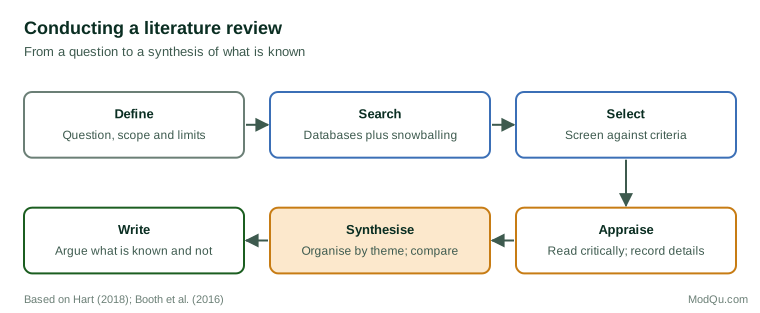
1. Define the question and scope
Start with a clear question. What exactly does the review aim to find out? What period, population, setting and types of study will it include? A clear scope prevents the review from expanding without limit. Cooper (1988) proposed a taxonomy of reviews based on six characteristics: focus, goal, perspective, coverage, organisation and audience. Thinking through each helps define the scope.
2. Search
Identify key concepts and their synonyms, and combine them into search strings for academic databases. Booth et al. (2016) recommended searching several databases, because each covers different journals, and supplementing database searches with other methods. Greenhalgh and Peacock (2005) found that in a review of complex evidence, most relevant studies were found not through database searches but by following references, tracking citations and personal contacts. Wohlin (2014) provided guidelines for snowballing: working backward through the references of key papers, and forward through the papers that cite them.
3. Select
Screen titles and abstracts against inclusion criteria, then read full texts of potentially relevant studies. Record the reasons for excluding studies, especially in systematic reviews.
4. Read and appraise
Read each included source critically. What question did it ask? What methods did it use? How strong is its evidence? What are its limitations? Hart (2018) emphasised that critical reading means evaluating arguments and evidence, not simply accepting conclusions. A table or spreadsheet recording key details of each study, such as context, sample, methods, findings and quality, makes comparison easier.
5. Synthesise
Synthesis is the core of a review. Rather than discussing sources one by one, organise the material by themes, concepts, methods or chronology. Webster and Watson (2002) recommended a concept-centric approach, in which the review is organised around key concepts and each section draws together the studies that address them. A concept matrix, with concepts as columns and sources as rows, helps show which sources address which concepts and where coverage is thin.
Synthesis means comparing and contrasting findings: where do studies agree, where do they disagree, and why? Differences may reflect different methods, populations or definitions. Identifying these explanations is often where a review adds the most value.
6. Write
A literature review should have a clear structure. The introduction states the question, scope and approach. The body presents the synthesis, organised by theme. The conclusion summarises what is known, what is uncertain and what further research is needed. Throughout, the reviewer's own voice should guide the reader, explaining how sources relate to one another and to the review's question.
Managing the material
Even a modest review can involve hundreds of records, so organisation matters from the start. Reference management software stores citations and full texts, removes duplicates and formats references. A search log records each database, search string, date and number of results, so that the search can be repeated, updated or reported. A data extraction table holds the key details of each included source in the same format, which makes it far easier to compare studies than notes written in different styles. Booth et al. (2016) recommended piloting the extraction table on a few sources before applying it to all of them, because the categories that seem obvious at the start often need adjusting once real studies are examined. Keeping these records also protects against a common problem: forgetting why a source was included or excluded when the review is revisited months later.
Common pitfalls
Several mistakes recur in literature reviews:
- Listing rather than synthesising. Summaries of one study after another, with no comparison or argument, leave the reader to do the work.
- Selective coverage. Choosing only sources that support a preferred view gives a misleading picture.
- Uncritical acceptance. Treating all published findings as equally reliable ignores differences in quality.
- Lack of focus. Reviews that try to cover everything end up saying little.
- Outdated searches. Fields move quickly; a review should include recent work.
- No conclusion. A review should say what the evidence means, not only what it contains.
An applied example
A hypothetical example: a company wants to understand what drives employee retention in customer service roles before designing a survey. A focused review defines the scope as studies published in the last fifteen years on turnover in front-line service jobs. Database searches, combined with snowballing from two widely cited reviews, identify forty relevant studies. A concept matrix shows that most studies examine pay, workload and supervision, but few examine scheduling flexibility, which several recent studies suggest is important. The review organises findings by these themes, notes where findings conflict and why, and concludes that scheduling deserves particular attention in the survey. The review has shaped the primary research rather than merely preceding it.
Conclusion
A good literature review identifies what is known, evaluates the strength of the evidence, synthesises findings by theme and identifies what remains to be learned. It requires a clear question, a thorough and documented search, critical reading and synthesis rather than summary. Done well, it is a contribution to knowledge in its own right, and the foundation for any research that follows.
References
Alvesson, M., & Sandberg, J. (2011). Generating research questions through problematization. Academy of Management Review, 36(2), 247–271. https://doi.org/10.5465/amr.2009.0188
Baumeister, R. F., & Leary, M. R. (1997). Writing narrative literature reviews. Review of General Psychology, 1(3), 311–320. https://doi.org/10.1037/1089-2680.1.3.311
Boote, D. N., & Beile, P. (2005). Scholars before researchers: On the centrality of the dissertation literature review in research preparation. Educational Researcher, 34(6), 3–15. https://doi.org/10.3102/0013189X034006003
Booth, A., Sutton, A., & Papaioannou, D. (2016). Systematic approaches to a successful literature review (2nd ed.). SAGE.
Cooper, H. M. (1988). Organizing knowledge syntheses: A taxonomy of literature reviews. Knowledge in Society, 1(1), 104–126. https://doi.org/10.1007/BF03177550
Grant, M. J., & Booth, A. (2009). A typology of reviews: An analysis of 14 review types and associated methodologies. Health Information & Libraries Journal, 26(2), 91–108. https://doi.org/10.1111/j.1471-1842.2009.00848.x
Greenhalgh, T., & Peacock, R. (2005). Effectiveness and efficiency of search methods in systematic reviews of complex evidence: Audit of primary sources. BMJ, 331(7524), 1064–1065. https://doi.org/10.1136/bmj.38636.593461.68
Hart, C. (2018). Doing a literature review: Releasing the research imagination (2nd ed.). SAGE.
Paré, G., Trudel, M.-C., Jaana, M., & Kitsiou, S. (2015). Synthesizing information systems knowledge: A typology of literature reviews. Information & Management, 52(2), 183–199. https://doi.org/10.1016/j.im.2014.08.008
Snyder, H. (2019). Literature review as a research methodology: An overview and guidelines. Journal of Business Research, 104, 333–339. https://doi.org/10.1016/j.jbusres.2019.07.039
Torraco, R. J. (2005). Writing integrative literature reviews: Guidelines and examples. Human Resource Development Review, 4(3), 356–367. https://doi.org/10.1177/1534484305278283
Tranfield, D., Denyer, D., & Smart, P. (2003). Towards a methodology for developing evidence-informed management knowledge by means of systematic review. British Journal of Management, 14(3), 207–222. https://doi.org/10.1111/1467-8551.00375
Webster, J., & Watson, R. T. (2002). Analyzing the past to prepare for the future: Writing a literature review. MIS Quarterly, 26(2), xiii–xxiii.
Wohlin, C. (2014). Guidelines for snowballing in systematic literature studies and a replication in software engineering. In Proceedings of the 18th International Conference on Evaluation and Assessment in Software Engineering (Article 38). ACM. https://doi.org/10.1145/2601248.2601268