
Research · Research design
Formulating Research Questions That Can Be Answered
How to turn a broad interest or business problem into a research question that a study can actually answer, with frameworks for checking scope, type and feasibility, and examples of weak and strong questions.
Most research that disappoints does so long before any data are collected. A study can be well funded, carefully sampled and expertly analysed, and still fail because it set out to answer a question that was vague, too broad, impossible to answer with the available methods, or not the question the decision-maker actually needed answered. Chalmers and Glasziou (2009) estimated that a large share of health research investment is wasted, and one of the first sources of waste they identified was asking questions that are not relevant to the people who will use the answers. Formulating a good research question is therefore not a formality but the most important design decision in a study. This article explains what makes a question answerable, the different types of question research can address, and practical techniques for sharpening a question before a study begins.
Why the question matters
The research question shapes everything that follows. It determines what data are needed, from whom, how they should be collected and how they should be analysed. Bryman (2007) interviewed social researchers about the role of research questions and found that, although methods textbooks place questions at the centre of design, many researchers in practice choose methods first and fit the question to them. The result is often a study whose findings do not quite answer anything.
Booth et al. (2016) describe a progression that helps researchers move from interest to question: from a topic ("customer loyalty"), to a question ("why do some customers stay with a bank after a fee increase?"), to a significance ("so that we can understand which customers are at risk when prices change"). Each step narrows the focus and makes clearer what the research must find out and why it matters.
Questions, objectives and hypotheses
Three terms are often used interchangeably but do different jobs. A research question states what the study is trying to find out. A research objective states what the study will do in order to answer it, such as "to estimate the share of small firms using cloud accounting". A hypothesis states a specific, testable expectation about the answer, such as "firms with fewer than ten employees are less likely to use cloud accounting than larger firms". Creswell and Creswell (2018) recommend that quantitative studies state hypotheses where theory or prior evidence supports a definite expectation, and that qualitative studies state a central question with a small number of sub-questions instead. White (2017) argues that the research question should come first and that objectives and hypotheses should be derived from it, not the other way round, because a hypothesis without a clear question tends to test whatever is easiest to measure.
Six types of question
Questions differ not only in topic but in what kind of answer they seek. Leek and Peng (2015) argued that many problems in data analysis arise because researchers, and the people who read their work, confuse one type of question with another. They distinguished six types, each demanding more of the data and the design than the last.
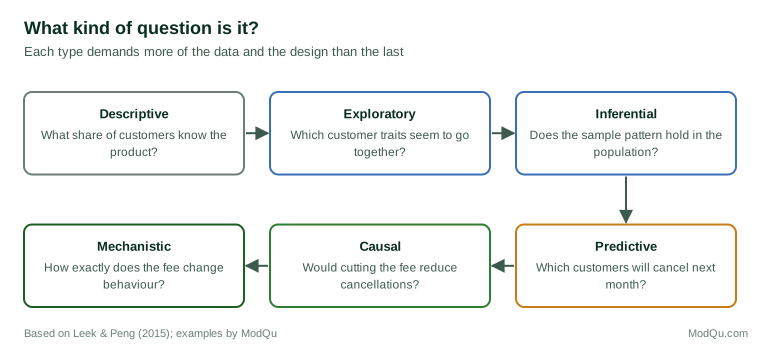
A descriptive question asks what is the case: what share of customers are aware of a product. An exploratory question looks for patterns that might suggest hypotheses: which customer characteristics seem to go together. An inferential question asks whether a pattern in a sample is likely to hold in the wider population. A predictive question asks what will happen for individuals or groups: which customers are likely to cancel next month. A causal question asks what would happen if something were changed: would reducing a fee lower cancellations. A mechanistic question asks exactly how a change produces its effect.
Hernán et al. (2019) proposed a similar classification of data science tasks into description, prediction and causal inference, and stressed that causal questions cannot be answered by prediction alone. A model that predicts cancellations accurately may still tell us nothing about what would reduce them. Shmueli (2010) made the same distinction between explaining and predicting. The practical lesson is to identify which type of question is being asked before choosing a design. A survey can answer a descriptive question well; it usually cannot answer a causal one without additional design features.
What makes a question answerable
Several frameworks help test whether a question is ready to guide a study.
FINER
Hulley et al. (2013), writing for clinical researchers, proposed that a good question should be feasible, interesting, novel, ethical and relevant. Feasibility covers whether enough participants, time, money and expertise are available. Interest and relevance cover whether the answer will matter to anyone. Novelty covers whether the question has already been answered. Ethical acceptability covers whether the study can be done without unacceptable risk to participants. The criteria are simple but surprisingly often neglected.
PICO and its variants
Evidence-based medicine developed a structure for clinical questions that has been widely adapted. Richardson et al. (1995) described the "well-built clinical question" in terms of four elements: the patient or population, the intervention, the comparison and the outcome. A question with all four elements tells the researcher exactly whom to study, what to compare and what to measure. Thabane et al. (2009) showed how adding further elements, such as the time frame and study design, makes questions even more precise.
PICO adapts readily to business research. "Does the new onboarding email improve retention?" becomes: among new customers of the basic plan (population), does receiving the three-message onboarding sequence (intervention), compared with the current single welcome message (comparison), reduce cancellations within 90 days (outcome)? The revised question tells the team what to randomise, whom to include, what to measure and when.
Concepts that can be measured
A question is only answerable if its key terms can be observed. "Do customers trust our brand?" is a reasonable starting point, but "trust" must be defined and measured before it can be studied. The process of turning concepts into measurable variables, called operationalisation, is discussed in a separate ModQu article. At the question stage, the test is simply whether each key term could, in principle, be observed or measured.
Sources of good questions
Where do good questions come from? Alvesson and Sandberg (2011) criticised the most common academic approach, which they called gap-spotting: reviewing the literature, finding a topic that has not been studied, and proposing to fill the gap. Gap-spotting produces incremental questions that accept existing assumptions. They proposed problematisation as an alternative: identifying and challenging the assumptions behind existing research, so that the question opens up new ways of seeing the topic. Sandberg and Alvesson (2011) found that gap-spotting dominated published management research, and argued that this helps explain why so few studies produce genuinely interesting theory.
Davis (1971), in a classic essay, argued that what makes a finding interesting is that it denies an assumption the audience held. "What seems to be X is actually not-X" captures attention in a way that confirming the obvious does not. Questions designed to test an assumption, rather than simply to measure something, are more likely to produce interesting and useful answers.
In applied research, the best source of questions is usually the decision the research is meant to inform. Haynes (2006) advised clinical researchers to start from a real uncertainty faced by practitioners. The equivalent in business is to ask: what decision will be made differently depending on the answer? A question that would not change any decision is unlikely to be worth the cost of answering.
Qualitative questions
Qualitative research questions differ in form. They are usually open, asking how or why rather than how much, and they often evolve during the study as the researcher learns more. Maxwell (2013) described qualitative design as interactive, with the question, methods and emerging findings shaping one another. Agee (2009) described developing qualitative questions as a reflective process: starting with a broad question that identifies the phenomenon of interest, then refining it as the researcher's understanding of the setting and participants grows.
This flexibility is a strength, but it is not a licence for vagueness. A qualitative question should still say what phenomenon is being studied, in which setting, and from whose perspective. "How do small business owners decide whether to switch accounting software?" is a good qualitative question; "what do people think about software?" is not.
From weak to strong questions
The examples below show how common weak questions can be improved.
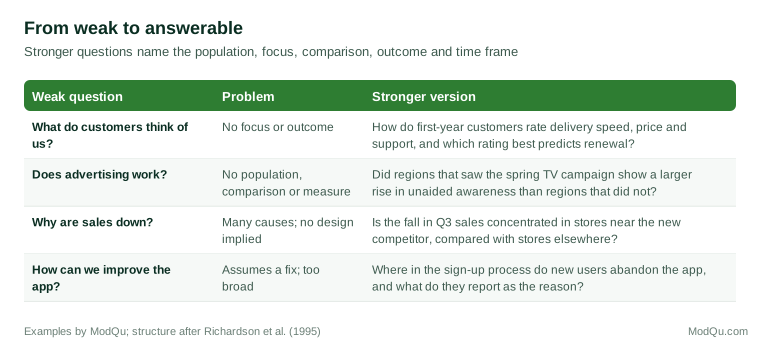
The pattern in each revision is the same: a defined population, a specific comparison or focus, a measurable outcome and a time frame. The strong versions are narrower, but they can be answered, and their answers can be acted on.
Common mistakes
Questions that are really several questions. "What do customers think of our service and how can we improve it?" combines a descriptive question with a much harder causal one. Separating them makes clear which can be answered by the planned study.
Questions that assume their answer. "How much has the new design improved satisfaction?" presupposes an improvement. "Has satisfaction changed since the new design, and by how much?" allows for the possibility that it has not.
Questions mismatched to the design. Asking a causal question of a one-off survey, or a population-level question of a dozen interviews, sets the study up to fail or to over-claim.
Questions revised after the results. Changing the question to fit what the data happen to show turns an exploratory finding into what looks like a confirmed answer. Kerr (1998) called the related practice of presenting post hoc hypotheses as if they were predicted HARKing. Writing the question down before data collection, and reporting any changes, protects against it.
A short checklist
Before committing to a study, it is worth checking that the question:
- states the population, the focus and, where relevant, the comparison and outcome;
- is clear about its type: descriptive, exploratory, inferential, predictive, causal or mechanistic;
- uses concepts that can be observed or measured;
- can be answered with the time, budget, data and skills available;
- would change a decision or advance understanding if answered;
- does not assume its own answer; and
- is written down before data collection begins.
Conclusion
A research question is a promise about what a study will find out. Good questions are specific about whom, what and when; clear about whether they seek description, prediction or explanation; built from concepts that can be measured; feasible; and connected to a decision or a genuine gap in understanding. Time spent sharpening the question is rarely wasted. It is far cheaper to discover at the start that a question cannot be answered, or is the wrong question, than to discover it when the report is delivered.
References
Agee, J. (2009). Developing qualitative research questions: A reflective process. International Journal of Qualitative Studies in Education, 22(4), 431–447. https://doi.org/10.1080/09518390902736512
Alvesson, M., & Sandberg, J. (2011). Generating research questions through problematization. Academy of Management Review, 36(2), 247–271. https://doi.org/10.5465/amr.2009.0188
Booth, W. C., Colomb, G. G., Williams, J. M., Bizup, J., & FitzGerald, W. T. (2016). The craft of research (4th ed.). University of Chicago Press.
Bryman, A. (2007). The research question in social research: What is its role? International Journal of Social Research Methodology, 10(1), 5–20. https://doi.org/10.1080/13645570600655282
Chalmers, I., & Glasziou, P. (2009). Avoidable waste in the production and reporting of research evidence. The Lancet, 374(9683), 86–89. https://doi.org/10.1016/S0140-6736(09)60329-9
Creswell, J. W., & Creswell, J. D. (2018). Research design: Qualitative, quantitative, and mixed methods approaches (5th ed.). SAGE.
Davis, M. S. (1971). That's interesting! Towards a phenomenology of sociology and a sociology of phenomenology. Philosophy of the Social Sciences, 1(4), 309–344. https://doi.org/10.1177/004839317100100211
Haynes, R. B. (2006). Forming research questions. Journal of Clinical Epidemiology, 59(9), 881–886. https://doi.org/10.1016/j.jclinepi.2006.06.006
Hernán, M. A., Hsu, J., & Healy, B. (2019). A second chance to get causal inference right: A classification of data science tasks. CHANCE, 32(1), 42–49. https://doi.org/10.1080/09332480.2019.1579578
Hulley, S. B., Cummings, S. R., Browner, W. S., Grady, D. G., & Newman, T. B. (2013). Designing clinical research (4th ed.). Lippincott Williams & Wilkins.
Kerr, N. L. (1998). HARKing: Hypothesizing after the results are known. Personality and Social Psychology Review, 2(3), 196–217. https://doi.org/10.1207/s15327957pspr0203_4
Leek, J. T., & Peng, R. D. (2015). What is the question? Science, 347(6228), 1314–1315. https://doi.org/10.1126/science.aaa6146
Maxwell, J. A. (2013). Qualitative research design: An interactive approach (3rd ed.). SAGE.
Richardson, W. S., Wilson, M. C., Nishikawa, J., & Hayward, R. S. (1995). The well-built clinical question: A key to evidence-based decisions. ACP Journal Club, 123(3), A12–A13. https://doi.org/10.7326/ACPJC-1995-123-3-A12
Sandberg, J., & Alvesson, M. (2011). Ways of constructing research questions: Gap-spotting or problematization? Organization, 18(1), 23–44. https://doi.org/10.1177/1350508410372151
Shmueli, G. (2010). To explain or to predict? Statistical Science, 25(3), 289–310. https://doi.org/10.1214/10-STS330
Thabane, L., Thomas, T., Ye, C., & Paul, J. (2009). Posing the research question: Not so simple. Canadian Journal of Anesthesia, 56(1), 71–79. https://doi.org/10.1007/s12630-008-9007-4
White, P. (2017). Developing research questions (2nd ed.). Palgrave.