
Research · Market and business research
Competitive Research and Benchmarking
How organisations identify and analyse competitors, how benchmarking compares performance and practices against the best, where the information comes from, and the ethical limits on gathering it.
Every business decision about prices, products, markets or operations is made in the presence of competitors. Competitive research is the systematic collection and analysis of information about those competitors: who they are, what they are doing, what they are able to do, and what they are likely to do next. Benchmarking is a related practice that compares an organisation's performance and methods with those of others, including organisations outside its own industry, in order to find better ways of working. This article explains how both are done, where the information comes from, the mistakes that most often weaken the results, and the ethical and legal limits on gathering competitive information.
Identifying competitors
Competitive research begins with a question that seems simple: who are the competitors? In practice, the answer depends on how the market is defined. A narrow definition includes only firms selling similar products to similar customers. A broader one includes any product that customers might use to meet the same need.
Day et al. (1979) argued that markets should be defined from the customer's point of view, by asking which products customers regard as substitutes in particular situations of use. A manufacturer of frozen pizza competes with other frozen pizza brands, but also with takeaway delivery, ready meals and the option of cooking from scratch. Each wider circle brings in competitors that a product-based view would miss.
Managers tend to see competition more narrowly than this. Clark and Montgomery (1999) reviewed research on how managers identify competitors and proposed that identification is a cognitive process: managers rely on a limited set of attributes, such as similarity of products and customers, to decide who counts as a competitor. Reger and Huff (1993) found that managers in the same industry shared broadly similar mental groupings of competing firms, which helps explain why whole industries can overlook the same threat.
Two frameworks help widen the view. Chen (1996) proposed that the competitive relationship between two firms depends on market commonality, the degree to which they serve the same customers and markets, and resource similarity, the degree to which they have comparable resources. Firms that overlap heavily on both are direct rivals. Firms that share resources but not yet markets are potential entrants. Bergen and Peteraf (2002) extended this reasoning, arguing that managers who scan only the product market miss threats from firms that could meet the same customer needs with different products, or that have the resources to enter. Peteraf and Bergen (2003) developed the framework further to cover these indirect and potential competitors.
A practical approach is to list competitors in three groups: direct competitors offering similar products to the same customers; substitutes meeting the same need in a different way; and potential entrants with relevant resources but no current presence. Customer research is the best test of the list. Asking recent buyers what else they considered, and what they would have done if the product had not existed, often reveals competitors that the company had not counted.
Analysing competitors
Once competitors are identified, the aim is to understand them well enough to anticipate their actions. Porter (1980) proposed that competitor analysis should cover four components (Figure 1). Two describe what a competitor does and can do: its current strategy, meaning how it competes now, and its capabilities, meaning its strengths and weaknesses. Two describe what drives it: its future goals and its assumptions about itself and the industry. Together, these allow the analyst to build a response profile: whether the competitor is satisfied with its position, what moves it is likely to make, where it is vulnerable, and how it would respond to a challenge.
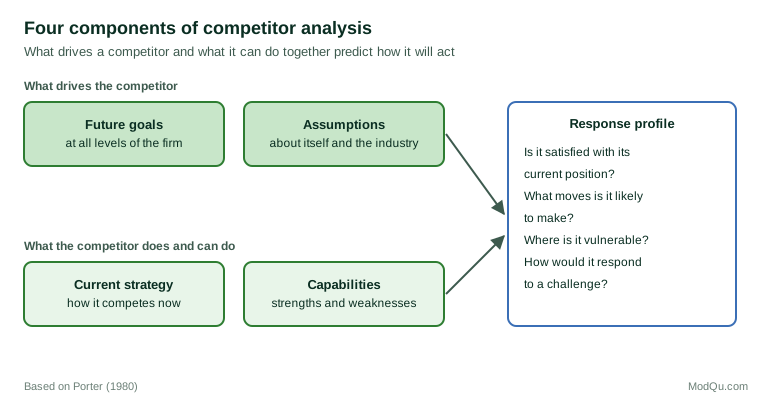
Goals and assumptions are the hardest components to research, but they often matter most. A competitor whose parent company needs cash will behave differently from one that has been told to gain market share at any cost. A competitor that assumes its customers are loyal may react slowly to a new entrant. Evidence on goals and assumptions comes from public statements, annual reports, investor presentations, hiring patterns and the history of how the competitor has reacted in the past.
Capabilities can be assessed with the resource-based view of the firm. Barney (1991) argued that resources produce lasting advantage when they are valuable, rare, difficult to imitate and difficult to substitute. Applying these tests to a competitor's resources, such as its brand, distribution network, patents or production technology, shows which of its strengths will be hard to match and which are likely to erode.
Porter's (1979) five forces framework places competitor analysis in a wider context. It examines rivalry among existing firms together with the threat of new entrants, the threat of substitutes, and the bargaining power of buyers and suppliers. A full competitive assessment looks at all five forces, because profitability in an industry depends on them together, not on rivalry alone.
Sources of competitive information
Most useful competitive information is public or can be gathered legitimately. The main sources are:
- Published information: annual reports, regulatory filings, investor presentations, press releases, patents, job postings, trade press and industry reports.
- The competitor's products and marketing: websites, price lists, advertising, catalogues and the products themselves, which can be bought and examined.
- Customers: win-loss interviews with buyers who chose or rejected the company, satisfaction surveys that include competitor ratings, and brand-tracking studies.
- Channel partners and suppliers: distributors, retailers and industry contacts, within the limits of confidentiality.
- Trade shows and conferences: where competitors present products and plans publicly.
- The company's own staff: sales and service employees hear about competitors every day, but this knowledge is rarely collected unless there is a system to capture it.
Customer research deserves particular emphasis. Competitors' strengths and weaknesses matter only as customers perceive them. A competitor's product may be technically inferior but preferred because of service, convenience or reputation. Asking customers how they compare the alternatives on the attributes that matter to them gives a more accurate picture than an internal comparison of specifications.
Win-loss analysis is one of the most productive of these methods. After a sale is won or lost, a researcher who was not involved in the sale interviews the buyer about how the decision was made: which suppliers were considered, which criteria mattered most, how each supplier performed on them, and what decided the outcome. Interviews are usually conducted soon after the decision, while it is fresh, and by someone other than the salesperson, because buyers are more candid with a neutral party. Over a few dozen interviews, patterns emerge. A company may learn that it loses mainly on implementation time rather than price, or that one competitor is consistently winning with a particular type of customer. These findings come directly from the people whose choices determine market share.
One way of presenting the result is the strategy canvas described by Kim and Mauborgne (2005). The horizontal axis lists the factors on which an industry competes, such as price, range, service and speed. The vertical axis shows the level each competitor offers on each factor. The resulting lines show where competitors converge and where there are factors that none of them offers well, which may be opportunities.
Benchmarking
Benchmarking compares an organisation's processes and performance with those of others, with the aim of learning and improving. The practice became widely known through Xerox in the late 1970s and 1980s. Camp (1989), who led benchmarking work at Xerox, defined it as the search for industry best practices that lead to superior performance. Xerox compared its manufacturing costs with those of competitors and found a large gap, then extended benchmarking to other functions. One often-cited case is its comparison of warehousing and order fulfilment with a mail-order clothing retailer, a company in a different industry that was known for excellence in that process.
Camp (1989) and Spendolini (1992) distinguish several types of benchmarking:
- Internal benchmarking compares units within the same organisation, such as branches, plants or regions. Data are easy to obtain, but the best practice may lie outside.
- Competitive benchmarking compares performance with direct competitors. It shows where the company stands, but detailed process information is hard to obtain.
- Functional or generic benchmarking compares a specific process, such as billing, logistics or customer service, with organisations in other industries that perform it well. Because these organisations are not competitors, they are often willing to share information, and they can reveal methods that no one in the industry has yet adopted.
The benchmarking process
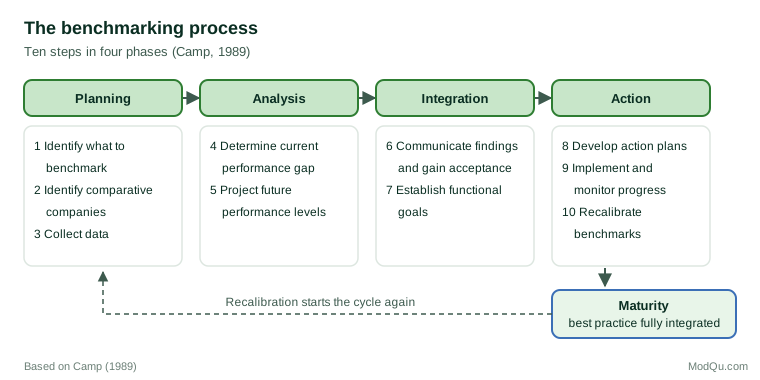
Camp (1989) set out a process of ten steps in four phases, followed by a stage of maturity in which best practices are fully integrated (Figure 2). The planning phase decides what to benchmark, which organisations to compare with, and how to collect the data. The analysis phase measures the current performance gap and projects how it will change. The integration phase communicates the findings, gains acceptance and sets goals. The action phase develops and carries out plans, monitors progress and recalibrates the benchmarks as performance and practices change.
Many other process models have since been published. Dattakumar and Jagadeesh (2003) reviewed the benchmarking literature and classified the published work. Anand and Kodali (2008) compared a large number of benchmarking models and found that they differed widely in the number and content of their steps; they proposed a more detailed consolidated model. The models share a common core: define the process and measures carefully, choose comparison partners for good reasons, understand the practices behind the numbers, and turn the findings into action.
The last point is the one most often neglected. A benchmark figure on its own shows the size of a gap but not how to close it. Useful benchmarking studies the practices, systems and conditions that produce the superior performance, and checks whether they can be adapted to the organisation's own circumstances.
Common weaknesses
Zahra and Chaples (1993) identified several blind spots that weaken competitive analysis. They include misjudging industry boundaries, poor identification of competitors, giving too much weight to competitors' visible strengths, focusing on where competitors will compete rather than how, making faulty assumptions about competitors, and paralysis by analysis, in which data collection continues without producing decisions.
Other common weaknesses include:
- Looking backward. Published data describe what competitors have already done. The value of analysis lies in anticipating what they will do next.
- Comparing like with unlike. Benchmark measures must be defined the same way for every organisation compared. Differences in accounting, scope or customer mix can make a gap appear larger or smaller than it is.
- Collecting without using. Ghoshal and Westney (1991) studied competitor analysis systems in three large companies and found that their usefulness depended on how they were organised and connected to the people making decisions. Intelligence that does not reach decision-makers in time and in usable form has little value.
Ethical and legal limits
Competitive research must stay within ethical and legal boundaries. Crane (2005) examined where legitimate competitive intelligence becomes industrial espionage. He identified three questions for judging a practice: whether the tactics used to obtain information are legal and honest; whether the information sought is private or confidential; and whether the purpose of gathering it is consistent with the public interest, or instead aims to harm fair competition.
In practice, this rules out misrepresenting one's identity to obtain information, inducing employees to disclose confidential information, taking documents, and any form of unauthorised access to systems. Questioning a competitor's former employees about trade secrets is also off limits. Information that is published, freely given or observable in the market is legitimate. Agreements between competitors to share prices or other sensitive commercial information can breach competition law, so benchmarking among competitors is often carried out through a neutral third party that publishes only aggregated, anonymised results.
Summary
Competitive research starts with a broad, customer-based view of who the competitors are, including substitutes and potential entrants. Analysis then looks at competitors' strategies and capabilities and also at their goals and assumptions, which shape how they will act. Benchmarking adds a comparison of processes and performance, often with organisations outside the industry, and is useful only when it leads to changed practices. Both depend on legitimate sources, consistent measures and a direct route from findings to decisions.
References
Anand, G., & Kodali, R. (2008). Benchmarking the benchmarking models. Benchmarking: An International Journal, 15(3), 257–291. https://doi.org/10.1108/14635770810876593
Barney, J. (1991). Firm resources and sustained competitive advantage. Journal of Management, 17(1), 99–120.
Bergen, M., & Peteraf, M. A. (2002). Competitor identification and competitor analysis: A broad-based managerial approach. Managerial and Decision Economics, 23(4–5), 157–169. https://doi.org/10.1002/mde.1059
Camp, R. C. (1989). Benchmarking: The search for industry best practices that lead to superior performance. ASQC Quality Press.
Chen, M.-J. (1996). Competitor analysis and interfirm rivalry: Toward a theoretical integration. Academy of Management Review, 21(1), 100–134. https://doi.org/10.2307/258631
Clark, B. H., & Montgomery, D. B. (1999). Managerial identification of competitors. Journal of Marketing, 63(3), 67–83. https://doi.org/10.1177/002224299906300305
Crane, A. (2005). In the company of spies: When competitive intelligence gathering becomes industrial espionage. Business Horizons, 48(3), 233–240.
Dattakumar, R., & Jagadeesh, R. (2003). A review of literature on benchmarking. Benchmarking: An International Journal, 10(3), 176–209. https://doi.org/10.1108/14635770310477744
Day, G. S., Shocker, A. D., & Srivastava, R. K. (1979). Customer-oriented approaches to identifying product-markets. Journal of Marketing, 43(4), 8–19.
Ghoshal, S., & Westney, D. E. (1991). Organizing competitor analysis systems. Strategic Management Journal, 12(1), 17–31. https://doi.org/10.1002/smj.4250120103
Kim, W. C., & Mauborgne, R. (2005). Blue ocean strategy: How to create uncontested market space and make the competition irrelevant. Harvard Business School Press.
Peteraf, M. A., & Bergen, M. E. (2003). Scanning dynamic competitive landscapes: A market-based and resource-based framework. Strategic Management Journal, 24(10), 1027–1041.
Porter, M. E. (1979). How competitive forces shape strategy. Harvard Business Review, 57(2), 137–145.
Porter, M. E. (1980). Competitive strategy: Techniques for analyzing industries and competitors. Free Press.
Reger, R. K., & Huff, A. S. (1993). Strategic groups: A cognitive perspective. Strategic Management Journal, 14(2), 103–123.
Spendolini, M. J. (1992). The benchmarking book. AMACOM.
Zahra, S. A., & Chaples, S. S. (1993). Blind spots in competitive analysis. Academy of Management Executive, 7(2), 7–28.